Thank you for visiting SNEWPapers!
Sign up free
Story
August 21, 1878
Juniata Sentinel And Republican
Mifflintown, Juniata County, Pennsylvania
What is this article about?
Instructional guide on propagating plant cuttings using a pot with rich loam and sand layer, emphasizing moisture, heat, light, and proper placement for successful root growth in houseplants and roses.
Clipping
OCR Quality
98%
Excellent
Full Text
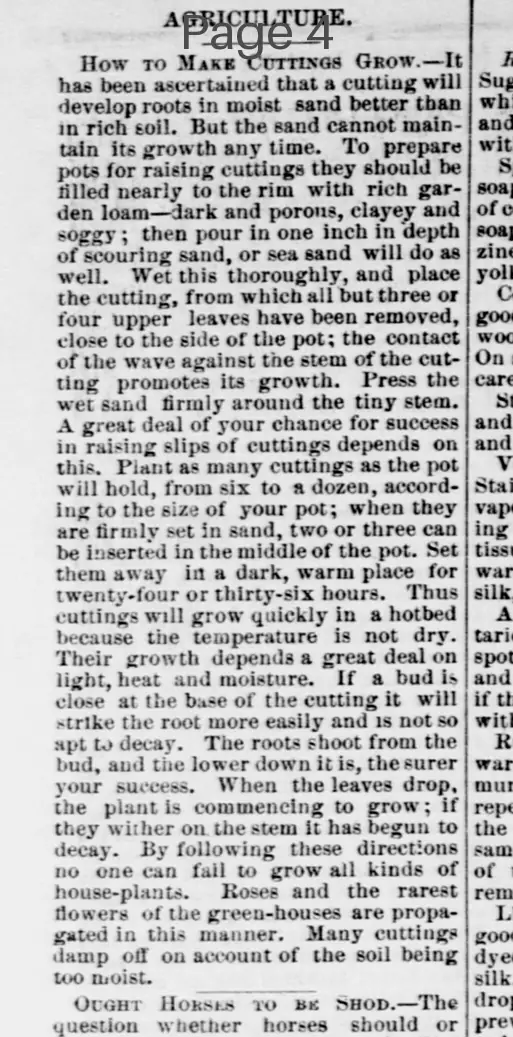
How To Make Cuttings Grow.
It has been ascertained that a cutting will develop roots in moist sand better than in rich soil. But the sand cannot maintain its growth any time. To prepare pots for raising cuttings they should be filled nearly to the rim with rich garden loam-dark and porous, clayey and soggy; then pour in one inch in depth of scouring sand, or sea sand will do as well. Wet this thoroughly, and place the cutting, from which all but three or four upper leaves have been removed, close to the side of the pot; the contact of the sand against the stem of the cutting promotes its growth. Press the wet sand firmly around the tiny stem. A great deal of your chance for success in raising slips of cuttings depends on this. Plant as many cuttings as the pot will hold, from six to a dozen, according to the size of your pot; when they are firmly set in sand, two or three can be inserted in the middle of the pot. Set them away in a dark, warm place for twenty-four or thirty-six hours. Thus cuttings will grow quickly in a hotbed because the temperature is not dry. Their growth depends a great deal on light, heat and moisture. If a bud is close at the base of the cutting it will strike the root more easily and is not so apt to decay. The roots shoot from the bud, and the lower down it is, the surer your success. When the leaves drop, the plant is commencing to grow; if they wither on the stem it has begun to decay. By following these directions no one can fail to grow all kinds of house-plants.
Roses and the rarest flowers of the green-houses are propagated in this manner. Many cuttings damp off on account of the soil being too moist.
It has been ascertained that a cutting will develop roots in moist sand better than in rich soil. But the sand cannot maintain its growth any time. To prepare pots for raising cuttings they should be filled nearly to the rim with rich garden loam-dark and porous, clayey and soggy; then pour in one inch in depth of scouring sand, or sea sand will do as well. Wet this thoroughly, and place the cutting, from which all but three or four upper leaves have been removed, close to the side of the pot; the contact of the sand against the stem of the cutting promotes its growth. Press the wet sand firmly around the tiny stem. A great deal of your chance for success in raising slips of cuttings depends on this. Plant as many cuttings as the pot will hold, from six to a dozen, according to the size of your pot; when they are firmly set in sand, two or three can be inserted in the middle of the pot. Set them away in a dark, warm place for twenty-four or thirty-six hours. Thus cuttings will grow quickly in a hotbed because the temperature is not dry. Their growth depends a great deal on light, heat and moisture. If a bud is close at the base of the cutting it will strike the root more easily and is not so apt to decay. The roots shoot from the bud, and the lower down it is, the surer your success. When the leaves drop, the plant is commencing to grow; if they wither on the stem it has begun to decay. By following these directions no one can fail to grow all kinds of house-plants.
Roses and the rarest flowers of the green-houses are propagated in this manner. Many cuttings damp off on account of the soil being too moist.
What sub-type of article is it?
How To Guide
Gardening Instruction
What keywords are associated?
Cuttings
Roots
Sand
Loam
Propagation
Hotbed
House Plants
Roses
Story Details
Story Details
Method involves filling pots with rich loam topped by one inch of moist sand, inserting prepared cuttings close to the pot side, pressing firmly, and placing in dark warm spot initially, then ensuring light, heat, and moisture for root development from basal buds.