Thank you for visiting SNEWPapers!
Sign up free
Virginia Argus
Richmond, Virginia
What is this article about?
Governor Caleb Strong addressed the Massachusetts Legislature on June 1, 1814, in Boston, discussing the repeal of embargo and non-importation laws, criticizing the War of 1812 as unnecessary, praising public forbearance, and urging peace and constitutional adherence. The speech, dated May 20, 1814, was committed to a committee. An editorial commentary critiques the governor's views on the war.
Merged-components note: Continuation of the Massachusetts Legislature coverage, including the Governor's speech, with direct textual continuation.
Clipping
OCR Quality
Full Text
Boston, June 1.
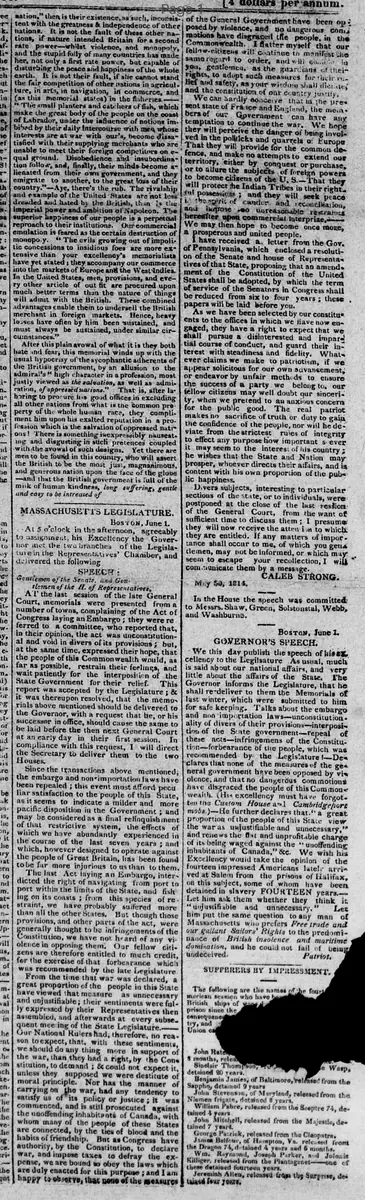
At 5 o'clock in the afternoon, agreeably to assignment, his Excellency the Governor met the two branches of the Legislature in the Representatives' Chamber, and delivered the following SPEECH:
Gentlemen of the Senate, and Gentlemen of the H. of Representatives,
AT the last session of the late General Court, memorials were presented from a number of towns, complaining of the Act of Congress laying an Embargo; they were referred to a committee, who reported that, in their opinion, the act was unconstitutional and void in divers of its provisions; but, at the same time, expressed their hope, that the people of this Commonwealth would, as far as possible, restrain their feelings, and wait patiently for the interposition of the State Government for their relief. This report was accepted by the Legislature; & it was thereupon resolved, that the memorials above mentioned should be delivered to the Governor, with a request that he, or his successor in office, should cause the same to be laid before the then next General Court at an early day in their first session. In compliance with this request, I will direct the Secretary to deliver them to the two Houses.
Since the transactions above mentioned; the embargo and non importation laws have been repealed; this event must afford peculiar satisfaction to the people of this State, as it seems to indicate a milder and more pacific disposition in the Government; and may be considered as a final relinquishment of that restrictive system, the effects of which we have abundantly experienced in the course of the last seven years; and which, however designed to operate against the people of Great Britain, has been found to be far more injurious to us than to them.
The last Act laying an Embargo, interdicted the right of navigating from port to port within the limits of the State, and fishing on its coasts; from this species of restraint, we have probably suffered more than all the other States. But though those provisions, and other parts of the act, were generally thought to be infringements of the Constitution, we have not heard of any violence in opposing them. Our fellow citizens are therefore entitled to much credit, for the exercise of that forbearance which was recommended by the late Legislature.
From the time that war was declared, a great proportion of the people in this State have viewed that measure as unnecessary and unjustifiable; their sentiments were fully expressed by their Representatives then assembled, and afterwards at every subsequent meeting of the State Legislature.-- Our National Rulers had, therefore, no reason to expect, that, with these sentiments, we should do any thing more in support of the war, than they had a right, by the Constitution, to demand; & could not expect it, unless they supposed we were destitute of moral principle. Nor has the manner of carrying on the war, had any tendency to satisfy us of its policy or justice; it was commenced, and is still prosecuted against the unoffending inhabitants of Canada, with whom many of the people of these States are connected, by the ties of blood and the habits of friendship. But as Congress have authority, by the Constitution, to declare war, and impose taxes to defray the expense, we are bound to obey the laws which are duly enacted for this purpose; and I am happy to observe, that none of the measures of the General Government have been opposed by violence, and no dangerous commotions have disgraced the people in the Commonwealth. I flatter myself that our fellow-citizens will continue to manifest the same regard to order, and confide in you, gentlemen, as the guardians of their rights, to adopt such measures for their relief and safety, as your wisdom shall dictate; and the constitution of our country justify.
We can hardly conceive that in the present state of France and England, the members of our Government can have any temptation to continue the war. We hope they will perceive the danger of being involved in the politicks and quarrels of Europe That they will provide for the common defence, and make no attempts to extend our territory, either by conquest or purchase, or to allure the subjects of foreign powers to become citizens of the U. S.--That they will protect the Indian Tribes in their rightful possessions; and they will seek peace in the spirit of candor and reconciliation, and impose no unreasonable restraints hereafter upon commercial interprize,-- We may then hope to become once more, a prosperous and united people.
I have received a letter from the Gov. of Pennsylvania, which enclosed a resolution of the Senate and house of Representatives of that State, proposing that an amendment of the Constitution of the United States shall be adopted, by which the term of service of the Senators in Congress shall be reduced from six to four years; these papers will be laid before you.
As we have been selected by our constituents to the offices in which we have now engaged, they have a right to expect that we shall pursue a disinterested and impartial course of conduct, and guard their interest with steadiness and fidelity. Whatever claims we make to patriotism, if we appear solicitous for our own advancement, or endeavor by unfair methods to ensure the success of a party we belong to, our fellow citizens may well doubt our sincerity, when we pretend to an anxious concern for the public good. The real patriot makes no sacrifice of truth or duty to gain the confidence of the people, nor will he deviate from the strictest rules of integrity to effect any purpose how important so ever it may seem to the interest of his country; he wishes that the State and Nation may prosper, whoever directs their affairs, and is content with his own proportion of the public happiness.
Divers subjects, interesting to particular sections of the state, or to individuals, were postponed at the close of the last session of the General Court, from the want of sufficient time to discuss them; I presume they will now receive the attention to which they are entitled. If any matters of importance shall occur to me, of which you gentlemen, may not be informed, or which may seem to escape your recollection, I will communicate them by a message.
CALEB STRONG.
May 20, 1814.
In the House the speech was committed to Messrs. Shaw, Green, Saltonstall, Webb, and Washburne.
Boston, June 1.
GOVERNOR'S SPEECH.
We this day publish the speech of his excellency to the Legislature As usual, much is said about our national affairs, and very little about the affairs of the State. The Governor informs the Legislature, that he shall re-deliver to them the Memorials of last winter, which were submitted to him for safe keeping. Talks about the embargo and non importation laws--unconstitutionality of divers of their provisions--interposition of the State government--repeal of these acts--infringements of the Constitution ~forbearance of the people, which was recommended by the Legislature!--Declares that none of the measures of the general government have been opposed by violence, and that no dangerous commotions have disgraced the people of this Commonwealth. His excellency must have forgotten the Custom House riot Cambridge port mobs.)--He further declares that "a great proportion of the people of this State view the war as unjustifiable and unnecessary," and renews the dull and unprofitable charge of its being waged against the "unoffending inhabitants of Canada," &c. We wish his Excellency would take the opinion of the fourteen impressed Americans lately arrived at Salem from the prisons of Halifax, on this subject, some of whom have been detained in slavery FOURTEEN years.-- Let him ask them whether they think it "unjustifiable and unnecessary." Let him put the same question to any man of Massachusetts who prefers Free trade and our gallant Sailors' Rights to the predominance of British insolence and maritime domination, and he could not fail of being undeceived.
Patriot.
What sub-type of article is it?
What keywords are associated?
What entities or persons were involved?
Where did it happen?
Domestic News Details
Primary Location
Boston
Event Date
June 1, 1814
Key Persons
Event Details
Governor Caleb Strong delivered a speech to the Massachusetts Legislature on June 1, 1814, in the Representatives' Chamber at 5 o'clock, covering topics including the delivery of prior memorials on the unconstitutional embargo act, satisfaction at its repeal, criticism of the War of 1812 as unnecessary and unjustifiable, praise for public forbearance, hopes for peace and avoidance of European entanglements, protection of Indian tribes, a proposed constitutional amendment from Pennsylvania on Senate terms, and expectations of impartial conduct. The speech, dated May 20, 1814, was committed to a committee in the House. An accompanying editorial commentary criticizes the governor's views on the war and highlights impressed Americans.