Thank you for visiting SNEWPapers!
Sign up free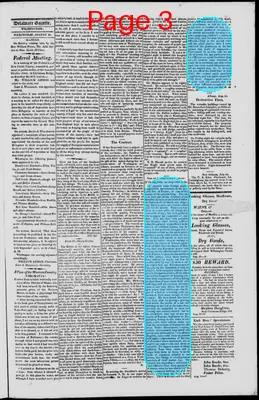
Editorial
August 20, 1817
Delaware Gazette And Peninsula Advertiser
Wilmington, New Castle County, Delaware
What is this article about?
Editorial from Baltimore Federal Republican dismisses foreign speculations on French monarchy's fate post-king's death, arguing France is revolution-weary and Europe unlikely to ally with it again, using analogies and Chief Justice Jay anecdote to critique hypothetical arguments.
Merged-components note: Continuation of opinion piece on foreign speculations with concluding anecdote; relabeled from foreign_news and filler to editorial as partisan commentary
Clipping
OCR Quality
92%
Excellent
Full Text
From the Baltimore Federal Republican.
If the sky falls, we may catch larks.
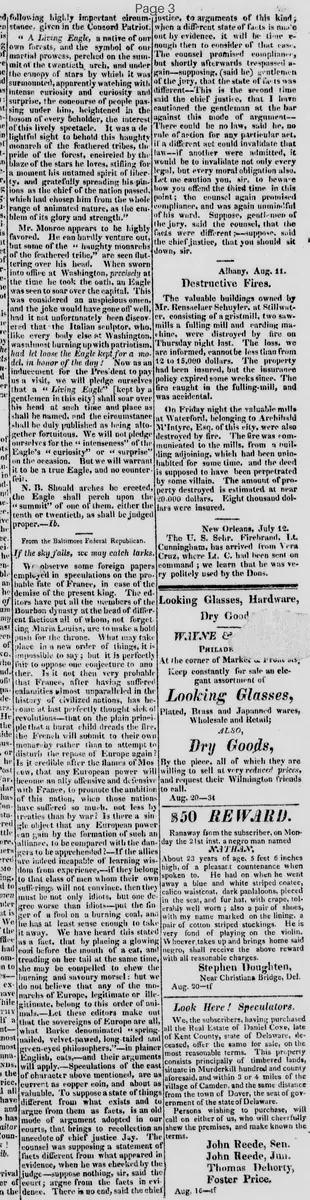
We observe some foreign papers employed in speculations on the probable fate of France, in case of the demise of the present king. The editors have put all the members of the Bourbon dynasty at the head of different factions all of whom, not forgetting Maria Louisa, are to make a bold push for the throne. What may take place in a new order of things, it is impossible to say; but it is perfectly fair to oppose one conjecture to another. Is it not then very probable that France, after having suffered calamities almost unparalleled in the history of civilized nations, has become at last perfectly thought sick of revolutions—that on the plain principle that a burnt child dreads the fire, the French will submit to their own monarchy rather than to attempt to disturb the repose of Europe again? Is it credible after the flames of Moscow, that any European power will become an ally offensive and defensive! with France, to promote the ambition of this nation, when those nations have suffered so much, not less by treaties than by war? Is there a single object that any European power can gain by the formation of such an alliance, to be compared with the dangers to be apprehended?—If the allies are indeed incapable of learning wisdom from experience,—if they belong to that class of men whom their own sufferings will not convince, then they must be not only idiots, but one degree worse than idiots—put the finger of a fool on a burning coal, and he has at least sense enough to take it away. We have heard this stated as a fact, that by placing a glowing coal before the mouth of a cat, and treading on her tail at the same time, she may be compelled to chew the burning and savoury morsel: but we do not believe that any of the monarchs of Europe, legitimate or illegitimate, belong to this order of animals.—Let these editors make out that the sovereigns of Europe are all, what Burke denominated "spring-nailed, velvet-pawed, long-tailed and green-eyed philosophers," in plainer English, cats,—and their arguments will apply.—Speculations of the cast of character above mentioned, are as current as copper coin, and about as valuable. To suppose a state of things different from what exists and to argue from them as facts, is an old mode of argument adopted in our courts, that brings to recollection an anecdote of chief justice Jay. The counsel was supposing a statement of facts different from what appeared in evidence, when he was checked by the judge—suppose nothing, sir, said the court; argue from the facts in evidence.
justice, to arguments of this kind; when a different state of facts is made out by evidence, it will be time enough then to consider of that case.
The counsel promised compliance but shortly afterwards trespassed again—supposing, (said he) gentlemen of the jury, that the state of facts was different—'This is the second time said the chief justice, that I have cautioned the gentleman at the bar against this mode of argument—There could be no law, said he, no rule of action for any particular act, if a different act could invalidate that law—if another were admitted, it would be to invalidate not only every legal, but every moral obligation also. Let me caution you, sir, to beware how you offend the third time in this point; the counsel again promised compliance, and was again unmindful of his word. Suppose, gentlemen of the jury, said the counsel, that the facts were different—suppose, said the chief justice, that you should sit down, sir.
If the sky falls, we may catch larks.
We observe some foreign papers employed in speculations on the probable fate of France, in case of the demise of the present king. The editors have put all the members of the Bourbon dynasty at the head of different factions all of whom, not forgetting Maria Louisa, are to make a bold push for the throne. What may take place in a new order of things, it is impossible to say; but it is perfectly fair to oppose one conjecture to another. Is it not then very probable that France, after having suffered calamities almost unparalleled in the history of civilized nations, has become at last perfectly thought sick of revolutions—that on the plain principle that a burnt child dreads the fire, the French will submit to their own monarchy rather than to attempt to disturb the repose of Europe again? Is it credible after the flames of Moscow, that any European power will become an ally offensive and defensive! with France, to promote the ambition of this nation, when those nations have suffered so much, not less by treaties than by war? Is there a single object that any European power can gain by the formation of such an alliance, to be compared with the dangers to be apprehended?—If the allies are indeed incapable of learning wisdom from experience,—if they belong to that class of men whom their own sufferings will not convince, then they must be not only idiots, but one degree worse than idiots—put the finger of a fool on a burning coal, and he has at least sense enough to take it away. We have heard this stated as a fact, that by placing a glowing coal before the mouth of a cat, and treading on her tail at the same time, she may be compelled to chew the burning and savoury morsel: but we do not believe that any of the monarchs of Europe, legitimate or illegitimate, belong to this order of animals.—Let these editors make out that the sovereigns of Europe are all, what Burke denominated "spring-nailed, velvet-pawed, long-tailed and green-eyed philosophers," in plainer English, cats,—and their arguments will apply.—Speculations of the cast of character above mentioned, are as current as copper coin, and about as valuable. To suppose a state of things different from what exists and to argue from them as facts, is an old mode of argument adopted in our courts, that brings to recollection an anecdote of chief justice Jay. The counsel was supposing a statement of facts different from what appeared in evidence, when he was checked by the judge—suppose nothing, sir, said the court; argue from the facts in evidence.
justice, to arguments of this kind; when a different state of facts is made out by evidence, it will be time enough then to consider of that case.
The counsel promised compliance but shortly afterwards trespassed again—supposing, (said he) gentlemen of the jury, that the state of facts was different—'This is the second time said the chief justice, that I have cautioned the gentleman at the bar against this mode of argument—There could be no law, said he, no rule of action for any particular act, if a different act could invalidate that law—if another were admitted, it would be to invalidate not only every legal, but every moral obligation also. Let me caution you, sir, to beware how you offend the third time in this point; the counsel again promised compliance, and was again unmindful of his word. Suppose, gentlemen of the jury, said the counsel, that the facts were different—suppose, said the chief justice, that you should sit down, sir.
What sub-type of article is it?
Foreign Affairs
Satire
What keywords are associated?
France Succession
Bourbon Factions
European Alliances
Anti Revolution
Hypothetical Arguments
Chief Justice Jay
What entities or persons were involved?
Bourbon Dynasty
Maria Louisa
European Monarchs
Edmund Burke
Chief Justice Jay
Editorial Details
Primary Topic
Critique Of Speculations On French Succession And European Alliances
Stance / Tone
Skeptical And Dismissive Of Revolutionary Scenarios
Key Figures
Bourbon Dynasty
Maria Louisa
European Monarchs
Edmund Burke
Chief Justice Jay
Key Arguments
France Is Weary Of Revolutions After Past Calamities
European Powers Unlikely To Ally With France Due To Historical Sufferings
Speculations On Hypothetical Scenarios Are Baseless And Worthless
Arguments Should Be Based On Existing Facts, Not Suppositions, As Per Jay Anecdote