Thank you for visiting SNEWPapers!
Sign up free
Litchfield Enquirer
Litchfield, Litchfield County, Connecticut
What is this article about?
The U.S. Senate passed the Pension Bill on Saturday the 19th inst. by a 24-19 vote, with all New England members affirming. The bill, aimed at explaining and extending the Revolutionary Pension system, differs from the House's version, both now pending in the opposite chamber, raising doubts about enactment.
Clipping
OCR Quality
Full Text
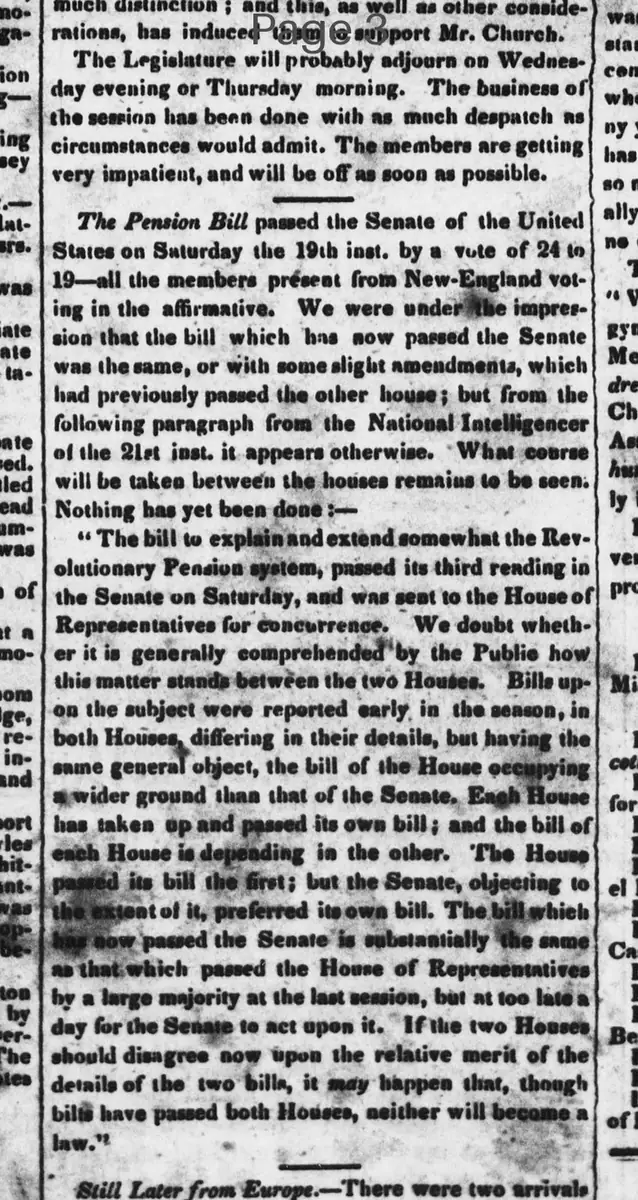
"The bill to explain and extend somewhat the Revolutionary Pension system, passed its third reading in the Senate on Saturday, and was sent to the House of Representatives for concurrence. We doubt whether it is generally comprehended by the Public how this matter stands between the two Houses. Bills upon the subject were reported early in the season, in both Houses, differing in their details, but having the same general object, the bill of the House occupying a wider ground than that of the Senate. Each House has taken up and passed its own bill; and the bill of each House is depending in the other. The House passed its bill the first; but the Senate, objecting to the extent of it, preferred its own bill. The bill which has now passed the Senate is substantially the same as that which passed the House of Representatives by a large majority at the last session, but at too late a day for the Senate to act upon it. If the two Houses should disagree now upon the relative merit of the details of the two bills, it may happen that, though bills have passed both Houses, neither will become a law."
What sub-type of article is it?
What keywords are associated?
Where did it happen?
Domestic News Details
Primary Location
United States Senate
Event Date
Saturday The 19th Inst.
Outcome
passed by a vote of 24 to 19; sent to the house of representatives for concurrence; uncertainty about final law due to differences with house bill
Event Details
The Pension Bill to explain and extend the Revolutionary Pension system passed its third reading in the Senate. It differs in details from the House's bill, though both aim at the same general object. Each house passed its own bill, now pending in the other. The Senate's bill resembles one passed by the House last session but too late for Senate action then.