Thank you for visiting SNEWPapers!
Sign up free
Editorial
April 9, 1811
The Rhode Island American, And General Advertiser
Providence, Providence County, Rhode Island
What is this article about?
Editorial from Connecticut Courant criticizes President Madison's reinterpretation of the 1810 non-intercourse law to include revocation of Britain's 1806 blockade, beyond the original intent targeting Orders in Council. Argues this maneuver, known to be unacceptable to Britain, aims to provoke war with England in alignment with France, risking US treasure, blood, and independence.
Clipping
OCR Quality
95%
Excellent
Full Text
Political.
FROM THE CONNECTICUT COURANT.
LOOK AT THIS.
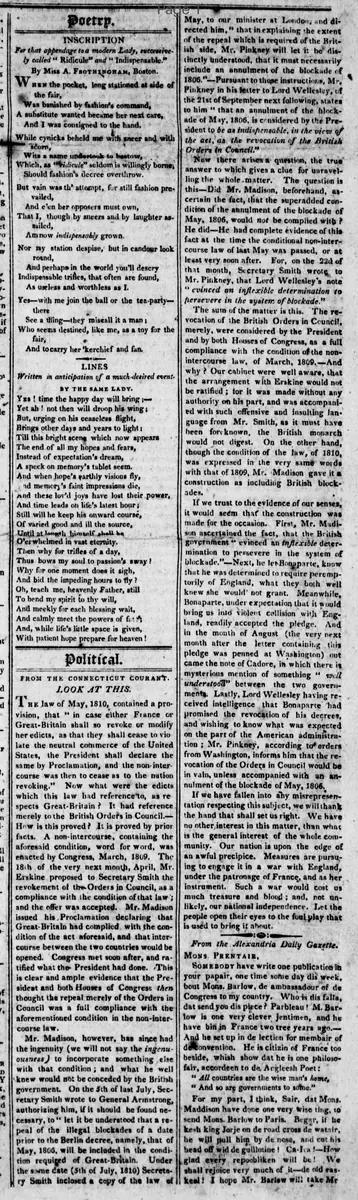
The law of May, 1810, contained a provision, that "in case either France or Great-Britain shall so revoke or modify her edicts, as that they shall cease to violate the neutral commerce of the United States, the President shall declare the same by Proclamation, and the non-intercourse was then to cease as to the nation revoking." Now what were the edicts which this law had reference to, as respects Great-Britain? It had reference merely to the British Orders in Council.
How is this proved? It is proved by prior facts. A non-intercourse, containing the aforesaid condition, word for word, was enacted by Congress, March, 1809. The 18th of the very next month, April, Mr. Erskine proposed to Secretary Smith the revokement of the Orders in Council, as a compliance with the condition of that law; and the offer was accepted. Mr. Madison issued his Proclamation declaring that Great-Britain had complied with the condition of the act aforesaid, and that intercourse between the two countries would be opened. Congress met soon after, and ratified what the President had done. This is clear and ample evidence that the President and both Houses of Congress then thought the repeal merely of the Orders in Council was a full compliance with the aforementioned condition in the non-intercourse law.
Mr. Madison, however, has since had the ingenuity (we will not say the ingenuousness) to incorporate something else with that condition; and what he well knew would not be conceded by the British government. On the 5th of last July, Secretary Smith wrote to General Armstrong, authorizing him, if it should be found necessary, to "let it be understood that a repeal of the illegal blockades of a date prior to the Berlin decree, namely, that of May, 1806, will be included in the condition required of Great-Britain." Under the same date (5th of July, 1810) Secretary Smith inclosed a copy of the law of May, to our minister at London; and directed him, "that in explaining the extent of the repeal which is required of the British side, Mr. Pinkney will let it be distinctly understood, that it must necessarily include an annulment of the blockade of 1806." Pursuant to these instructions, Mr. Pinkney in his letter to Lord Wellesley, of the 21st of September next following, states to him "that an annulment of the blockade of May, 1806, is considered by the President to be as indispensable, in the view of the act, as the revocation of the British Orders in Council."
Now there arises a question, the true answer to which gives a clue for unraveling the whole matter. The question is this—Did Mr. Madison, beforehand, ascertain the fact, that the superadded condition of the annulment of the blockade of May, 1806, would not be complied with? He did—He had complete evidence of this fact at the time the conditional non-intercourse law of last May was passed, or at least very soon after. For, on the 22d of that month, Secretary Smith wrote to Mr. Pinkney, that Lord Wellesley's note "evinced an inflexible determination to persevere in the system of blockade."
The sum of the matter is this. The revocation of the British Orders in Council, merely, were considered by the President and by both Houses of Congress, as a full compliance with the condition of the non-intercourse law, of March, 1809.—And why? Our cabinet were well aware, that the arrangement with Erskine would not be ratified; for it was made without any authority on his part, and was accompanied with such offensive and insulting language from Mr. Smith, as it must have been foreknown, the British monarch would not digest. On the other hand, though the condition of the law, of 1810, was expressed in the very same words with that of 1809, Mr. Madison gave it a construction as including British blockades.
If we trust to the evidence of our senses, it would seem that the construction was made for the occasion. First, Mr. Madison ascertained the fact, that the British government "evinced an inflexible determination to persevere in the system of blockade."—Next, he let Bonaparte know that he was determined to require peremptorily of England, what they both well knew she would not grant. Meanwhile, Bonaparte, under expectation that it would bring us into violent collision with England, readily accepted the pledge. And in the month of August (the very next month after the letter containing this pledge was penned at Washington) out came the note of Cadore, in which there is mysterious mention of something "well understood" between the two governments. Lastly, Lord Wellesley having received intelligence that Bonaparte had promised the revocation of his decrees, and wishing to know what was expected on the part of the American administration; Mr. Pinkney, according to orders from Washington, informs him that the revocation of the Orders in Council would be in vain, unless accompanied with an annulment of the blockade of May, 1806.
If we have fallen into any misrepresentation respecting this subject, we will thank the hand that shall set us right. We have no other interest in this matter, than what is the general interest of the whole community. Our nation is upon the edge of an awful precipice. Measures are pursuing to engage it in a war with England, under the patronage of France, and as her instrument. Such a war would cost us much treasure and blood; and, not unlikely, our national independence. Let the people open their eyes to the foul play that is used to bring it about.
FROM THE CONNECTICUT COURANT.
LOOK AT THIS.
The law of May, 1810, contained a provision, that "in case either France or Great-Britain shall so revoke or modify her edicts, as that they shall cease to violate the neutral commerce of the United States, the President shall declare the same by Proclamation, and the non-intercourse was then to cease as to the nation revoking." Now what were the edicts which this law had reference to, as respects Great-Britain? It had reference merely to the British Orders in Council.
How is this proved? It is proved by prior facts. A non-intercourse, containing the aforesaid condition, word for word, was enacted by Congress, March, 1809. The 18th of the very next month, April, Mr. Erskine proposed to Secretary Smith the revokement of the Orders in Council, as a compliance with the condition of that law; and the offer was accepted. Mr. Madison issued his Proclamation declaring that Great-Britain had complied with the condition of the act aforesaid, and that intercourse between the two countries would be opened. Congress met soon after, and ratified what the President had done. This is clear and ample evidence that the President and both Houses of Congress then thought the repeal merely of the Orders in Council was a full compliance with the aforementioned condition in the non-intercourse law.
Mr. Madison, however, has since had the ingenuity (we will not say the ingenuousness) to incorporate something else with that condition; and what he well knew would not be conceded by the British government. On the 5th of last July, Secretary Smith wrote to General Armstrong, authorizing him, if it should be found necessary, to "let it be understood that a repeal of the illegal blockades of a date prior to the Berlin decree, namely, that of May, 1806, will be included in the condition required of Great-Britain." Under the same date (5th of July, 1810) Secretary Smith inclosed a copy of the law of May, to our minister at London; and directed him, "that in explaining the extent of the repeal which is required of the British side, Mr. Pinkney will let it be distinctly understood, that it must necessarily include an annulment of the blockade of 1806." Pursuant to these instructions, Mr. Pinkney in his letter to Lord Wellesley, of the 21st of September next following, states to him "that an annulment of the blockade of May, 1806, is considered by the President to be as indispensable, in the view of the act, as the revocation of the British Orders in Council."
Now there arises a question, the true answer to which gives a clue for unraveling the whole matter. The question is this—Did Mr. Madison, beforehand, ascertain the fact, that the superadded condition of the annulment of the blockade of May, 1806, would not be complied with? He did—He had complete evidence of this fact at the time the conditional non-intercourse law of last May was passed, or at least very soon after. For, on the 22d of that month, Secretary Smith wrote to Mr. Pinkney, that Lord Wellesley's note "evinced an inflexible determination to persevere in the system of blockade."
The sum of the matter is this. The revocation of the British Orders in Council, merely, were considered by the President and by both Houses of Congress, as a full compliance with the condition of the non-intercourse law, of March, 1809.—And why? Our cabinet were well aware, that the arrangement with Erskine would not be ratified; for it was made without any authority on his part, and was accompanied with such offensive and insulting language from Mr. Smith, as it must have been foreknown, the British monarch would not digest. On the other hand, though the condition of the law, of 1810, was expressed in the very same words with that of 1809, Mr. Madison gave it a construction as including British blockades.
If we trust to the evidence of our senses, it would seem that the construction was made for the occasion. First, Mr. Madison ascertained the fact, that the British government "evinced an inflexible determination to persevere in the system of blockade."—Next, he let Bonaparte know that he was determined to require peremptorily of England, what they both well knew she would not grant. Meanwhile, Bonaparte, under expectation that it would bring us into violent collision with England, readily accepted the pledge. And in the month of August (the very next month after the letter containing this pledge was penned at Washington) out came the note of Cadore, in which there is mysterious mention of something "well understood" between the two governments. Lastly, Lord Wellesley having received intelligence that Bonaparte had promised the revocation of his decrees, and wishing to know what was expected on the part of the American administration; Mr. Pinkney, according to orders from Washington, informs him that the revocation of the Orders in Council would be in vain, unless accompanied with an annulment of the blockade of May, 1806.
If we have fallen into any misrepresentation respecting this subject, we will thank the hand that shall set us right. We have no other interest in this matter, than what is the general interest of the whole community. Our nation is upon the edge of an awful precipice. Measures are pursuing to engage it in a war with England, under the patronage of France, and as her instrument. Such a war would cost us much treasure and blood; and, not unlikely, our national independence. Let the people open their eyes to the foul play that is used to bring it about.
What sub-type of article is it?
Foreign Affairs
War Or Peace
Partisan Politics
What keywords are associated?
Non Intercourse Act
British Orders In Council
Blockade Of 1806
Madison Foreign Policy
War With England
French Decrees
Neutral Commerce
What entities or persons were involved?
Mr. Madison
Mr. Erskine
Secretary Smith
General Armstrong
Mr. Pinkney
Lord Wellesley
Bonaparte
Congress
British Government
France
Editorial Details
Primary Topic
Critique Of Madison's Interpretation Of Non Intercourse Law Regarding British Blockades
Stance / Tone
Strongly Critical Of Madison Administration, Warning Against War With England
Key Figures
Mr. Madison
Mr. Erskine
Secretary Smith
General Armstrong
Mr. Pinkney
Lord Wellesley
Bonaparte
Congress
British Government
France
Key Arguments
The 1810 Non Intercourse Law Referenced Only British Orders In Council, As Shown By 1809 Precedent With Erskine.
Madison Later Added Requirement For Annulment Of 1806 Blockade, Knowing Britain Would Refuse.
This Change Was Made To Provoke Conflict With England While Aligning With France.
Evidence From Prior Communications Shows Britain's Inflexible Stance On Blockades.
The Maneuver Risks War With England Under French Influence, Endangering Us Independence.