Thank you for visiting SNEWPapers!
Sign up free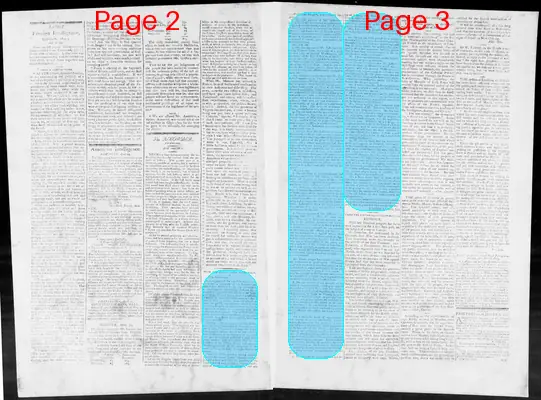
The Recorder
Richmond, Virginia
What is this article about?
Joseph Lewis, Jr., a candidate for Congress, responds to 'A Farmer's' questions in the Alexandria Advertiser, critiquing Thomas Jefferson's actions on pardons, appointments, taxes, foreign policy, and religious views, often expressing disapproval.
Merged-components note: Continuation of the same letter to the editor (Joseph Lewis's responses to questions) across page 2 to page 3; corrected label of second part from 'editorial' to 'letter_to_editor'.
Clippings
1 of 2
OCR Quality
Full Text
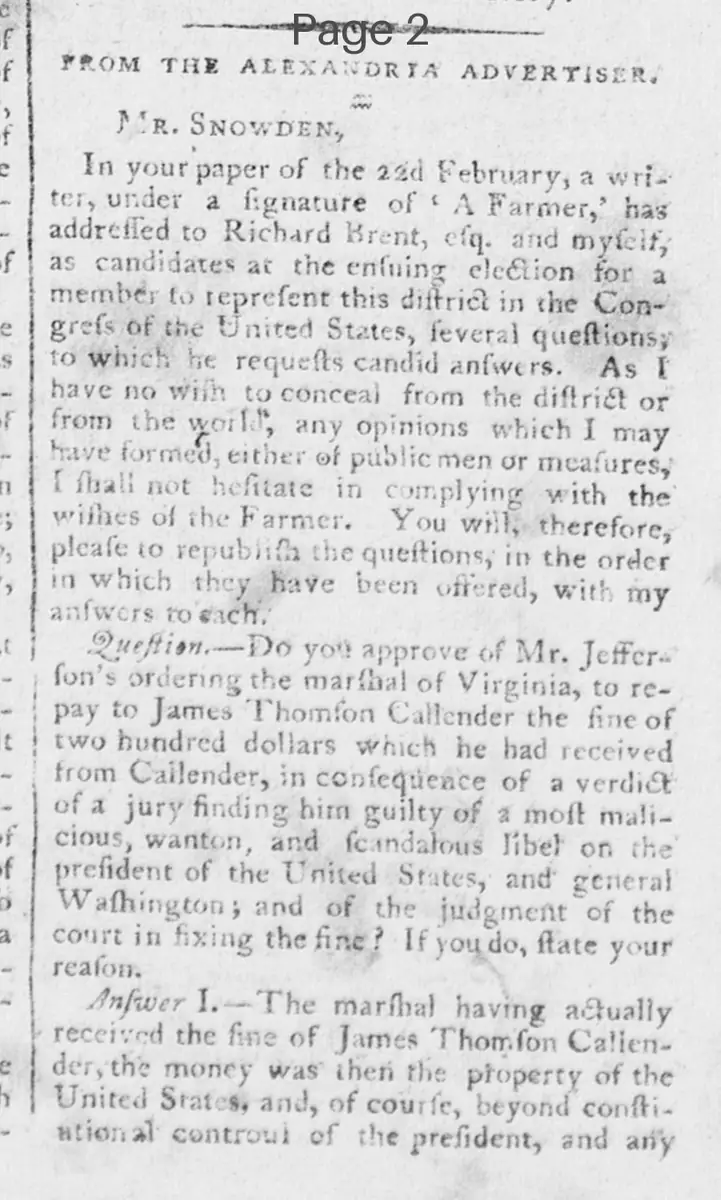
MR. SNOWDEN,
In your paper of the 22d February, a writer, under a signature of 'A Farmer,' has addressed to Richard Brent, esq. and myself, as candidates at the ensuing election for a member to represent this district in the Congress of the United States, several questions, to which he requests candid answers. As I have no wish to conceal from the district or from the world, any opinions which I may have formed, either of public men or measures, I shall not hesitate in complying with the wishes of the Farmer. You will, therefore, please to republish the questions, in the order in which they have been offered, with my answers to each.
Question.-Do you approve of Mr. Jefferson's ordering the marshal of Virginia, to repay to James Thomson Callender the fine of two hundred dollars which he had received from Callender, in consequence of a verdict of a jury finding him guilty of a most malicious, wanton, and scandalous libel on the president of the United States, and general Washington; and of the judgment of the court in fixing the fine? If you do, state your reason.
Answer I.-The marshal having actually received the fine of James Thomson Callender, the money was then the property of the United States, and, of course, beyond constitutional control of the president, and any Interference on his part, was certainly improper.
2. Do you approve of Mr. Jefferson's paying Callender $100 dollars to enable him to write and print his book, called The Prospect Before Us, in which it contained the libel for which he was fined—therein he calls General Washington a traitor to his country, and Mr. Adams a murderer, and an hoary headed incendiary? If you do, give your reasons for such approbation.
Ans. I do not.
3. Do you approve of Mr. Jefferson's inviting Thomas Paine, the writer of a most abusive letter to General Washington, and the author of the Age of Reason, in which he denies the existence of Jesus Christ, and reviles our holy religion—to come to this country in one of our national ships. And do you not believe Mr. Jefferson and Mr. Paine are intimate friends, and affectionately attached to each other?
Ans. Whatever might have been Mr. Jefferson's attachment to Thomas Paine, or his enmity to General Washington, a decent respect for the opinions of the American people, ought to have deterred the president of the United States from inviting to this country, the man whose favorite theme is the abuse of that great and good man; who is revered by his countrymen, and whose services will never be forgotten by those who are real Americans. I know nothing of Mr. Jefferson's attachment to Mr. Paine. His letter of invitation to Paine, is couched in very affectionate terms.
4. Do you think that the law of the last session of Congress, depriving the judges of the circuit courts of their commissions, without being convicted before the proper tribunal of misbehaviour in office, is constitutional?
Ans. I have no hesitation in believing the law unconstitutional.
5. Do you think Mr. Jefferson could constitutionally withhold from certain persons in the district of Columbia, commissions appointing them justices of the peace in that district for five years, which appointment had been approved of by the senate, and commissions signed by the late president, and left in the office of the secretary of state, to be recorded before they were delivered to the persons thus appointed, especially when the act of the 27th February, 1801, concerning the district of Columbia, declares that the justices appointed by virtue of it, shall hold their offices for five years?
Ans. I do not.
6. Do you think it was expedient or just in Congress, at their last session, to take the taxes off pleasure carriages, whiskey, and white sugar and to continue them on bohea tea, and brown sugar, coffee, and salt?
Ans. Whenever the situation of our country will warrant the reduction of taxes, it ought to be the object of the representatives of the people to unburden those articles, which are absolutely necessary to all classes of our citizens, and to retain the taxes on the luxuries only. I, therefore, think the law unjust, as the interests of the poor are sacrificed to the convenience of the rich.
7. Do you approve of Mr. Jefferson's removing men from office, for other reasons than that of their not agreeing with him in his political opinions, and putting in their places only such as do think with him in politics; and particularly do you approve of his removing old officers and soldiers of our revolutionary war, against whom there was no complaint as to their conduct in office; such as colonel William Heath of Petersburg, who was a valiant officer in our army, and while collector of the customs of Petersburg, acted most faithfully towards the public, and against whom Mr. Jefferson could not allege a single fault, except that of not thinking with him in politics?
Ans. I have always been opposed to political intolerance or proscription. Whenever good men are to be driven from office, or excluded from an equal participation in our government, liberty is gone, it is a name. I have been taught to believe that merit alone, in a republican government, is a grand pivot on which executive favor ought to turn.
8. Do you approve of the conduct of the house of representatives, refusing to request the president to give them such information as he may have received respecting the cession of Louisiana, by Spain to France, if, in his opinion it would be proper to give the information; and do you believe the president has been as attentive to this subject as he ought to have been? Do you think he has ever yet officially called on the French and Spaniards, to say whether the cession has been made or not?
Ans. I think the house of representatives was entitled to every information which it was in the power of the president to give; especially on a subject of so much importance to the interests of this country, and one on which it was absolutely necessary for them to act. A refusal on the part of the majority to request of the president the necessary information, was certainly improper. It is impossible for me to say, whether the president has ever officially called on the French or Spaniards, or what steps he may have taken in this business, being without any information on this subject.
9. Do you approve of the expense and delay of sending Mr. Monroe to Spain and France, when in each country we have ministers who have but lately left America, and who must be as competent as Mr. Monroe to negotiate on this subject.
Ans. I have always supposed the executive the best judges, in all affairs of a foreign nature.
10. Do you not think that if it is proper to send a special envoy to France or Spain, that he ought to be sent six or nine months ago; and that the delay which the president has been guilty of in this important business, proves him to have been very inattentive to the interest of our western citizens?
Ans. I have no information on this subject; therefore, can give no opinion.
11. Do you not believe that Mr. Jefferson wrote the letter to Mazzei, in which the executive, who was General Washington, is charged with endeavouring to introduce the principles of the British government into our own, and with being at the head of an angelo-monarchic and aristocratic party; and do you believe the charges are true.
Ans. I believe that Mr. Jefferson did write the letter to Mazzei: and I also believe that the charges in it are untrue.
12. Do you not believe that Mr. Jefferson is a deist, and if so, is he a proper person to be at the head of a people who profess themselves to be believers in Christianity?
Ans. Never having been honoured with the confidence of Mr. Jefferson, I know nothing of his religious tenets. He has been frequently and publicly charged with deistical principles, and never having deigned to contradict those charges, it is fair to presume they are true. Whether he is a proper or improper person to be at the head of a Christian people, must be answered by the people themselves, who have the same information, on this subject, that I have. I think a deist an improper person to be at the head of those professing Christianity.
13. Do you not think that the democratic party in Congress, in directing monuments to be erected to the memory of certain officers who were killed during the war, after they had refused to have one erected to the memory of General Washington, show the reason of that refusal, to wit: the expense was not the real one but that it proceeded from a hatred to him, and a wish to bury, as soon as possible, in oblivion his services as president of the United States: so that the influence which the recollection of the services might have, in opposing their views might be soon destroyed.
Ans. I have never been in favor of the erection of monuments to the memory of any man; but certainly if one was denied to the memory of General Washington, none ought to be granted to any other person, or persons whatever; the conduct of Congress, therefore; at the last session, on this subject, meets my disapprobation.
I have thus answered concisely and candidly the questions that have been propounded to me, and I shall be pleased if they are satisfactory.
JOSEPH LEWIS, Jun.
What sub-type of article is it?
What themes does it cover?
What keywords are associated?
What entities or persons were involved?
Letter to Editor Details
Author
Joseph Lewis, Jun.
Recipient
Mr. Snowden
Main Argument
joseph lewis provides candid answers to 'a farmer's' questions on jefferson's policies and actions, frequently disapproving of them as unconstitutional, unjust, or improper.
Notable Details