Thank you for visiting SNEWPapers!
Sign up free
The New York Herald
New York, New York County, New York
What is this article about?
Mr. Whitecar's book exposes active British slave trade in Mauritius: natives bought from chiefs, imported with governor's encouragement, auctioned to planters, and subjected to brutal treatment on plantations.
Clipping
OCR Quality
Full Text
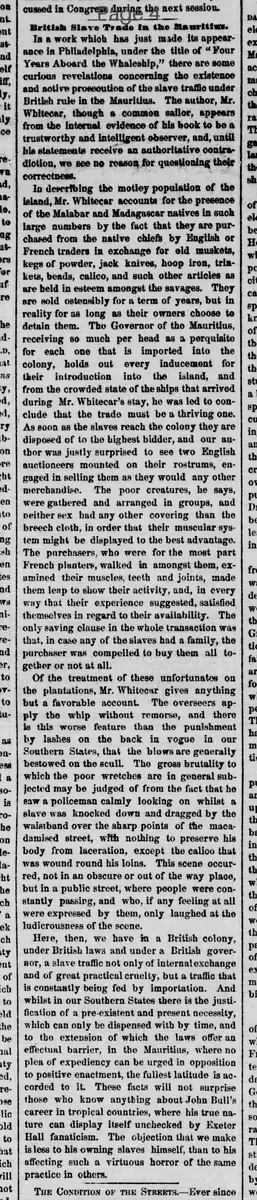
In a work which has just made its appearance in Philadelphia, under the title of "Four Years Aboard the Whaleship," there are some curious revelations concerning the existence and active prosecution of the slave traffic under British rule in the Mauritius. The author, Mr. Whitecar, though a common sailor, appears from the internal evidence of his book to be a trustworthy and intelligent observer, and, until his statements receive an authoritative contradiction, we see no reason for questioning their correctness.
In describing the motley population of the island, Mr. Whitecar accounts for the presence of the Malabar and Madagascar natives in such large numbers by the fact that they are purchased from the native chiefs by English or French traders in exchange for old muskets, kegs of powder, jack knives, hoop iron, trinkets, beads, calico, and such other articles as are held in esteem amongst the savages. They are sold ostensibly for a term of years, but in reality for as long as their owners choose to detain them. The Governor of the Mauritius, receiving so much per head as a perquisite for each one that is imported into the colony, holds out every inducement for their introduction into the island, and from the crowded state of the ships that arrived during Mr. Whitecar's stay, he was led to conclude that the trade must be a thriving one.
As soon as the slaves reach the colony they are disposed of to the highest bidder, and our author was justly surprised to see two English auctioneers mounted on their rostrums, engaged in selling them as they would any other merchandise. The poor creatures, he says, were gathered and arranged in groups, and neither sex had any other covering than the breech cloth, in order that their muscular system might be displayed to the best advantage. The purchasers, who were for the most part French planters, walked in amongst them, examined their muscles, teeth and joints, made them leap to show their activity, and, in every way that their experience suggested, satisfied themselves in regard to their availability. The only saving clause in the whole transaction was that, in case any of the slaves had a family, the purchaser was compelled to buy them all together or not at all.
Of the treatment of these unfortunates on the plantations, Mr. Whitecar gives anything but a favorable account. The overseers apply the whip without remorse, and there is this worse feature than the punishment by lashes on the back in vogue in our Southern States, that the blows are generally bestowed on the scull. The gross brutality to which the poor wretches are in general subjected may be judged of from the fact that he saw a policeman calmly looking on whilst a slave was knocked down and dragged by the waistband over the sharp points of the macadamised street, with nothing to preserve his body from laceration, except the calico that was wound round his loins. This scene occurred, not in an obscure or out of the way place, but in a public street, where people were constantly passing, and who, if any feeling at all were expressed by them, only laughed at the ludicrousness of the scene.
Here, then, we have in a British colony under British laws and under a British governor, a slave traffic not only of internal exchange and of great practical cruelty, but a traffic that is constantly being fed by importation. And whilst in our Southern States there is the justification of a pre-existent and present necessity, which can only be dispensed with by time, and to the extension of which the laws offer an effectual barrier, in the Mauritius, where no plea of expediency can be urged in opposition to positive enactment, the fullest latitude is accorded to it. These facts will not surprise those who know anything about John Bull's career in tropical countries, where his true nature can display itself unchecked by Exeter Hall fanaticism. The objection that we make is less to his owning slaves himself, than to his affecting such a virtuous horror of the same practice in others.
What sub-type of article is it?
What keywords are associated?
What entities or persons were involved?
Where did it happen?
Foreign News Details
Primary Location
Mauritius
Key Persons
Outcome
thriving slave trade with importation from malabar and madagascar, public auctions by english auctioneers to french planters, compulsory family purchases; brutal treatment including whipping on the skull and public dragging.
Event Details
Mr. Whitecar's book describes the purchase of Malabar and Madagascar natives by English or French traders from chiefs using muskets, powder, knives, iron, trinkets, beads, calico; sold for indefinite terms. Governor receives per head perquisite, encouraging imports via crowded ships. Slaves auctioned publicly, examined physically; treated harshly on plantations with skull whippings and public brutality.