Thank you for visiting SNEWPapers!
Sign up free
Massachusetts Spy And Worcester Advertiser
Worcester, Worcester County, Massachusetts
What is this article about?
Report on the 1802 U.S.-Georgia compact requiring extinguishment of Cherokee land titles in Georgia. Cherokees refuse further sales and protest treaties. Georgia delegation demands forced removal; President Monroe's message asserts no obligation for force. Congress committee recommends removal by force if necessary.
Clipping
OCR Quality
Full Text
WEDNESDAY, MAY 5, 1824.
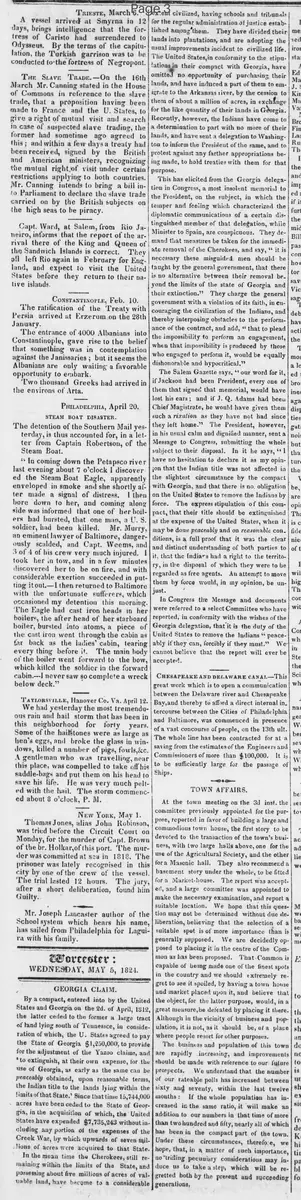
GEORGIA CLAIM.
By a compact, entered into by the United States and Georgia on the 2d. of April, 1802, the latter ceded to the former a large tract of land lying south of Tennessee, in consideration of which, the U. States agreed to pay the State of Georgia $1,250,000, to provide for the adjustment of the Yazoo claims, and 'to extinguish, at their own expense, for the use of Georgia, as early as the same can be peaceably obtained, upon reasonable terms, the Indian title to the lands lying within the limits of that State.' Since that time 15,744,000 acres have been ceded to the State of Georgia, in the acquisition of which, the United States have expended $7,735,243 without including any portion of the expenses of the Creek War, by which upwards of seven millions of acres were acquired to that State. In the mean time the Cherokees, still remaining within the limits of the State, and possessing about five millions of acres of valuable land, have become to a considerable extent civilized, having schools and tribunals for the regular administration of justice established among them. They have divided their lands into plantations, and are adopting the usual improvements incident to civilized life. The United States, in conformity to the stipulations in their compact with Georgia, have omitted no opportunity of purchasing their lands, and have induced a part of them to emigrate to the Arkansas river, by the cession to them of about a million of acres, in exchange for the like quantity of their lands in Georgia. Recently, however, the Indians have come to the resolution to sell no more of their lands, and have sent a delegation to Washington to inform the President of the same, and to protest against any farther appropriations being made, to hold treaties with them for that purpose.
This has elicited from the Georgia delegation in Congress, a most insolent memorial to the President, on the subject, in which the temper and feeling which characterized the diplomatic communications of a certain distinguished member of that delegation, while Minister to Spain, are conspicuous. They demand that measures be taken for the immediate removal of the Cherokees, and say, "it is necessary these misguided men should be taught by the general government, that there is no alternative between their removal beyond the limits of the state of Georgia and their extinction." They charge the general government with a violation of its faith, in encouraging the civilization of the Indians, and thereby interposing obstacles to the performance of the contract, and add, "that to plead the impossibility to perform an engagement, when that impossibility is produced by those who engaged to perform it, would be equally dishonorable and hypocritical."
The Salem Gazette says, "our word for it, if Jackson had been President, every one of them that signed that memorial, would have lost his ears; and if J. Q. Adams had been Chief Magistrate, he would have given them such a rixation as they have not had since they left home." The President, however, in his usual calm and dignified manner, sent a Message to Congress, submitting the whole subject to their disposal. In it he says, "I have no hesitation to declare it as my opinion that the Indian title was not affected in the slightest circumstance by the compact with Georgia, and that there is no obligation on the United States to remove the Indians by force. The express stipulation of this compact, that their title should be extinguished at the expense of the United States, when it may be done peaceably and on reasonable conditions, is a full proof that it was the clear and distinct understanding of both parties to it, that the Indians had a right to the territory, in the disposal of which they were to be regarded as free agents. An attempt to move them by force would, in my opinion, be unjust."
In Congress the Message and documents were referred to a select Committee who have reported, in conformity with the wishes of the Georgia delegation, that it is the duty of the United States to remove the Indians "peaceably if they can, forcibly if they must." We cannot believe that the report will ever be accepted.
What sub-type of article is it?
What keywords are associated?
What entities or persons were involved?
Where did it happen?
Domestic News Details
Primary Location
Georgia
Event Date
May 5, 1824
Key Persons
Outcome
congressional committee recommends removal of cherokees peaceably if possible, forcibly if necessary; president's message opposes forced removal.
Event Details
Under 1802 compact, U.S. agreed to extinguish Indian titles in Georgia peaceably. Cherokees, now civilized and refusing further land sales, send delegation to protest. Georgia delegation demands immediate removal, threatening extinction otherwise. President submits to Congress, stating no obligation for force. Committee reports in favor of forced removal if needed.