Thank you for visiting SNEWPapers!
Sign up free
Story
May 6, 1896
Clarke Courier
Berryville, Clarke County, Virginia
What is this article about?
Professor Barrett recounts his near-disaster as 19-year-old quartermaster on the steamboat City of Buffalo in Lake Erie, averting a crash into rocks near Fairport by waking from sleep and steering away, saving 1,100 lives from wreck and explosion.
Clipping
OCR Quality
88%
Good
Full Text
A STEAMER'S PERIL
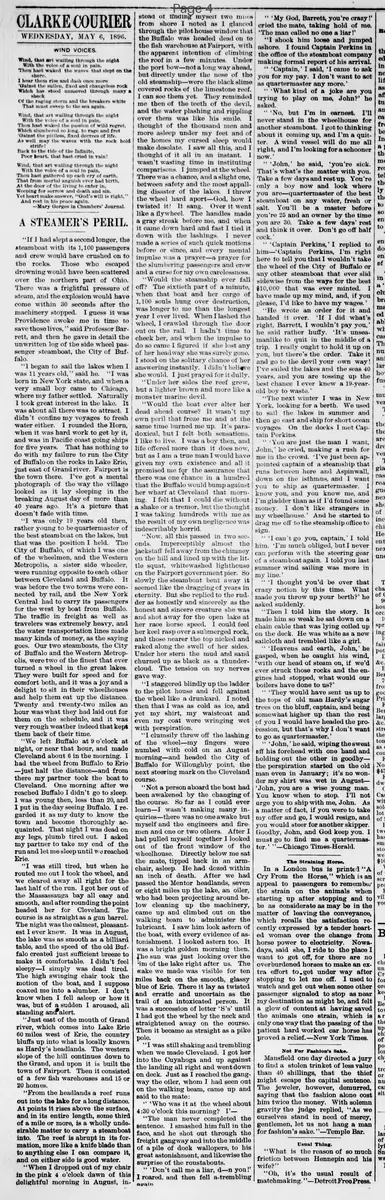
"If I had slept a second longer, the steamboat with its 1,100 passengers and crew would have crushed on to the rocks. Those who escaped drowning would have been scattered over the northern part of Ohio. There was a frightful pressure of steam, and the explosion would have come within 30 seconds after the machinery stopped. I guess it was Providence awoke me in time to save those lives," said Professor Barrett, and then he gave in detail the unwritten log of the side wheel passenger steamboat, the City of Buffalo.
"I began to sail the lakes when I was 11 years old," said he. "I was born in New York state, and when a very small boy came to Chicago, where my father settled. Naturally I took great interest in the lake. It was about all there was to attract. I didn't confine my voyages to fresh water either. I rounded the Horn, when it was hard work to get by it, and was in Pacific coast going ships for five years. That has nothing to do with my failure to run the City of Buffalo on the rocks in Lake Erie, just east of Grand river. Fairport is the town there. I've got a mental photograph of the way the village looked as it lay sleeping in the breaking August day of more than 40 years ago. It's a picture that doesn't fade with time.
"I was only 19 years old then, rather young to be quartermaster of the best steamboat on the lakes, but that was the position I held. The City of Buffalo, of which I was one of the wheelmen, and the Western Metropolis, a sister side wheeler, were running opposite to each other between Cleveland and Buffalo. It was before the two towns were connected by rail, and the New York Central had to carry its passengers for the west by boat from Buffalo. The traffic in freight as well as travelers was extremely heavy, and the water transportation lines made many kinds of money, as the saying goes. Our two steamboats, the City of Buffalo and the Western Metropolis, were two of the finest that ever turned a wheel in the great lakes. They were built for speed and for comfort both, and it was a joy and a delight to sit in their wheelhouses and help them eat up the distance. Twenty and twenty-two miles an hour was what they had laid out for them on the schedule, and it was very rough weather indeed that kept them back of their time.
"We left Buffalo at 9 o'clock at night, or near that hour, and made Cleveland about 6 in the morning. I had the wheel from Buffalo to Erie-just half the distance-and from there my partner took the boat to Cleveland. One morning after we reached Buffalo I didn't go to sleep. I was young then, less than 20, and I put in the day seeing Buffalo. I regarded it as my duty to know the town and become thoroughly acquainted. That night I was dead on my legs, plumb tired out. I asked my partner to take my end of the run and let me sleep until we reached Erie.
"I was still tired, but when he roused me out I took the wheel, and we cleared away all right for the last half of the run. I got her out of the Massassauga bay all easy and smooth, and after rounding the point headed her for Cleveland. The course is as straight as a gun barrel. The night was the calmest, pleasantest I ever knew. It was in August the lake was as smooth as a billiard table, and the speed of the old Buffalo created just sufficient breeze to make it comfortable. I didn't feel sleepy-I simply was dead tired. The high swinging chair took the motion of the boat, and I suppose coaxed me into a slumber. I don't know when I fell asleep or how it was, but of a sudden I aroused, all standing and alert.
"Just east of the mouth of Grand river, which comes into Lake Erie 60 miles west of Erie, the country bluffs up into what is locally known as Hardy's headlands. The western slope of the hill continues down to the Grand, and upon it is built the town of Fairport. Then it consisted of a few fish warehouses and 15 or 20 homes.
"From the headlands a reef runs out into the lake for a long distance. At points it rises above the surface, and in its entire length, some third of a mile or more, is a wholly undesirable matter to carry a steamboat into. The reef is abrupt in its formation, more like a knife blade than to anything else I can compare it, and on either side is good water.
"When I dropped out of my chair in the pink 4 o'clock dawn of this delightful morning in August, instead of finding myself two miles from shore I noted as I glanced through the pilot house window that the Buffalo was headed dead on to the fish warehouse at Fairport, with the apparent intention of climbing the roof in a few minutes. Under the port bow-not a long way ahead, but directly under the nose of the old steamship-were the black slime covered rocks of the limestone reef. I can see them yet. They reminded me then of the teeth of the devil, and the water plashing and rippling over them was like his smile. I thought of the thousand men and more asleep under my feet and of the homes my cursed sleep would make desolate. I saw all this, and I thought of it all in an instant. I wasn't wasting time in instituting comparisons. I jumped at the wheel. There was a chance, and a slight one, between safety and the most appalling disaster of the lakes. I threw the wheel hard aport-God, how I twisted it! It sang. Over it went like a flywheel. The handles made a gray streak before me, and when it came down hard and fast I tied it down with the lashings. I never made a series of such quick motions before or since, and every mental impulse was a prayer-a prayer for the slumbering passengers and crew and a curse for my own carelessness.
"Would the steamship ever fall off? The sixtieth part of a minute, when that boat and her cargo of 1,100 souls hung over destruction, was longer to me than the longest year I ever lived. When I lashed the wheel, I crawled through the door out on the rail. I hadn't time to check her, and when the impulse to do so came I figured if she lost any of her headway she was surely gone. I stood on the solitary chance of her answering instantly. I didn't believe she would. I just prayed for it dully.
"Under her sides the reef grew, but a lighter brown and more like a monster marine devil.
"Would the boat ever alter her dead ahead course? It wasn't my own peril that froze me and at the same time burned me up. It's paradoxical, but I felt both sensations. I like to live. I was a boy then, and life offered more than it does now, but as I am a true man I would have given my own existence and all it promised me for the assurance that there was one chance in a hundred that the Buffalo would bump against her wharf at Cleveland that morning. I felt that I could die without a shake or a tremor, but the thought I was taking hundreds with me as the result of my own negligence was indescribably horrid.
"Now, all this passed in two seconds. Imperceptibly almost the jackstaff fell away from the chimney on the hill and lined up with the little squat, whitewashed lighthouse on the Fairport government pier. So slowly the steamboat bent away it seemed like the dragging of years in eternity. But she replied to the rudder as honestly and sincerely as the honest and sincere creature she was and shot away for the open lake at her race horse speed. I could feel her keel rasp over a submerged rock, and those nearer the top nicked and raked along the swell of her sides. Under her stern the mud and sand churned up as black as a thundercloud. The tension on my nerves gave way.
"I staggered blindly up the ladder to the pilot house and fell against the wheel like a drunkard. I noted then that I was as cold as ice, and yet my shirt, my waistcoat and even my coat were wringing wet with perspiration.
"I clumsily threw off the lashing of the wheel-my fingers were numbed with cold on an August morning-and headed the City of Buffalo for Willoughby point, the next steering mark on the Cleveland course.
"Not a person aboard the boat had been awakened by the changing of the course. So far as I could ever learn-I wasn't making many inquiries-there was no one awake but myself and the engineers and firemen and one or two others. After I had pulled myself together I looked out of the front window of the wheelhouse. Directly below me sat the mate, tipped back in an armchair, asleep. He had dozed within an inch of death. After we had passed the Mentor headlands, seven or eight miles up the lake, an oiler, who had been projecting around below cleaning up the machinery, came up and climbed out on the walking beam to administer the lubricant. I saw him look astern of the boat, with every evidence of astonishment. I looked astern too. It was a bright golden morning then. The sun was just looking over the rim of the lake right after us. The wake we made was visible for ten miles back on the smooth, glassy blue of Erie. There it lay as twisted and erratic and uncertain as the trail of an intoxicated person. It was a succession of letter 'S's' until I had got the wheel by the neck and straightened away on the course. Then it became as straight as a pike pole.
"I was still shaking and trembling when we made Cleveland. I got her into the Cuyahoga and up against the landing all right and went down on deck. Just as I reached the gangway the oiler, whom I had seen out on the walking beam, came up and said to the mate:
" 'Who was it at the wheel about 4:30 o'clock this morning? I-'
"The man never completed the sentence. I smashed him full in the face, and he shot out through the freight gangway and into the middle of a pile of dock wallopers, to his great astonishment, and likewise the surprise of the roustabouts.
" 'Don't call me a liar, d-n you!' I roared, and then fell a-trembling again.
" 'My God, Barrett, you're crazy!' cried the mate, taking hold of me. 'The man called no one a liar!'
"I shook him loose and jumped ashore. I found Captain Perkins in the office of the steamboat company making formal report of his arrival.
" 'Captain,' I said. 'I came to ask you for my pay. I don't want to act as quartermaster any more.'
" 'What kind of a joke are you trying to play on me, John?' he asked.
" 'No, but I'm in earnest. I'll never stand in the wheelhouse for another steamboat. I got to thinking about it coming up, and I'm a quitter. A wind vessel will do me all right, and I'm looking for a schooner now.'
" 'John,' he said, 'you're sick. That's what's the matter with you. Take a few days and rest up. You're only a boy now and look where you are-quartermaster of the best steamboat on any water, fresh or salt. You'll be a master before you're 25 and an owner by the time you are 30. Take a few days' rest and think it over. Don't go off half cocked.'
" 'Captain Perkins,' I replied to him-'Captain Perkins, I'm right here to tell you that I wouldn't take the wheel of the City of Buffalo or any other steamboat that ever slid sidewise from the ways for the best $10,000 that was ever minted. I have made up my mind, and, if you please, I'd like to have my wages.'
"He wrote an order for it and handed it over. 'If I did what's right, Barrett, I wouldn't pay you,' he said rather huffy. 'It's unseamanlike to quit in the middle of a trip. I really ought to hold it up on you, but there's the order. Take it and go to the devil your own way! I've sailed the lakes and the seas 40 years, and you are tossing up the best chance I ever knew a 19-year-old boy to waste.'
"The next winter I was in New York, looking for a berth. We used to sail the lakes in summer and then go east and ship for short ocean voyages. On the docks I met Captain Perkins.
" 'You are just the man I want, John,' he cried, making a rush for me in the crowd. 'I've just been appointed captain of a steamship that runs between here and Aspinwall, down on the isthmus, and I want you to ship as quartermaster. I know you, and you know me, and I'm gladder than as if I'd found some money. I don't like strangers in my wheelhouse.' And he started to drag me off to the steamship office to sign.
" 'I can't go you, captain,' I told him. 'I'm much obliged, but I never can perform with the steering gear of a steamboat again. I told you last summer wind sailing was more in my line.'
" 'I thought you'd be over that crazy notion by this time. What made you throw up your berth?' he asked suddenly.
"Then I told him the story. It made him so weak he sat down on a chain cable that was lying coiled up on the deck. He was white as a new sailcloth and trembled like a girl.
" 'Heavens and earth, John,' he gasped, when he caught his wind, 'with our head of steam on, if we'd ever struck those rocks and the engines had stopped, what would our boilers have done to us?'
" 'They would have sent us up to the tops of old man Hardy's sugar trees on the bluff, captain, and being somewhat higher up than the rest of you I would have headed the procession, but that's why I don't want to go as quartermaster.'
" 'John,' he said, wiping the sweat off his forehead with one hand and holding out the other in goodbye-the perspiration started on the old man even in January; it's no wonder my shirt was wet in August-'John, you are a wise young man. You know when to stop. I'll not urge you to ship with me, John. As a matter of fact, if you were to take my offer and go, I would resign, and you would steer for another skipper. Goodbye, John, and God keep you. I must go to find me a quartermaster.' "-Chicago Times-Herald
"If I had slept a second longer, the steamboat with its 1,100 passengers and crew would have crushed on to the rocks. Those who escaped drowning would have been scattered over the northern part of Ohio. There was a frightful pressure of steam, and the explosion would have come within 30 seconds after the machinery stopped. I guess it was Providence awoke me in time to save those lives," said Professor Barrett, and then he gave in detail the unwritten log of the side wheel passenger steamboat, the City of Buffalo.
"I began to sail the lakes when I was 11 years old," said he. "I was born in New York state, and when a very small boy came to Chicago, where my father settled. Naturally I took great interest in the lake. It was about all there was to attract. I didn't confine my voyages to fresh water either. I rounded the Horn, when it was hard work to get by it, and was in Pacific coast going ships for five years. That has nothing to do with my failure to run the City of Buffalo on the rocks in Lake Erie, just east of Grand river. Fairport is the town there. I've got a mental photograph of the way the village looked as it lay sleeping in the breaking August day of more than 40 years ago. It's a picture that doesn't fade with time.
"I was only 19 years old then, rather young to be quartermaster of the best steamboat on the lakes, but that was the position I held. The City of Buffalo, of which I was one of the wheelmen, and the Western Metropolis, a sister side wheeler, were running opposite to each other between Cleveland and Buffalo. It was before the two towns were connected by rail, and the New York Central had to carry its passengers for the west by boat from Buffalo. The traffic in freight as well as travelers was extremely heavy, and the water transportation lines made many kinds of money, as the saying goes. Our two steamboats, the City of Buffalo and the Western Metropolis, were two of the finest that ever turned a wheel in the great lakes. They were built for speed and for comfort both, and it was a joy and a delight to sit in their wheelhouses and help them eat up the distance. Twenty and twenty-two miles an hour was what they had laid out for them on the schedule, and it was very rough weather indeed that kept them back of their time.
"We left Buffalo at 9 o'clock at night, or near that hour, and made Cleveland about 6 in the morning. I had the wheel from Buffalo to Erie-just half the distance-and from there my partner took the boat to Cleveland. One morning after we reached Buffalo I didn't go to sleep. I was young then, less than 20, and I put in the day seeing Buffalo. I regarded it as my duty to know the town and become thoroughly acquainted. That night I was dead on my legs, plumb tired out. I asked my partner to take my end of the run and let me sleep until we reached Erie.
"I was still tired, but when he roused me out I took the wheel, and we cleared away all right for the last half of the run. I got her out of the Massassauga bay all easy and smooth, and after rounding the point headed her for Cleveland. The course is as straight as a gun barrel. The night was the calmest, pleasantest I ever knew. It was in August the lake was as smooth as a billiard table, and the speed of the old Buffalo created just sufficient breeze to make it comfortable. I didn't feel sleepy-I simply was dead tired. The high swinging chair took the motion of the boat, and I suppose coaxed me into a slumber. I don't know when I fell asleep or how it was, but of a sudden I aroused, all standing and alert.
"Just east of the mouth of Grand river, which comes into Lake Erie 60 miles west of Erie, the country bluffs up into what is locally known as Hardy's headlands. The western slope of the hill continues down to the Grand, and upon it is built the town of Fairport. Then it consisted of a few fish warehouses and 15 or 20 homes.
"From the headlands a reef runs out into the lake for a long distance. At points it rises above the surface, and in its entire length, some third of a mile or more, is a wholly undesirable matter to carry a steamboat into. The reef is abrupt in its formation, more like a knife blade than to anything else I can compare it, and on either side is good water.
"When I dropped out of my chair in the pink 4 o'clock dawn of this delightful morning in August, instead of finding myself two miles from shore I noted as I glanced through the pilot house window that the Buffalo was headed dead on to the fish warehouse at Fairport, with the apparent intention of climbing the roof in a few minutes. Under the port bow-not a long way ahead, but directly under the nose of the old steamship-were the black slime covered rocks of the limestone reef. I can see them yet. They reminded me then of the teeth of the devil, and the water plashing and rippling over them was like his smile. I thought of the thousand men and more asleep under my feet and of the homes my cursed sleep would make desolate. I saw all this, and I thought of it all in an instant. I wasn't wasting time in instituting comparisons. I jumped at the wheel. There was a chance, and a slight one, between safety and the most appalling disaster of the lakes. I threw the wheel hard aport-God, how I twisted it! It sang. Over it went like a flywheel. The handles made a gray streak before me, and when it came down hard and fast I tied it down with the lashings. I never made a series of such quick motions before or since, and every mental impulse was a prayer-a prayer for the slumbering passengers and crew and a curse for my own carelessness.
"Would the steamship ever fall off? The sixtieth part of a minute, when that boat and her cargo of 1,100 souls hung over destruction, was longer to me than the longest year I ever lived. When I lashed the wheel, I crawled through the door out on the rail. I hadn't time to check her, and when the impulse to do so came I figured if she lost any of her headway she was surely gone. I stood on the solitary chance of her answering instantly. I didn't believe she would. I just prayed for it dully.
"Under her sides the reef grew, but a lighter brown and more like a monster marine devil.
"Would the boat ever alter her dead ahead course? It wasn't my own peril that froze me and at the same time burned me up. It's paradoxical, but I felt both sensations. I like to live. I was a boy then, and life offered more than it does now, but as I am a true man I would have given my own existence and all it promised me for the assurance that there was one chance in a hundred that the Buffalo would bump against her wharf at Cleveland that morning. I felt that I could die without a shake or a tremor, but the thought I was taking hundreds with me as the result of my own negligence was indescribably horrid.
"Now, all this passed in two seconds. Imperceptibly almost the jackstaff fell away from the chimney on the hill and lined up with the little squat, whitewashed lighthouse on the Fairport government pier. So slowly the steamboat bent away it seemed like the dragging of years in eternity. But she replied to the rudder as honestly and sincerely as the honest and sincere creature she was and shot away for the open lake at her race horse speed. I could feel her keel rasp over a submerged rock, and those nearer the top nicked and raked along the swell of her sides. Under her stern the mud and sand churned up as black as a thundercloud. The tension on my nerves gave way.
"I staggered blindly up the ladder to the pilot house and fell against the wheel like a drunkard. I noted then that I was as cold as ice, and yet my shirt, my waistcoat and even my coat were wringing wet with perspiration.
"I clumsily threw off the lashing of the wheel-my fingers were numbed with cold on an August morning-and headed the City of Buffalo for Willoughby point, the next steering mark on the Cleveland course.
"Not a person aboard the boat had been awakened by the changing of the course. So far as I could ever learn-I wasn't making many inquiries-there was no one awake but myself and the engineers and firemen and one or two others. After I had pulled myself together I looked out of the front window of the wheelhouse. Directly below me sat the mate, tipped back in an armchair, asleep. He had dozed within an inch of death. After we had passed the Mentor headlands, seven or eight miles up the lake, an oiler, who had been projecting around below cleaning up the machinery, came up and climbed out on the walking beam to administer the lubricant. I saw him look astern of the boat, with every evidence of astonishment. I looked astern too. It was a bright golden morning then. The sun was just looking over the rim of the lake right after us. The wake we made was visible for ten miles back on the smooth, glassy blue of Erie. There it lay as twisted and erratic and uncertain as the trail of an intoxicated person. It was a succession of letter 'S's' until I had got the wheel by the neck and straightened away on the course. Then it became as straight as a pike pole.
"I was still shaking and trembling when we made Cleveland. I got her into the Cuyahoga and up against the landing all right and went down on deck. Just as I reached the gangway the oiler, whom I had seen out on the walking beam, came up and said to the mate:
" 'Who was it at the wheel about 4:30 o'clock this morning? I-'
"The man never completed the sentence. I smashed him full in the face, and he shot out through the freight gangway and into the middle of a pile of dock wallopers, to his great astonishment, and likewise the surprise of the roustabouts.
" 'Don't call me a liar, d-n you!' I roared, and then fell a-trembling again.
" 'My God, Barrett, you're crazy!' cried the mate, taking hold of me. 'The man called no one a liar!'
"I shook him loose and jumped ashore. I found Captain Perkins in the office of the steamboat company making formal report of his arrival.
" 'Captain,' I said. 'I came to ask you for my pay. I don't want to act as quartermaster any more.'
" 'What kind of a joke are you trying to play on me, John?' he asked.
" 'No, but I'm in earnest. I'll never stand in the wheelhouse for another steamboat. I got to thinking about it coming up, and I'm a quitter. A wind vessel will do me all right, and I'm looking for a schooner now.'
" 'John,' he said, 'you're sick. That's what's the matter with you. Take a few days and rest up. You're only a boy now and look where you are-quartermaster of the best steamboat on any water, fresh or salt. You'll be a master before you're 25 and an owner by the time you are 30. Take a few days' rest and think it over. Don't go off half cocked.'
" 'Captain Perkins,' I replied to him-'Captain Perkins, I'm right here to tell you that I wouldn't take the wheel of the City of Buffalo or any other steamboat that ever slid sidewise from the ways for the best $10,000 that was ever minted. I have made up my mind, and, if you please, I'd like to have my wages.'
"He wrote an order for it and handed it over. 'If I did what's right, Barrett, I wouldn't pay you,' he said rather huffy. 'It's unseamanlike to quit in the middle of a trip. I really ought to hold it up on you, but there's the order. Take it and go to the devil your own way! I've sailed the lakes and the seas 40 years, and you are tossing up the best chance I ever knew a 19-year-old boy to waste.'
"The next winter I was in New York, looking for a berth. We used to sail the lakes in summer and then go east and ship for short ocean voyages. On the docks I met Captain Perkins.
" 'You are just the man I want, John,' he cried, making a rush for me in the crowd. 'I've just been appointed captain of a steamship that runs between here and Aspinwall, down on the isthmus, and I want you to ship as quartermaster. I know you, and you know me, and I'm gladder than as if I'd found some money. I don't like strangers in my wheelhouse.' And he started to drag me off to the steamship office to sign.
" 'I can't go you, captain,' I told him. 'I'm much obliged, but I never can perform with the steering gear of a steamboat again. I told you last summer wind sailing was more in my line.'
" 'I thought you'd be over that crazy notion by this time. What made you throw up your berth?' he asked suddenly.
"Then I told him the story. It made him so weak he sat down on a chain cable that was lying coiled up on the deck. He was white as a new sailcloth and trembled like a girl.
" 'Heavens and earth, John,' he gasped, when he caught his wind, 'with our head of steam on, if we'd ever struck those rocks and the engines had stopped, what would our boilers have done to us?'
" 'They would have sent us up to the tops of old man Hardy's sugar trees on the bluff, captain, and being somewhat higher up than the rest of you I would have headed the procession, but that's why I don't want to go as quartermaster.'
" 'John,' he said, wiping the sweat off his forehead with one hand and holding out the other in goodbye-the perspiration started on the old man even in January; it's no wonder my shirt was wet in August-'John, you are a wise young man. You know when to stop. I'll not urge you to ship with me, John. As a matter of fact, if you were to take my offer and go, I would resign, and you would steer for another skipper. Goodbye, John, and God keep you. I must go to find me a quartermaster.' "-Chicago Times-Herald
What sub-type of article is it?
Heroic Act
Personal Triumph
Adventure
What themes does it cover?
Bravery Heroism
Fate Providence
Survival
What keywords are associated?
Steamboat Peril
Heroic Steering
Lake Erie Reef
Providence Awakening
Near Disaster Averted
What entities or persons were involved?
Professor Barrett
Captain Perkins
Where did it happen?
Lake Erie, Near Fairport, Between Buffalo And Cleveland
Story Details
Key Persons
Professor Barrett
Captain Perkins
Location
Lake Erie, Near Fairport, Between Buffalo And Cleveland
Event Date
August, More Than 40 Years Ago
Story Details
At 19, quartermaster John Barrett falls asleep at the wheel of the steamboat City of Buffalo, heading toward rocks near Fairport; he awakens in time, steers sharply to safety, averting disaster for 1,100 aboard, then quits steamships for sailing vessels.