Thank you for visiting SNEWPapers!
Sign up free
Alexandria Daily Gazette, Commercial & Political
Alexandria, Virginia
What is this article about?
Political essay by 'Arminius' in the Federal Republican defending the British government's diplomatic conduct against misrepresentations in the National Intelligencer. It refutes claims of duplicity in correspondence between Mr. Pinkney and the Marquis of Wellesley regarding the recall of Mr. Jackson, emphasizing Britain's restraint and equal stance in US-UK relations amid tensions with France.
Clipping
OCR Quality
Full Text
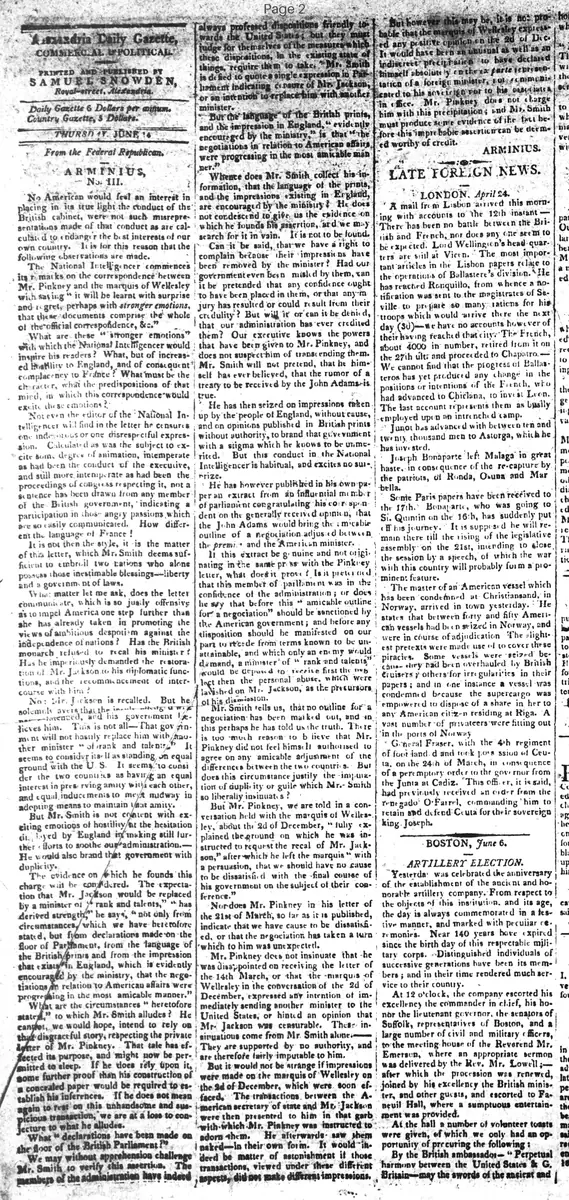
ARMINIUS
No. XIII.
No American would feel an interest in placing in its true light the conduct of the British cabinet, were not such misrepresentations made of that conduct as are calculated to endanger the best interests of our own country. It is for this reason that the following observations are made.
The National Intelligencer commences its remarks on the correspondence between Mr. Pinkney and the Marquis of Wellesley with saying "it will be learnt with surprise and regret, perhaps with stronger emotions, that these documents comprise the whole of the official correspondence, &c."
What are these "stronger emotions" with which the National Intelligencer would inspire its readers? What, but of increased hostility to England, and of consequent complacency to France? What must be the character, what the predispositions of that mind, in which this correspondence would excite these emotions?
Not even the editor of the National Intelligencer will find in the letter he censures one invidious or one disrespectful expression. Calculated as was the subject to excite some degree of animation, intemperate as had been the conduct of the executive, and still more intemperate as had been the proceedings of congress respecting it, not a sentence has been drawn from any member of the British government, indicating a participation in those angry passions, which are so easily communicated. How different the language of France!
It is not then the style, it is the matter of this letter, which Mr. Smith deems sufficient to embroil two nations who alone possess those inestimable blessings—liberty and a government of laws.
What matter let me ask, does the letter communicate, which is so justly offensive as to impel America one step further than she has already taken in promoting the views of ambitious despotism against the independence of nations? Has the British monarch refused to recall his minister? Has he imperiously demanded the restoration of Mr. Jackson to his diplomatic functions, and the recommencement of intercourse with him?
No: Mr. Jackson is recalled. But he solemnly avers that the insult attempted, and his government believes him. This is not all. That government will not hastily replace him with another minister "of rank and talent:" It seems to consider itself as standing on equal ground with the U. S. "It seems to consider the two countries as having an equal interest in preserving amity with each other, and equal inducements to meet midway in adopting means to maintain that amity."
But Mr. Smith is not content with exciting emotions of hostility at the hesitation evinced by England in making still further efforts to soothe our administration. He would also brand that government with duplicity.
The evidence on which he founds this charge will be considered. The expectation that Mr. Jackson would be replaced by a minister "of rank and talents," "has derived strength," he says, "not only from circumstances, which we have heretofore stated, but from declarations made on the floor of Parliament, from the language of the British prints and from the impression that exists in England, which is evidently encouraged by the ministry, that the negotiations in relation to American affairs were progressing in the most amicable manner."
What are the circumstances "heretofore stated," to which Mr. Smith alludes? He cannot, we would hope, intend to rely on that disgraceful story, respecting the private anger of Mr. Pinkney. That tale has effected its purpose, and might now be permitted to sleep. If he does rely upon it, some further proof than his construction of a concealed paper would be required to establish his inferences. If he does not mean again to trespass on this unhandsome and suspicious transaction, we are at a loss to conjecture to what he alludes.
What "declarations have been made on the floor of the British Parliament?"
We may without apprehension challenge Mr. Smith to verify this assertion. The members of the administration have indeed always professed dispositions friendly towards the United States but they not judge for themselves of the measures which these dispositions, in the existing state of things, require them to take. Mr. Smith is defied to quote a single expression in Parliament indicating censure of Mr. Jackson, or an intention to replace him with another minister.
But the language of the British prints, and the impression in England, "evidently encouraged by the ministry," is that "the negotiations in relation to American affairs were progressing in the most amicable manner."
Whence does Mr. Smith collect his information, that the language of the prints, and the impressions existing in England, are encouraged by the ministry? He does not condescend to give us the evidence on which he founds his assertion, and, we may search for it in vain. It is not to be found.
Can it be said that we have a right to complain because their impressions have been removed by the minister? Had our government even been misled by them, can it be pretended that any confidence ought to have been placed in them, or that any injury has resulted or could result from their credulity? But will it or can it be denied, that our administration has "ever credited them? Our executive knows the powers that have been given to Mr. Pinkney, and does not suspect him of transcending them.
Mr. Smith will not pretend, that he himself has ever believed, that the rumor of a treaty to be received by the John Adams is true.
He has then seized on impressions taken up by the people of England, without cause, and on opinions published in British prints without authority, to brand that government with a stigma which he knows to be unmerited. But this conduct in the National Intelligencer is habitual, and excites no surprise.
He has however published in his own paper an extract from an influential member of parliament congratulating his correspondent on the generally received opinion, that the John Adams would bring the amicable outline of a negotiation adjusted between the premier and the American minister.
If this extract be genuine and not originating in the same press with the Pinkney letter, what does it prove? Is it pretended that this member of parliament was in the confidence of the administration; or does he say that before this "amicable outline for a negotiation" should be sanctioned by the American government; and before any disposition should be manifested on our part to recede from terms known to be unattainable, and which only an enemy would demand, a minister of "rank and talents" would be deputed to receive first the neglect then the personal abuse, which were lavished on Mr. Jackson, as the precursors of his dismission.
Mr. Smith tells us, that no outline for a negotiation has been marked out, and in this perhaps he has told us the truth. There is too much reason to believe that Mr. Pinkney did not feel himself authorized to agree on any amicable adjustment of the differences between the two countries. But does this circumstance justify the imputation of duplicity or guile which Mr. Smith so liberally insinuates?
But Mr. Pinkney, we are told in a conversation held with the Marquis of Wellesley, 'about the 2d of December,' fully explained the ground on which he was instructed to request the recall of Mr. Jackson," after which he left the marquis "with a persuasion, that we should have no cause to be dissatisfied with the final course of his government on the subject of their conference.
Nor does Mr. Pinkney in his letter of the 31st of March, so far as it is published, indicate that we have cause to be dissatisfied, or that the negotiation has taken a turn which to him was unexpected.
Mr. Pinkney does not insinuate that he was disappointed on receiving the letter of the 14th March, or that the Marquis of Wellesley in the conversation of the 2d of December, expressed any intention of immediately sending another minister to the United States, or hinted an opinion that Mr. Jackson was censurable. These insinuations come from Mr. Smith alone. They are supported by no authority, and are therefore fairly imputable to him.
"But it would not be strange if impressions were made on the Marquis of Wellesley on the 2d of December, which were soon effaced. The transactions between the American secretary of state and Mr. Jackson were then presented to him in that garb with which Mr. Pinkney was instructed to adorn them. He afterwards saw them naked—in their own form. It would indeed be matter of astonishment if those transactions, viewed under these different aspects, did not make different impressions.
It is probable that the Marquis of Wellesley expressed any positive opinion on the 2d of Dec. It would have been an unusual as well as an indiscreet precipitation to have declared himself absolutely on the ex parte representations made to his sovereign or to his associates in office. Mr. Pinkney does not charge him with this precipitation; and Mr. Smith must produce some evidence of the fact he asserts before this improbable assertion can be deemed worthy of credit.
ARMINIUS.
What sub-type of article is it?
What themes does it cover?
What keywords are associated?
What entities or persons were involved?
Story Details
Key Persons
Event Date
About The 2d Of December; 14th March; 31st Of March
Story Details
Arminius critiques the National Intelligencer's portrayal of British-US diplomatic correspondence, defending Britain against charges of duplicity in recalling Mr. Jackson and hesitating to send a replacement minister, arguing it reflects equal footing and restraint compared to French intemperance.