Thank you for visiting SNEWPapers!
Sign up free
Alexandria Advertiser And Commercial Intelligencer
Alexandria, Virginia
What is this article about?
Thomas Paine's letter accuses George Washington of hypocrisy in the Jay Treaty with Britain, which undermines the French alliance, downplays Washington's military leadership in the Revolution, and emphasizes French aid's decisive role in victory, portraying Washington as pusillanimous and ungrateful.
Merged-components note: Continuation of Thomas Paine's letter to General Washington across pages 2 and 3; text flows directly from one component to the next.
Clippings
1 of 2
OCR Quality
Full Text
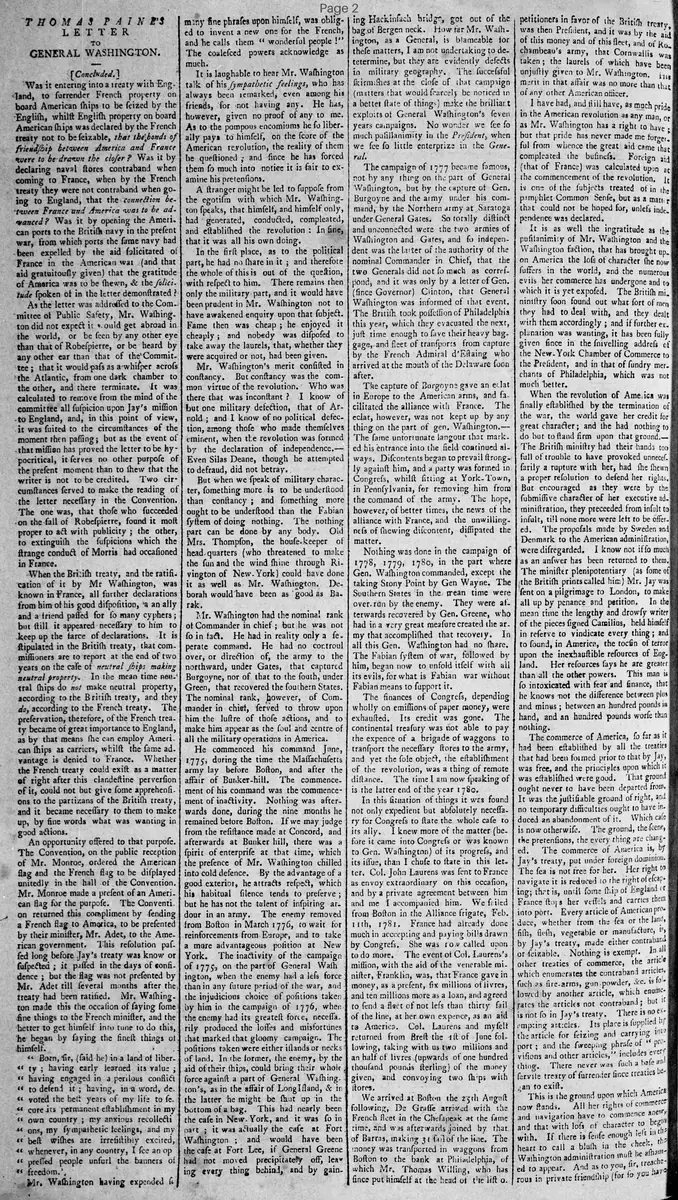
LETTER
GENERAL WASHINGTON
[Concluded.]
Was it entering into a treaty with England, to surrender French property on board American ships to be seized by the English, whilst English property on board American ships was declared by the French treaty not to be seizable, that the bonds of friendship between America and France were to be drawn the closer? Was it by declaring naval stores contraband when coming to France, when by the French treaty they were not contraband when going to England, that the connexion between France and America was to be advanced? Was it by opening the American ports to the British navy in the present war, from which ports the same navy had been expelled by the aid solicited of France in the American war (and that aid gratuitously given) that the gratitude of America was to be shewn, & the solicitude spoken of in the letter demonstrated?
As the letter was addressed to the Committee of Public Safety, Mr. Washington did not expect it would get abroad in the world, or be seen by any other eye than that of Robespierre, or be heard by any other ear than that of the Committee; that it would pass as a whisper across the Atlantic, from one dark chamber to the other, and there terminate. It was calculated to remove from the mind of the committee all suspicion upon Jay's mission to England, and, in this point of view, it was suited to the circumstances of the moment then passing; but as the event of that mission has proved the letter to be hypocritical, it serves no other purpose of the present moment than to shew that the writer is not to be credited. Two circumstances served to make the reading of the letter necessary in the Convention.
The one was, that those who succeeded on the fall of Robespierre, found it most proper to act with publicity; the other, to extinguish the suspicions which the strange conduct of Morris had occasioned in France.
When the British treaty, and the ratification of it by Mr. Washington, was known in France, all further declarations from him of his good disposition, as an ally and a friend passed for so many cyphers; but till it appeared necessary to him to keep up the farce of declarations. It is stipulated in the British treaty, that commissioners are to report at the end of two years on the case of neutral ships making neutral property. In the mean time neutral ships do not make neutral property, according to the British treaty, and they do, according to the French treaty. The preservation, therefore, of the French treaty became of great importance to England, as by that means she can employ American ships as carriers, whilst the same advantage is denied to France. Whether the French treaty could exist as a matter of right after this clandestine perversion of it, could not but give some apprehensions to the partizans of the British treaty, and it became necessary to them to make up, by fine words what was wanting in good actions.
An opportunity offered to that purpose. The Convention, on the public reception of Mr. Monroe, ordered the American flag and the French flag to be displayed unitedly in the hall of the Convention. Mr. Monroe made a present of an American flag for the purpose. The Convention returned this compliment by sending a French flag to America, to be presented by their minister, Mr. Adet, to the American government. This resolution passed long before Jay's treaty was known or suspected; it passed in the days of confidence; but the flag was not presented by Mr. Adet till several months after the treaty had been ratified. Mr. Washington made this the occasion of saying some fine things to the French minister, and the better to get himself into tune to do this, he began by saying the finest things of himself.
Born, it (said he) in a land of liberty; having early learned its value; having engaged in a perilous conflict to defend it; having, in a word, devoted the best years of my life to secure its permanent establishment in my own country; my anxious recollections, my sympathetic feelings, and my best wishes are irresistibly excited, whenever, in any country, I see an oppressed people unfurl the banners of freedom.'
Mr. Washington having expended many fine phrases upon himself, was obliged to invent a new one for the French, and he calls them "wonderful people!" The coalesced powers acknowledge as much.
It is laughable to hear Mr. Washington talk of his sympathetic feelings, who has always been remarked, even among his friends, for not having any. He has, however, given no proof of any to me.
As to the pompous encomiums he so liberally pays to himself, on the score of the American revolution, the reality of them may be questioned; and since he has forced them so much into notice it is fair to examine his pretensions.
A stranger might be led to suppose from the egotism with which Mr. Washington speaks, that himself, and himself only, had generated, conducted, compleated, and established the revolution: In fine, that it was all his own doing.
In the first place, as to the political part, he had no share in it; and therefore the whole of this is out of the question, with respect to him. There remains then only the military part, and it would have been prudent in Mr. Washington not to have awakened enquiry upon that subject.
Fame then was cheap; he enjoyed it cheaply; and nobody was disposed to take away the laurels, that, whether they were acquired or not, had been given.
Mr. Washington's merit consisted in constancy. But constancy was the common virtue of the revolution. Who was there that was inconstant? I know of but one military defection, that of Arnold; and I know of no political defection, among those who made themselves eminent, when the revolution was formed by the declaration of independence.
Even Silas Deane, though he attempted to defraud, did not betray.
But when we speak of military character, something more is to be understood than constancy; and something more ought to be understood than the Fabian system of doing nothing. The nothing part can be done by anybody. Old Mrs. Thompson, the house-keeper of head-quarters (who threatened to make the sun and the wind shine through Rivington of New-York) could have done it as well as Mr. Washington. Deborah would have been as good as Barak.
Mr. Washington had the nominal rank of Commander in chief: but he was not so in fact. He had in reality only a separate command. He had no controul over, or direction of, the army to the northward, under Gates, that captured Burgoyne, nor of that to the south, under Green, that recovered the southern States.
The nominal rank, however, of Commander in chief, served to throw upon him the lustre of those actions, and to make him appear as the soul and centre of all the military operations in America.
He commenced his command June, 1775, during the time the Massachusetts army lay before Boston, and after the affair of Bunker-hill. The commencement of his command was the commencement of inactivity. Nothing was afterwards done, during the nine months he remained before Boston. If we may judge from the resistance made at Concord, and afterwards at Bunker hill, there was a spirit of enterprize at that time, which the presence of Mr. Washington chilled into cold defence. By the advantage of a good exterior, he attracts respect, which his habitual silence tends to preserve; but he has not the talent of inspiring ardour in an army. The enemy removed from Boston in March 1776, to wait for reinforcements from Europe, and to take a more advantageous position at New York. The inactivity of the campaign of 1776, on the part of General Washington, when the enemy had a less force than in any future period of the war, and the injudicious choice of positions taken by him in the campaign of 1776, when the enemy had its greatest force, necessarily produced the losses and misfortunes that marked that gloomy campaign. The positions taken were either islands or necks of land. In the former, the enemy, by the aid of their ships, could bring their whole force against a part of General Washington's, as in the affair of Long Island, & in the latter he might be shut up in the bottom of a bag. This had nearly been the case in New-York, and it was so in part; it was actually the case at Fort Washington; and would have been the case at Fort Lee, if General Greene had not moved precipitately off, leaving every thing behind, and by gaining Hackensack bridge, got out of the bag of Bergen neck. How far Mr. Washington, as a General, is blameable for these matters, I am not undertaking to determine, but they are evidently defects in military geography. The successful skirmishes at the close of that campaign (matters that would scarcely be noticed in a better state of things) make the brilliant exploits of General Washington's eight years campaigns. No wonder we see so much pusillanimity in the President, when we see so little enterprize in the General.
The campaign of 1777 became famous, not by anything on the part of General Washington, but by the capture of Gen. Burgoyne and the army under his command, by the Northern army at Saratoga under General Gates. So totally distinct and unconnected were the two armies of Washington and Gates, and so independent was the latter of the authority of the nominal Commander in Chief, that the two Generals did not so much as correspond, and it was only by a letter of Gen. (since Governor) Clinton, that General Washington was informed of that event.
The British took possession of Philadelphia this year, which they evacuated the next, just time enough to save their heavy baggage, and fleet of transports from capture by the French Admiral d'Estaing who arrived at the mouth of the Delaware soon after.
The capture of Burgoyne gave an eclat in Europe to the American arms, and facilitated the alliance with France. The eclat, however, was not kept up by anything on the part of Gen. Washington. The same unfortunate languor that marked his entrance into the field continued always. Discontents began to prevail strongly against him, and a party was formed in Congress, whilst sitting at York-Town, in Pennsylvania, for removing him from the command of the army. The hope, however, of better times, the news of the alliance with France, and the unwillingness of shewing discontent, dissipated the matter.
Nothing was done in the campaign of 1778, 1779, 1780, in the part where Gen. Washington commanded, except the taking Stony Point by Gen Wayne. The Southern States in the mean time were over-run by the enemy. They were afterwards recovered by Gen. Greene, who had in a very great measure created the army that accomplished that recovery. In all this Gen. Washington had no share.
The Fabian system of war, followed by him, began now to unfold itself with all its evils, for what is Fabian war without Fabian means to support it.
The finances of Congress, depending wholly on emissions of paper money, were exhausted. Its credit was gone. The continental treasury was not able to pay the expence of a brigade of waggons to transport the necessary stores to the army, and yet the sole object, the establishment of the revolution, was a thing of remote distance. The time I am now speaking of is the latter end of the year 1780.
In this situation of things it was found not only expedient but absolutely necessary for Congress to state the whole case to its ally. I knew more of the matter (before it came into Congress or was known to Gen. Washington) of its progress, and its issue, than I chuse to state in this letter. Col. John Laurens was sent to France as envoy extraordinary on this occasion, and by a private agreement between him and me I accompanied him. We sailed from Boston in the Alliance frigate, Feb. 11th, 1781. France had already done much in accepting and paying bills drawn by Congress. She was now called upon to do more. The event of Col. Laurens's mission, with the aid of the venerable minister, Franklin, was, that France gave in money, as a present, six millions of livres, and ten millions more as a loan, and agreed to send a fleet of not less than thirty sail of the line, at her own expence, as an aid to America. Col. Laurens and myself returned from Brest the 1st of June following, taking with us two millions and an half of livres (upwards of one hundred thousand pounds sterling) of the money given, and convoying two ships with stores.
We arrived at Boston the 25th August following, De Grasse arrived with the French fleet in the Chesapeake at the same time, and was afterwards joined by that of Barras, making 36 sail of the line. The money was transported in waggons from Boston to the bank at Philadelphia, of which Mr. Thomas Willing, who has since put himself at the head of the list of petitioners in favor of the British treaty, was then President, and it was by the aid of this money and of this fleet, and of Rochambeau's army, that Cornwallis was taken; the laurels of which have been unjustly given to Mr. Washington. His merit in that affair was no more than that of any other American officer.
I have had, and still have, as much pride in the American revolution as any man, or as Mr. Washington has a right to have: but that pride has never made me forgetful from whence the great aid came that compleated the business. Foreign aid (that of France) was calculated upon at the commencement of the revolution. It is one of the subjects treated of in the pamphlet Common Sense, but as a matter that could not be hoped for, unless independence was declared.
It is as well the ingratitude as the pusillanimity of Mr. Washington and the Washington faction, that has brought upon America the loss of character she now suffers in the world, and the numerous evils her commerce has undergone and to which it is yet exposed. The British ministry soon found out what sort of men they had to deal with, and they dealt with them accordingly; and if further explanation was wanting, it has been fully given since in the servile address of the New-York Chamber of Commerce to the President, and in that of sundry merchants of Philadelphia, which was not much better.
When the revolution of America was finally established by the termination of the war, the world gave her credit for great character; and she had nothing to do but to stand firm upon that ground. The British ministry had their hands too full of trouble to have provoked unnecessarily a rupture with her, had she shewn a proper resolution to defend her rights. But encouraged as they were by the submissive character of her executive administration, they proceeded from insult to insult, till none more were left to be offered. The proposals made by Sweden and Denmark to the American administration were disregarded. I know not if so much as an answer has been returned to them. The minister plenipotentiary (as some of the British prints called him) Mr. Jay was sent on a pilgrimage to London, to make all up by penance and petition. In the mean time the lengthy and drowsy writer of the pieces signed Camillus, held himself in reserve to vindicate every thing; and to sound, in America, the tocsin of terror upon the inexhaustible resources of England. Her resources says he are greater than all the other powers. This man is so intoxicated with fear and finance, that he knows not the difference between plus and minus; between an hundred pounds in hand, and an hundred pounds worse than nothing.
The commerce of America, so far as it had been established by all the treaties that had been formed prior to that by Jay, was free, and the principles upon which it was established were good. That ground ought never to have been departed from. It was the justifiable ground of right, and no temporary difficulties ought to have induced an abandonment of it. Which case is now otherwise. The ground, the scene, the pretensions, the every thing are changed. The commerce of America is, by Jay's treaty, put under foreign dominion. The sea is not free for her. Her right to navigate it is reduced to the right of escaping; that is, until some ship of England or France stops her vessels and carries them into port. Every article of American produce, whether from the sea or the land, fish, flesh, vegetable or manufacture, is, or may be seized; and nothing is exempt. In all other treaties of commerce, the article such as fire-arms, gun-powder, &c. is followed by another article, which enumerates the articles not contraband; but it is not so in Jay's treaty. There is no exempting article. Its place is supplied by the article for seizing and carrying into port; and the sweeping phrase of "provisions and other articles." includes every thing. There never was such a base and servile treaty of surrender since treaties began to exist.
This is the ground upon which America now stands. All her rights of commerce and navigation have to commence anew; and that with loss of character to begin with. If there is sense enough left in the Washington administration must be ashamed to appear. And as to you, sir, treacherous in private friendship (for so you have been to me, and that in the day of danger) I now repeat to you, once more, to disavow it or make it public.
been to me, and that in the day of danger and a hypocrite in public life, the world will be puzzled to decide, whether you are an apostate or an impostor, whether you have abandoned good principles, or whether you ever had any?
THOMAS PAINE
What sub-type of article is it?
What themes does it cover?
What keywords are associated?
What entities or persons were involved?
Letter to Editor Details
Author
Thomas Paine
Recipient
General Washington
Main Argument
thomas paine accuses george washington of hypocrisy in the jay treaty, which betrays the french alliance and american interests, questions his exaggerated role in the revolution while crediting french aid, and labels him pusillanimous and ungrateful.
Notable Details