Thank you for visiting SNEWPapers!
Sign up free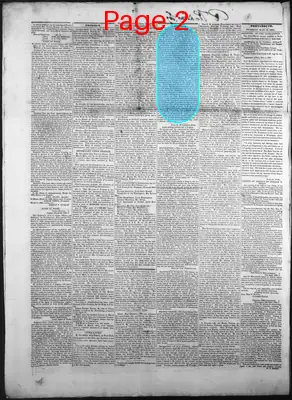
Editorial
May 12, 1835
The New Hampshire Gazette
Portsmouth, Rockingham County, New Hampshire
What is this article about?
An editorial from the Boston Statesman critiques Daniel Webster's political principles and suitability for the presidency, questioning his past ultra-federalist views, opposition to the War of 1812, and associations with the Hartford Convention.
Clipping
OCR Quality
95%
Excellent
Full Text
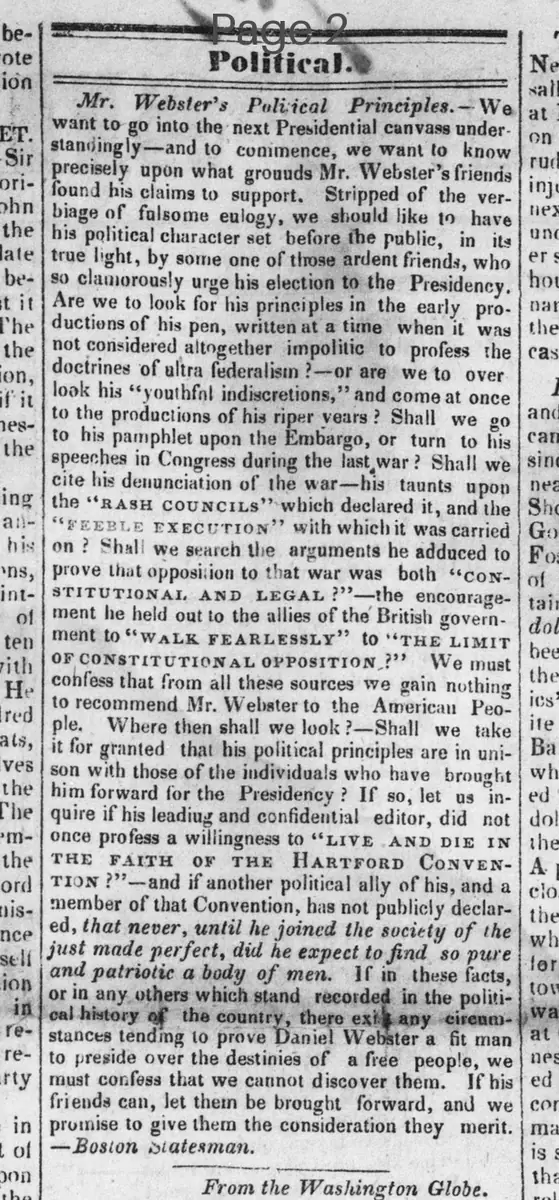
Mr. Webster's Political Principles.—We want to go into the next Presidential canvass understandingly—and to commence, we want to know precisely upon what grounds Mr. Webster's friends found his claims to support. Stripped of the verbiage of fulsome eulogy, we should like to have his political character set before the public, in its true light, by some one of those ardent friends, who so clamorously urge his election to the Presidency.
Are we to look for his principles in the early productions of his pen, written at a time when it was not considered altogether impolitic to profess the doctrines of ultra federalism?—or are we to overlook his 'youthful indiscretions,' and come at once to the productions of his riper years? Shall we go to his pamphlet upon the Embargo, or turn to his speeches in Congress during the last war? Shall we cite his denunciation of the war—his taunts upon the 'RASH councils' which declared it, and the 'FEEBLE EXECUTION' with which it was carried on? Shall we search the arguments he adduced to prove that opposition to that war was both 'CONSTITUTIONAL AND LEGAL?'—the encouragement he held out to the allies of the British government to 'WALK FEARLESSLY' to 'THE LIMIT OF CONSTITUTIONAL OPPOSITION?' We must confess that from all these sources we gain nothing to recommend Mr. Webster to the American People. Where then shall we look?—Shall we take it for granted that his political principles are in unison with those of the individuals who have brought him forward for the Presidency? If so, let us inquire if his leading and confidential editor, did not once profess a willingness to 'LIVE AND DIE IN THE FAITH OF THE HARTFORD CONVENTION?'—and if another political ally of his, and a member of that Convention, has not publicly declared, that never, until he joined the society of the just made perfect, did he expect to find so pure and patriotic a body of men. If in these facts, or in any others which stand recorded in the political history of the country, there exist any circumstances tending to prove Daniel Webster a fit man to preside over the destinies of a free people, we must confess that we cannot discover them. If his friends can, let them be brought forward, and we promise to give them the consideration they merit.
—Boston Statesman.
Are we to look for his principles in the early productions of his pen, written at a time when it was not considered altogether impolitic to profess the doctrines of ultra federalism?—or are we to overlook his 'youthful indiscretions,' and come at once to the productions of his riper years? Shall we go to his pamphlet upon the Embargo, or turn to his speeches in Congress during the last war? Shall we cite his denunciation of the war—his taunts upon the 'RASH councils' which declared it, and the 'FEEBLE EXECUTION' with which it was carried on? Shall we search the arguments he adduced to prove that opposition to that war was both 'CONSTITUTIONAL AND LEGAL?'—the encouragement he held out to the allies of the British government to 'WALK FEARLESSLY' to 'THE LIMIT OF CONSTITUTIONAL OPPOSITION?' We must confess that from all these sources we gain nothing to recommend Mr. Webster to the American People. Where then shall we look?—Shall we take it for granted that his political principles are in unison with those of the individuals who have brought him forward for the Presidency? If so, let us inquire if his leading and confidential editor, did not once profess a willingness to 'LIVE AND DIE IN THE FAITH OF THE HARTFORD CONVENTION?'—and if another political ally of his, and a member of that Convention, has not publicly declared, that never, until he joined the society of the just made perfect, did he expect to find so pure and patriotic a body of men. If in these facts, or in any others which stand recorded in the political history of the country, there exist any circumstances tending to prove Daniel Webster a fit man to preside over the destinies of a free people, we must confess that we cannot discover them. If his friends can, let them be brought forward, and we promise to give them the consideration they merit.
—Boston Statesman.
What sub-type of article is it?
Partisan Politics
Constitutional
War Or Peace
What keywords are associated?
Webster Principles
Presidential Candidacy
Ultra Federalism
War Of 1812 Opposition
Hartford Convention
Constitutional Opposition
What entities or persons were involved?
Daniel Webster
Mr. Webster's Friends
Leading And Confidential Editor
Political Ally And Member Of Hartford Convention
British Government Allies
Editorial Details
Primary Topic
Critique Of Daniel Webster's Political Principles For Presidency
Stance / Tone
Critical Opposition To Webster's Candidacy
Key Figures
Daniel Webster
Mr. Webster's Friends
Leading And Confidential Editor
Political Ally And Member Of Hartford Convention
British Government Allies
Key Arguments
Early Writings Professed Ultra Federalism
Pamphlet On Embargo And Speeches During Last War Show Opposition
Denounced The War As Result Of Rash Councils And Feeble Execution
Argued Opposition To War Was Constitutional And Legal
Encouraged Allies Of British To Constitutional Opposition
Principles Align With Hartford Convention Supporters