Thank you for visiting SNEWPapers!
Sign up free
Alexandria Daily Advertiser
Alexandria, Virginia
What is this article about?
On December 22, 1807, the U.S. House of Representatives debated and passed a fortification bill appropriating $1,000,000, considered a resolution for presidential authority to establish telegraphs, and received secret messages leading to the passage of the Embargo Act, prohibiting U.S. ships from foreign trade, signed by the President (Senate: 22-6; House: 82-44).
Clipping
OCR Quality
Full Text
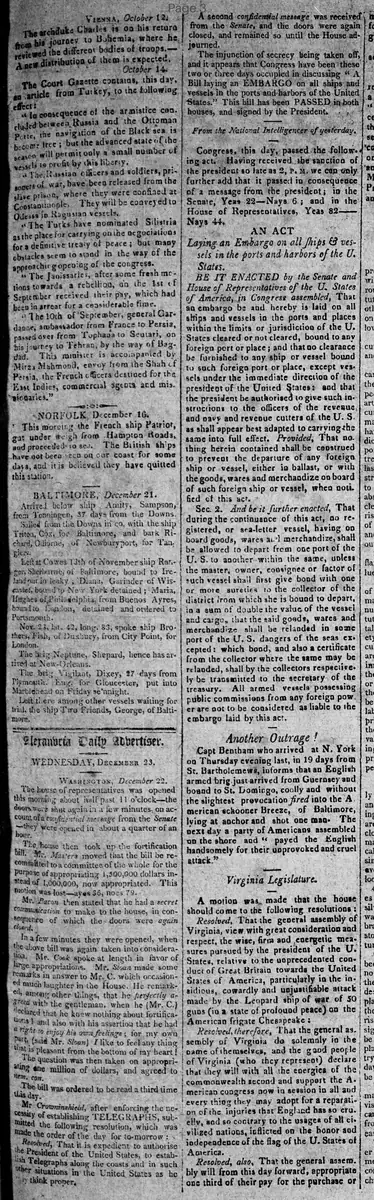
The house of representatives was opened this morning about half past 11 o'clock; the doors were shut again in a few minutes, on account of a confidential message from the Senate—they were opened in about a quarter of an hour.
The house then took up the fortification bill. Mr. Masters moved that the bill be recommitted to a committee of the whole for the purpose of appropriating 1,500,000 dollars instead of 1,000,000, now appropriated. This motion was lost ayes 36, noes 79.
Mr. Bacon then stated that he had a secret communication to make to the house, in consequence of which the doors were again closed.
In a few minutes they were opened, when the above bill was again taken into consideration. Mr. Cook spoke at length in favor of large appropriations. Mr. Sloan made some remarks in answer to Mr. C. which occasioned much laughter in the House. He remarked, among other things, that he perfectly agreed with the gentleman, when he (Mr. C.) declared that he knew nothing about fortifications; and also with his assertion that he had a right to enjoy his own feelings; for my own part, (said Mr. Sloan) I like to feel any thing that is pleasant from the bottom of my heart!
The question was then taken on appropriating one million of dollars, and agreed to nem. con.
The bill was ordered to be read a third time this day.
Mr. Crowninshield, after enforcing the necessity of establishing TELEGRAPHS, submitted the following resolution, which was made the order of the day for to-morrow:
Resolved, That it is expedient to authorise the President of the United States, to establish Telegraphs along the coasts and in such other situations in the United States as he may think proper.
A second confidential message was received from the Senate, and the doors were again closed, and remained so until the House adjourned.
The injunction of secrecy being taken off, and it appears that Congress have been these two or three days occupied in discussing "A Bill laying an EMBARGO on all ships, and vessels in the ports and harbors of the United States." This bill has been PASSED in both houses, and signed by the President.
From the National Intelligencer of yesterday.
Congress, this day, passed the following act. Having received the sanction of the president so late as 2, P. M. we can only further add that it passed in consequence of a message from the president; in the Senate, Yeas 22 Nays 6; and in the House of Representatives, Yeas 82 Nays 44.
AN ACT
Laying an Embargo on all ships & vessels in the ports and harbors of the U. States.
BE IT ENACTED by the Senate and House of Representatives of the U. States of America, in Congress assembled, That an embargo be and hereby is laid on all ships and vessels in the ports and places within the limits or jurisdiction of the U. States, cleared or not cleared, bound to any foreign port or place; and that no clearance be furnished to any ship or vessel bound to such foreign port or place, except vessels under the immediate direction of the president of the United States: and that the president be authorised to give such instructions to the officers of the revenue and navy and revenue cutters of the U. S. as shall appear best adapted to carrying the same into full effect. Provided, That nothing herein contained shall be construed to prevent the departure of any foreign ship or vessel, either in ballast, or with the goods, wares and merchandize on board of such foreign ship or vessel, when notified of this act.
Sec. 2. And be it further enacted, That during the continuance of this act, no registered, or sea-letter vessel, having on board goods, wares and merchandize, shall be allowed to depart from one port of the U. S. to another within the same, unless the master, owner, consignee or factor of such vessel shall first give bond with one or more sureties to the collector of the district from which she is bound to depart, in a sum of double the value of the vessel and cargo, that the said goods, wares and merchandize shall be relanded in some port of the U. S. dangers of the seas excepted: which bond, and also a certificate from the collector where the same may be relanded, shall by the collectors respectively be transmitted to the secretary of the treasury. All armed vessels possessing public commissions from any foreign power are not to be considered as liable to the embargo laid by this act.
What sub-type of article is it?
What keywords are associated?
What entities or persons were involved?
Where did it happen?
Domestic News Details
Primary Location
Washington
Event Date
December 22
Key Persons
Outcome
fortification bill passed with $1,000,000 appropriation (motion for $1,500,000 lost 36-79); embargo act passed in senate (yeas 22, nays 6) and house (yeas 82, nays 44), signed by president; telegraph resolution ordered for next day.
Event Details
House session opened at 11:30 a.m., doors closed for Senate's confidential message, then debated fortification bill with motions and speeches; secret communication from Mr. Bacon led to closed doors; bill passed nem. con.; Mr. Crowninshield submitted telegraph resolution; second confidential message on Embargo Act, which was passed after discussion.