Thank you for visiting SNEWPapers!
Sign up free
Mcallen Daily Press
Mcallen, Hidalgo County, Texas
What is this article about?
Senate anti-draft leaders, undeterred by GOP nominee Willkie's support for peacetime conscription, push Maloney amendment to condition Burke-Wadsworth draft bill on failed voluntary enlistments. Debate shows divided support, with isolationists criticizing Willkie's ambiguous stance. (248 characters)
Clipping
OCR Quality
Full Text
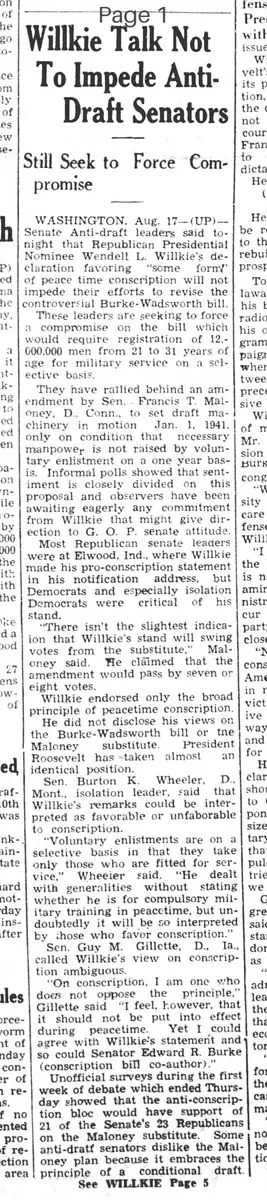
WASHINGTON, Aug. 17-(UP)- Senate Anti-draft leaders said tonight that Republican Presidential Nominee Wendell L. Willkie's declaration favoring "some form" of peace time conscription will not impede their efforts to revise the controversial Burke-Wadsworth bill.
These leaders are seeking to force a compromise on the bill which would require registration of 12,000,000 men from 21 to 31 years of age for military service on a selective basis.
They have rallied behind an amendment by Sen. Francis T. Maloney, D. Conn., to set draft machinery in motion Jan. 1, 1941, only on condition that necessary manpower is not raised by voluntary enlistment on a one year basis. Informal polls showed that sentiment is closely divided on this proposal and observers have been awaiting eagerly any commitment from Willkie that might give direction to G. O. P. senate attitude.
Most Republican senate leaders were at Elwood, Ind., where Willkie made his pro-conscription statement in his notification address, but Democrats and especially isolation Democrats were critical of his stand.
"There isn't the slightest indication that Willkie's stand will swing votes from the substitute," Maloney said. He claimed that the amendment would pass by seven or eight votes.
Willkie endorsed only the broad principle of peacetime conscription. He did not disclose his views on the Burke-Wadsworth bill or the Maloney substitute. President Roosevelt has taken almost an identical position.
Sen. Burton K. Wheeler, D., Mont., isolation leader, said that Willkie's remarks could be interpreted as favorable or unfavorable to conscription.
"Voluntary enlistments are on a selective basis in that they take only those who are fitted for service," Wheeler said. "He dealt with generalities without stating whether he is for compulsory military training in peacetime, but undoubtedly it will be so interpreted by those who favor conscription."
Sen. Guy M. Gillette, D., Ia., called Willkie's view on conscription ambiguous.
"On conscription, I am one who does not oppose the principle," Gillette said "I feel, however, that it should not be put into effect during peacetime.
Yet I could agree with Willkie's statement and so could Senator Edward R. Burke (conscription bill co-author)."
Unofficial surveys during the first week of debate which ended Thursday showed that the anti-conscription bloc would have support of 21 of the Senate's 23 Republicans on the Maloney substitute. Some anti-draft senators dislike the Maloney plan because it embraces the principle of a conditional draft.
What sub-type of article is it?
What keywords are associated?
What entities or persons were involved?
Where did it happen?
Domestic News Details
Primary Location
Washington
Event Date
Aug. 17
Key Persons
Outcome
sentiment closely divided on maloney amendment; unofficial surveys show anti-conscription bloc support from 21 of 23 senate republicans; maloney claims amendment will pass by seven or eight votes.
Event Details
Senate anti-draft leaders stated that Willkie's declaration favoring some form of peacetime conscription will not impede efforts to revise the Burke-Wadsworth bill requiring registration of 12,000,000 men aged 21 to 31. They support Maloney's amendment to activate draft machinery on Jan. 1, 1941, only if voluntary enlistments fail to meet manpower needs. Willkie endorsed the principle without specifics on the bill. Isolation Democrats criticized his stand; Wheeler and Gillette commented on its ambiguity. Debate's first week ended Thursday.