Thank you for visiting SNEWPapers!
Sign up free
Literary
September 19, 1923
The Cody Enterprise
Cody, Park County, Wyoming
What is this article about?
In a Wyoming ranch, Pierre's jealousy over Joan's interest in books from minister Holliwell escalates during his absence. Returning early, he confronts her, ties her, and brands her shoulder with his cattle iron to mark her as his property, destroying their trust amid winter isolation.
Clipping
OCR Quality
95%
Excellent
Full Text
WEDNESDAY.
SEPT. 19, 1923
THE BRANDING IRON
Copyright by Katharine N. Burt
SYNOPSIS
Joan Landis, eighteen years old, wife of Pierre, is the daughter of John Carver, who murdered her mother for adultery. Her lonely life, with her father in a Wyoming cabin, unbearable, Joan leaves him to work in a hotel in a nearby town. Joan meets Pierre, and the two, mutually attracted, are married. Carver tells Pierre story of Joan's mother. Pierre forges a cattle brand. Frank Holliwell, young minister, presents books to Joan. Pierre forbids her to read them.
CHAPTER V—Continued.
"There's poetry this time," he said. "Get Pierre to read it aloud to you."
The suggestion was met by a rude laugh from Pierre.
"I wouldn't be wastin' my time," he jeered.
It was the first rift in his courtesy. Holliwell looked up in sharp surprise. He saw a flash of the truth, a little wriggle of the green serpent in Pierre's eyes before they fell. He flushed and glanced at Joan.
She wore an almost timorous air, accepted his remarks in silence, shot doubtful looks at Pierre before she answered questions, was an entirely different Joan. Now Holliwell was angry and he stiffened toward his host and hostess, dropped all his talk about the books and smoked haughtily. He was young and over-sensitive, no more master of himself in this instance than Pierre and Joan. But before he left after supper, refusing a bed, though Pierre conquered his dislike sufficiently to urge it, Holliwell had a moment with Joan. It was very touching. He would tell about it afterward, but for a long time he could not bear to remember it.
She tried to return his books, coming with her arms full of them and lifting up eyes that were almost tragic with repugnance.
"I can't be taking time to read them, Mr. Holliwell," she said, that extraordinary, over-expressive voice of hers running an octave of regret; "an' someway Pierre don't like that I should spend my evenin's on them. Seems like he thinks I was settin' myself up to be knowin' more than him."
She laughed ruefully. "Me—knowin' more'n Pierre! It's laughable. But anyways I don't want him to be thinkin' that. So take the books, please. I like them."
She paused. "I love them," she said hungrily, and blinking, thrust them into his hands.
He put them down on the table.
"You're wrong, Joan," he said quickly. "You mustn't give in to such a foolish idea. You have rights of your own, a life of your own. Pierre mustn't stand in the way of your learning. You mustn't let him. I'll speak to him."
"Oh, no!"
Some intuition warned her of the danger in his doing this.
"Well, then, keep your books and talk to Pierre about them. Try to persuade him to read aloud to you. I shan't be back now till spring, but I want you to read this winter, read all the stuff that's there. Come, Joan, to please me," and he smiled coaxingly.
"I ain't afraid of Pierre," said Joan slowly. Her pride was stung by the suggestion.
"I'll keep the books."
She sighed.
"Good-by. When I see you in the spring, I'll be a right learned schoolmarm."
She held out her hand and he took and held it, pressing it in his own. He felt troubled about her, unwilling to leave her in the snowbound wilderness with that young savage of the smoldering eyes.
"Good-by," said Pierre behind him.
His soft voice had a click.
Holliwell turned to him.
"Good-by, Landis. I shan't see either of you till the spring. I wish you a good winter and I hope—"
He broke off and held out his hand.
"Well," said he, "you're pretty far out of everybody's way here. Be good to each other."
"Damn your interference!" said Pierre's eyes, but he took the hand and even escorted Holliwell to his horse.
Snow came early and deep that winter. Pierre had cut and stacked his winter wood; he had sent his cows to a richer man's ranch for winter feeding. There was very little for him to do. After he had brought in two buckets of water from the well and had cut for the day's consumption a piece of meat from his elk hanging outside against the wall, he had only to sit and smoke, to read old magazines and papers and to watch Joan.
Then the poisonous roots of his jealousy struck deep. Always his brain, falsely interpreting her wistful silence—she was thinking of the parson, hungry to read his books, longing for the open season and his coming again to the ranch.
In December a man came in on snowshoes bringing "the mail"—one letter for Pierre, a communication which brought heat to his face. The Forest service threatened him with a loss of land; it pointed to some flaw in his title; part of his property, the most valuable part, had not yet been surveyed. . . . Pierre looked up with set jaws, every fighting instinct sharpened to hold what was his own.
"I hev put in two years' hard work on them acres," he told his visitor, "an' I'm not plannin' to give them over to the first fool favored by the Service. My title is as clean as my hand. It'll take more'n thievery an' more'n spite to take it away from me."
"You better go to Robinson," advised the bearer of the letter; "can't get after them fellers too soon. It's a country where you can easy come by what you want, but where it ain't so easy to hold onto it. If it ain't yer land it's yer hosses; if it ain't yer hosses it's yer wife."
He looked at Joan and laughed.
Pierre went white and dumb; the chance shot had inflamed his wound.
He strapped on his snowshoes and bade a grim good-by to Joan, after the man had left.
"Don't you be wastin' oil while I'm away," he told her sharply, standing in the doorway, his head level with the steep wall of snow behind him, and he gave her a threatening look so that the tenderness in her heart was frozen.
After he had gone,
"Pierre, say a real good-by, say good-by," she whispered.
Her face cramped and tears came.
She heard his steps lightly crunching across the hard, bright surface of the snow; they entered into the terrible frozen silence. Then she turned from the door, dried her eyes with her sleeve like a little village girl, and ran across the room to a certain shelf.
Pierre would be gone a week. She would not waste oil, but she would read.
It was with the appetite of a starved creature that she fell upon her books.
CHAPTER VI
Pierre Takes Steps to Preserve His Property.
A log fell forward and Joan lifted her head.
She had not come to an end of Isabella's tragedy nor of her own memories, but something other than the falling log had startled her; a light, crunching step upon the snow.
She looked toward the window. For an instant the room was almost dark and the white night peered in at her, its gigantic snow-peaks pressing against the long, horizontal window panes, and in that instant she saw a face.
Joan came to her feet with pounding pulses.
It had been Pierre's face, but at the same time the face of a stranger.
He had come back five days too soon and something terrible had happened.
Surely his chancing to see her with her book would not make him look like that.
Besides, she was not wasting oil.
She had stood up, but at first she was incapable of moving forward.
For the first time in her life she knew the paralysis of unreasoning fear.
Then the door opened and Pierre came in out of the crystal night.
"What brought you back so soon?" asked Joan.
"Too soon for you, eh?"
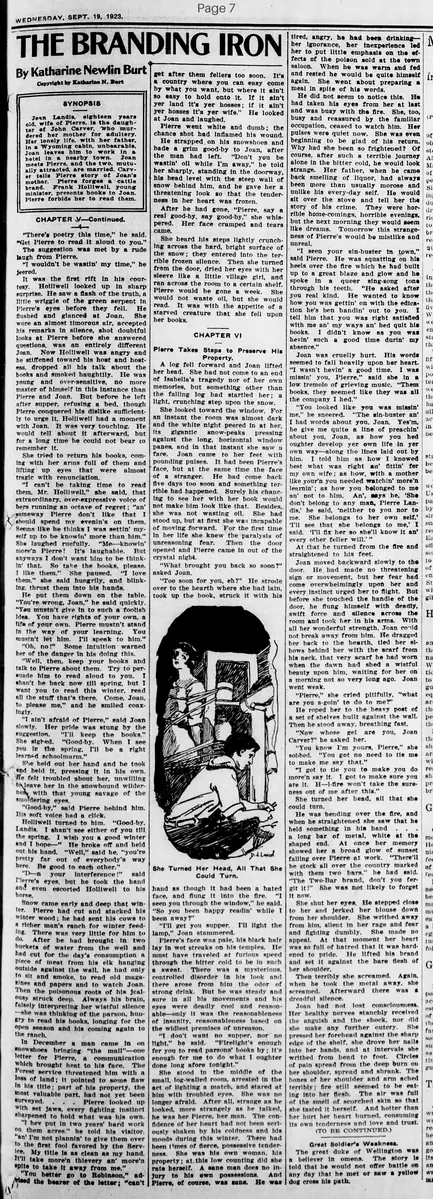
He strode over to the hearth where she had lain, took up the book, struck it with his hand as though it had been a hated face, and flung it into the fire.
"I seen you through the window," he said. "So you been happy readin' whlle I been away?"
"I'll get you supper. I'll light the lamp," Joan stammered.
Pierre's face was pale, his black hair lay in wet streaks on his temples. He must have traveled at furious speed through the bitter cold to be in such a sweat.
There was a mysterious, controlled disorder in his look and there arose from him the odor of strong drink.
But he was steady and sure in all his movements and his eyes were deadly cool and reasonable—only it was the reasonableness of insanity, reasonableness based on the wildest premises of unreason.
"I don't want no supper, nor no light," he said. "Firelight's enough fer you to read parsons' books by; it's enough fer me to do what I oughter done long afore tonight."
She stood in the middle of the small, log-walled room, arrested in the act of lighting a match, and stared at him with troubled eyes.
She was no longer afraid. After all, strange as he looked, more strangely as he talked, he was her Pierre, her man. The confidence of her heart had not been seriously shaken by his coldness and his moods during this winter.
There had been times of fierce, possessive tenderness.
She was his own woman, his property; at this low counting did she rate herself.
A sane man does no injury to his own possessions.
And Pierre, of course, was sane.
He was tired, angry, he had been drinking—her ignorance, her inexperience led her to put little emphasis on the effects of the poison sold at the town saloon. When he was warm and fed and rested he would be quite himself again. She went about preparing meal in spite of his words.
He did not seem to notice this. He had taken his eyes from her at last and was busy with the fire. She, too, busy and reassured by the familiar occupation, ceased to watch him. Her pulses were quiet now. She was even beginning to be glad of his return.
Why had she been so frightened? Of course, after such a terrible journey alone in the bitter cold, he would look strange. Her father, when he came back smelling of liquor, had always been more than usually morose and unlike his every-day self. He would sit over the stove and tell her the story of his crime. They were horrible home-comings, horrible evenings, but the next morning they would seem like dreams. Tomorrow this strangeness of Pierre's would be mistlike and unreal.
"I seen your sin-buster in town," said Pierre. He was squatting on his heels over the fire which he had built up to a great blaze and glow and he spoke in a queer sing-song tone through his teeth. "He asked after you real kind. He wanted to know how you was gettin' on with the edication he's ben handin' out to you. I tell him that you was right satisfied with me an' my ways an' hed quit his books. I didn't know as you was hevin' such a good time durin' my absence."
Joan was cruelly hurt. His words seemed to fall heavily upon her heart.
"I wasn't hevin' a good time. I was missin' you, Pierre," said she in a low tremolo of grieving music. "Them books, they seemed like they was all the company I hed."
"You looked like you was missin' me," he sneered. "The sin-buster an' I had words about you, Joan. Yes'm, he give me quite a line of preachin' about you, Joan, as how you hed oughter develop yer own life in yer own way—along the lines laid out by him. I told him as how I knowed best what was right an' fittin' fer my own wife; as how, with a mother like your'n you needed watchin' more'n learnin'; as how you belonged to me an' not to him. An', mays he, 'She don't belong to any man, Pierre Landis,' he said, 'neither to you nor to me. She belongs to her own self.'
"'I'll see that she belongs to me,' I said. 'I'll fix her so she'll know it an' every other feller will.'"
At that he turned from the fire and straightened to his feet.
Joan moved backward slowly to the door. He had made no threatening sign or movement, but her fear had come overwhelmingly upon her and every instinct urged her to flight. But before she touched the handle of the door, he flung himself with deadly, swift force and silence across the room and took her in his arms. With all her wonderful strength, Joan could not break away from him. He dragged her back to the hearth, tied her elbows behind her with the scarf from his neck, that very scarf he had worn when the dawn had shed a wistful beauty upon him, waiting for her on a morning not so very long ago. Joan went weak.
"Pierre," she cried pitifully. "What are you a-goin' to do to me?"
He roped her to the heavy post of a set of shelves built against the wall.
Then he stood away, breathing fast.
"Now whose gel are you, Joan Carver?" he asked her.
"You know I'm yours, Pierre," she sobbed. "You got no need to tie me to make me say that."
"I got to tie you to make you do more'n say it. I got to make sure you are it. H--l-fire won't take the sureness out of me after this."
She turned her head, all that she could turn.
He was bending over the fire, and when he straightened she saw that he held something in his hand—a long bar of metal, white at the shaped end. At once her memory showed her a broad glow of sunset falling over Pierre at work. "There'll be stock all over the country marked with them two bars," he had said. "The Two-Bar brand. Don't you fer git it!" She was not likely to forget it now.
She shut her eyes. He stepped close to her and jerked her blouse down from her shoulder. She writhed away from him, silent in her rage and fear and fighting dumbly.
She made no appeal. At that moment her heart was so full of hatred that it was hardened to pride. He lifted his brand and set it against the bare flesh of her shoulder.
Then terribly she screamed. Again, when he took the metal away, she screamed. Afterward there was dreadful silence.
Joan had not lost consciousness.
Her healthy nerves stanchly received the anguish and the shock, nor did she make any further outcry. She pressed her forehead against the sharp edge of the shelf, she drove her nails into her hands, and at intervals she writhed from head to foot. Circles of pain spread from the deep burn on her shoulder, spread and shrank. The bones of her shoulder and arm ached terribly; fire still seemed to be eating into her flesh. The air was full of the smell of scorched skin so that she tasted it herself. And hotter than her hurt her heart burned, consuming its own tenderness and love and trust.
(TO BE CONTINUED.)
SEPT. 19, 1923
THE BRANDING IRON
Copyright by Katharine N. Burt
SYNOPSIS
Joan Landis, eighteen years old, wife of Pierre, is the daughter of John Carver, who murdered her mother for adultery. Her lonely life, with her father in a Wyoming cabin, unbearable, Joan leaves him to work in a hotel in a nearby town. Joan meets Pierre, and the two, mutually attracted, are married. Carver tells Pierre story of Joan's mother. Pierre forges a cattle brand. Frank Holliwell, young minister, presents books to Joan. Pierre forbids her to read them.
CHAPTER V—Continued.
"There's poetry this time," he said. "Get Pierre to read it aloud to you."
The suggestion was met by a rude laugh from Pierre.
"I wouldn't be wastin' my time," he jeered.
It was the first rift in his courtesy. Holliwell looked up in sharp surprise. He saw a flash of the truth, a little wriggle of the green serpent in Pierre's eyes before they fell. He flushed and glanced at Joan.
She wore an almost timorous air, accepted his remarks in silence, shot doubtful looks at Pierre before she answered questions, was an entirely different Joan. Now Holliwell was angry and he stiffened toward his host and hostess, dropped all his talk about the books and smoked haughtily. He was young and over-sensitive, no more master of himself in this instance than Pierre and Joan. But before he left after supper, refusing a bed, though Pierre conquered his dislike sufficiently to urge it, Holliwell had a moment with Joan. It was very touching. He would tell about it afterward, but for a long time he could not bear to remember it.
She tried to return his books, coming with her arms full of them and lifting up eyes that were almost tragic with repugnance.
"I can't be taking time to read them, Mr. Holliwell," she said, that extraordinary, over-expressive voice of hers running an octave of regret; "an' someway Pierre don't like that I should spend my evenin's on them. Seems like he thinks I was settin' myself up to be knowin' more than him."
She laughed ruefully. "Me—knowin' more'n Pierre! It's laughable. But anyways I don't want him to be thinkin' that. So take the books, please. I like them."
She paused. "I love them," she said hungrily, and blinking, thrust them into his hands.
He put them down on the table.
"You're wrong, Joan," he said quickly. "You mustn't give in to such a foolish idea. You have rights of your own, a life of your own. Pierre mustn't stand in the way of your learning. You mustn't let him. I'll speak to him."
"Oh, no!"
Some intuition warned her of the danger in his doing this.
"Well, then, keep your books and talk to Pierre about them. Try to persuade him to read aloud to you. I shan't be back now till spring, but I want you to read this winter, read all the stuff that's there. Come, Joan, to please me," and he smiled coaxingly.
"I ain't afraid of Pierre," said Joan slowly. Her pride was stung by the suggestion.
"I'll keep the books."
She sighed.
"Good-by. When I see you in the spring, I'll be a right learned schoolmarm."
She held out her hand and he took and held it, pressing it in his own. He felt troubled about her, unwilling to leave her in the snowbound wilderness with that young savage of the smoldering eyes.
"Good-by," said Pierre behind him.
His soft voice had a click.
Holliwell turned to him.
"Good-by, Landis. I shan't see either of you till the spring. I wish you a good winter and I hope—"
He broke off and held out his hand.
"Well," said he, "you're pretty far out of everybody's way here. Be good to each other."
"Damn your interference!" said Pierre's eyes, but he took the hand and even escorted Holliwell to his horse.
Snow came early and deep that winter. Pierre had cut and stacked his winter wood; he had sent his cows to a richer man's ranch for winter feeding. There was very little for him to do. After he had brought in two buckets of water from the well and had cut for the day's consumption a piece of meat from his elk hanging outside against the wall, he had only to sit and smoke, to read old magazines and papers and to watch Joan.
Then the poisonous roots of his jealousy struck deep. Always his brain, falsely interpreting her wistful silence—she was thinking of the parson, hungry to read his books, longing for the open season and his coming again to the ranch.
In December a man came in on snowshoes bringing "the mail"—one letter for Pierre, a communication which brought heat to his face. The Forest service threatened him with a loss of land; it pointed to some flaw in his title; part of his property, the most valuable part, had not yet been surveyed. . . . Pierre looked up with set jaws, every fighting instinct sharpened to hold what was his own.
"I hev put in two years' hard work on them acres," he told his visitor, "an' I'm not plannin' to give them over to the first fool favored by the Service. My title is as clean as my hand. It'll take more'n thievery an' more'n spite to take it away from me."
"You better go to Robinson," advised the bearer of the letter; "can't get after them fellers too soon. It's a country where you can easy come by what you want, but where it ain't so easy to hold onto it. If it ain't yer land it's yer hosses; if it ain't yer hosses it's yer wife."
He looked at Joan and laughed.
Pierre went white and dumb; the chance shot had inflamed his wound.
He strapped on his snowshoes and bade a grim good-by to Joan, after the man had left.
"Don't you be wastin' oil while I'm away," he told her sharply, standing in the doorway, his head level with the steep wall of snow behind him, and he gave her a threatening look so that the tenderness in her heart was frozen.
After he had gone,
"Pierre, say a real good-by, say good-by," she whispered.
Her face cramped and tears came.
She heard his steps lightly crunching across the hard, bright surface of the snow; they entered into the terrible frozen silence. Then she turned from the door, dried her eyes with her sleeve like a little village girl, and ran across the room to a certain shelf.
Pierre would be gone a week. She would not waste oil, but she would read.
It was with the appetite of a starved creature that she fell upon her books.
CHAPTER VI
Pierre Takes Steps to Preserve His Property.
A log fell forward and Joan lifted her head.
She had not come to an end of Isabella's tragedy nor of her own memories, but something other than the falling log had startled her; a light, crunching step upon the snow.
She looked toward the window. For an instant the room was almost dark and the white night peered in at her, its gigantic snow-peaks pressing against the long, horizontal window panes, and in that instant she saw a face.
Joan came to her feet with pounding pulses.
It had been Pierre's face, but at the same time the face of a stranger.
He had come back five days too soon and something terrible had happened.
Surely his chancing to see her with her book would not make him look like that.
Besides, she was not wasting oil.
She had stood up, but at first she was incapable of moving forward.
For the first time in her life she knew the paralysis of unreasoning fear.
Then the door opened and Pierre came in out of the crystal night.
"What brought you back so soon?" asked Joan.
"Too soon for you, eh?"
He strode over to the hearth where she had lain, took up the book, struck it with his hand as though it had been a hated face, and flung it into the fire.
"I seen you through the window," he said. "So you been happy readin' whlle I been away?"
"I'll get you supper. I'll light the lamp," Joan stammered.
Pierre's face was pale, his black hair lay in wet streaks on his temples. He must have traveled at furious speed through the bitter cold to be in such a sweat.
There was a mysterious, controlled disorder in his look and there arose from him the odor of strong drink.
But he was steady and sure in all his movements and his eyes were deadly cool and reasonable—only it was the reasonableness of insanity, reasonableness based on the wildest premises of unreason.
"I don't want no supper, nor no light," he said. "Firelight's enough fer you to read parsons' books by; it's enough fer me to do what I oughter done long afore tonight."
She stood in the middle of the small, log-walled room, arrested in the act of lighting a match, and stared at him with troubled eyes.
She was no longer afraid. After all, strange as he looked, more strangely as he talked, he was her Pierre, her man. The confidence of her heart had not been seriously shaken by his coldness and his moods during this winter.
There had been times of fierce, possessive tenderness.
She was his own woman, his property; at this low counting did she rate herself.
A sane man does no injury to his own possessions.
And Pierre, of course, was sane.
He was tired, angry, he had been drinking—her ignorance, her inexperience led her to put little emphasis on the effects of the poison sold at the town saloon. When he was warm and fed and rested he would be quite himself again. She went about preparing meal in spite of his words.
He did not seem to notice this. He had taken his eyes from her at last and was busy with the fire. She, too, busy and reassured by the familiar occupation, ceased to watch him. Her pulses were quiet now. She was even beginning to be glad of his return.
Why had she been so frightened? Of course, after such a terrible journey alone in the bitter cold, he would look strange. Her father, when he came back smelling of liquor, had always been more than usually morose and unlike his every-day self. He would sit over the stove and tell her the story of his crime. They were horrible home-comings, horrible evenings, but the next morning they would seem like dreams. Tomorrow this strangeness of Pierre's would be mistlike and unreal.
"I seen your sin-buster in town," said Pierre. He was squatting on his heels over the fire which he had built up to a great blaze and glow and he spoke in a queer sing-song tone through his teeth. "He asked after you real kind. He wanted to know how you was gettin' on with the edication he's ben handin' out to you. I tell him that you was right satisfied with me an' my ways an' hed quit his books. I didn't know as you was hevin' such a good time durin' my absence."
Joan was cruelly hurt. His words seemed to fall heavily upon her heart.
"I wasn't hevin' a good time. I was missin' you, Pierre," said she in a low tremolo of grieving music. "Them books, they seemed like they was all the company I hed."
"You looked like you was missin' me," he sneered. "The sin-buster an' I had words about you, Joan. Yes'm, he give me quite a line of preachin' about you, Joan, as how you hed oughter develop yer own life in yer own way—along the lines laid out by him. I told him as how I knowed best what was right an' fittin' fer my own wife; as how, with a mother like your'n you needed watchin' more'n learnin'; as how you belonged to me an' not to him. An', mays he, 'She don't belong to any man, Pierre Landis,' he said, 'neither to you nor to me. She belongs to her own self.'
"'I'll see that she belongs to me,' I said. 'I'll fix her so she'll know it an' every other feller will.'"
At that he turned from the fire and straightened to his feet.
Joan moved backward slowly to the door. He had made no threatening sign or movement, but her fear had come overwhelmingly upon her and every instinct urged her to flight. But before she touched the handle of the door, he flung himself with deadly, swift force and silence across the room and took her in his arms. With all her wonderful strength, Joan could not break away from him. He dragged her back to the hearth, tied her elbows behind her with the scarf from his neck, that very scarf he had worn when the dawn had shed a wistful beauty upon him, waiting for her on a morning not so very long ago. Joan went weak.
"Pierre," she cried pitifully. "What are you a-goin' to do to me?"
He roped her to the heavy post of a set of shelves built against the wall.
Then he stood away, breathing fast.
"Now whose gel are you, Joan Carver?" he asked her.
"You know I'm yours, Pierre," she sobbed. "You got no need to tie me to make me say that."
"I got to tie you to make you do more'n say it. I got to make sure you are it. H--l-fire won't take the sureness out of me after this."
She turned her head, all that she could turn.
He was bending over the fire, and when he straightened she saw that he held something in his hand—a long bar of metal, white at the shaped end. At once her memory showed her a broad glow of sunset falling over Pierre at work. "There'll be stock all over the country marked with them two bars," he had said. "The Two-Bar brand. Don't you fer git it!" She was not likely to forget it now.
She shut her eyes. He stepped close to her and jerked her blouse down from her shoulder. She writhed away from him, silent in her rage and fear and fighting dumbly.
She made no appeal. At that moment her heart was so full of hatred that it was hardened to pride. He lifted his brand and set it against the bare flesh of her shoulder.
Then terribly she screamed. Again, when he took the metal away, she screamed. Afterward there was dreadful silence.
Joan had not lost consciousness.
Her healthy nerves stanchly received the anguish and the shock, nor did she make any further outcry. She pressed her forehead against the sharp edge of the shelf, she drove her nails into her hands, and at intervals she writhed from head to foot. Circles of pain spread from the deep burn on her shoulder, spread and shrank. The bones of her shoulder and arm ached terribly; fire still seemed to be eating into her flesh. The air was full of the smell of scorched skin so that she tasted it herself. And hotter than her hurt her heart burned, consuming its own tenderness and love and trust.
(TO BE CONTINUED.)
What sub-type of article is it?
Prose Fiction
What themes does it cover?
Love Romance
Moral Virtue
Social Manners
What keywords are associated?
Jealousy
Branding
Possession
Wyoming Ranch
Marital Abuse
What entities or persons were involved?
Katharine N. Burt
Literary Details
Title
The Branding Iron, Chapter V—Continued And Chapter Vi
Author
Katharine N. Burt
Subject
Pierre's Jealousy Leads To Branding Joan As His Property
Key Lines
"I Got To Tie You To Make You Do More'n Say It. I Got To Make Sure You Are It. H L Fire Won't Take The Sureness Out Of Me After This."
He Lifted His Brand And Set It Against The Bare Flesh Of Her Shoulder.
Then Terribly She Screamed. Again, When He Took The Metal Away, She Screamed. Afterward There Was Dreadful Silence.