Thank you for visiting SNEWPapers!
Sign up free
Kodiak Mirror
Kodiak, Alaska
What is this article about?
At a crowded Kodiak fisheries hearing presided by Howard Baltzo, local fishermen oppose an August 7 closure, preferring the August 13 date and mid-season options to handle late runs; criticize area licensing; urge predator control; reports highlight poor 1958 escapement and variable salmon packs.
Merged-components note: Continuation of fishermen oppose closure story from page 1 to page 2.
Clippings
1 of 2
OCR Quality
Full Text
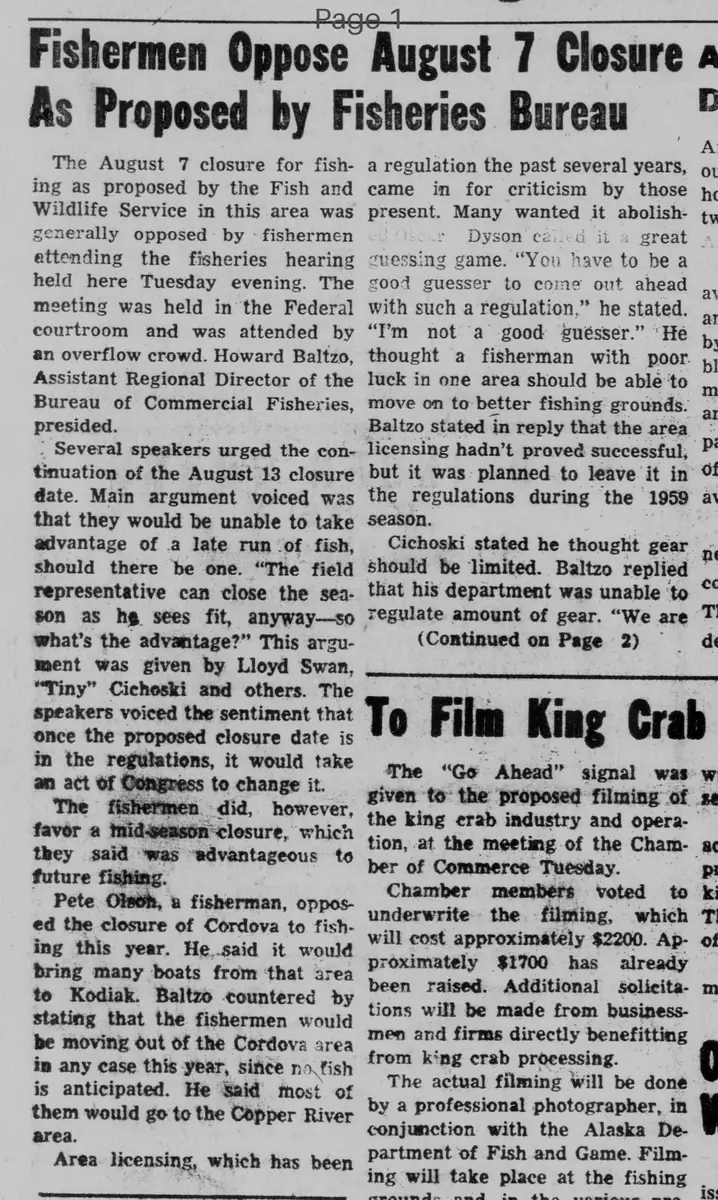
The August 7 closure for fishing as proposed by the Fish and Wildlife Service in this area was generally opposed by fishermen attending the fisheries hearing held here Tuesday evening. The meeting was held in the Federal courtroom and was attended by an overflow crowd. Howard Baltzo, Assistant Regional Director of the Bureau of Commercial Fisheries presided.
Several speakers urged the continuation of the August 13 closure date. Main argument voiced was that they would be unable to take advantage of a late run of fish, should there be one. "The field representative can close the season as he sees fit, anyway-so what's the advantage?" This argument was given by Lloyd Swan, "Tiny" Cichoski and others. The speakers voiced the sentiment that once the proposed closure date is in the regulations, it would take an act of Congress to change it.
The fishermen did, however, favor a mid season closure, which they said was advantageous to future fishing.
Pete Olson, a fisherman, opposed the closure of Cordova to fishing this year. He said it would bring many boats from that area to Kodiak. Baltzo countered by stating that the fishermen would be moving out of the Cordova area in any case this year, since no fish is anticipated. He said most of them would go to the Copper River area.
Area licensing, which has been a regulation the past several years, came in for criticism by those present. Many wanted it abolished. Dyson called it a great guessing game. "You have to be a good guesser to come out ahead with such a regulation," he stated. "I'm not a good guesser." He thought a fisherman with poor luck in one area should be able to move on to better fishing grounds.
Baltzo stated in reply that the area licensing hadn't proved successful; but it was planned to leave it in the regulations during the 1959 season.
Cichoski stated he thought gear should be limited. Baltzo replied that his department was unable to regulate amount of gear. "We are (Continued on Page 2)
FISHERMEN OPPOSE
(Continued from Page 1)
bound by the White act," he stated. "Seaton abolished fish traps for obvious political reasons," Cichoski replied. "Why can't he change that, too?" Baltzo then stated: "If we had imposed the 'grandfather clause' in the regulations four years ago, we would be in better shape today."
Beaver and sea lions were seen as predators on fish, making serious inroads on the population. DeWitt Fields and Alf Anderson thought they should be controlled, especially in certain stream areas.
Tommy Clampferr stated the sea lions are getting plentiful, and are destroying fish. "There are millions of them around Kodiak," he said. Baltzo admitted the sea lions were fish predators. "But how to control them is the problem. Studies are now being made to utilize the meat and oil from them," he said.
Chuck Connelley, FWS agent here, in his report, stated that there was 'much more gear in the water than Kodiak appears able to stand.' "By simple mathematics, it can be shown that this year's average catch per seine boat amounted to slightly over 9000 salmon, or roughly $4,000. This kind of competition to make a living is good neither for the fishery nor the fisherman," he stated. He said removal of all competing types of gear wouldn't help greatly, since the seine catch runs nearly 75% of the total. Under such pressure, maintaining our salmon calls for less and less fishing time to insure even a minimum escapement of what might be expected for a sustained yield."
Karluk and Alitak areas were the biggest producers last year, with 25% and 23% of the season's catch in these areas, according to the report. A million pinks, and 200,000 chums were taken from the former, and over a million pinks from the latter. The general district came next, with 15%, or 600,000 pinks, and 100,000 chums.
Concerning escapement in the Kodiak area, generally the showing is poor, he said. Red River held up fairly well in red escapement, but low in pinks. Karluk came out reasonably well for escapement of pinks.
Because of the relatively poor escapement in 1957, the outlook for strength in the pink salmon runs of 1959 is not encouraging, according to the Department's estimates. Two determining factors that may save the run, however, is the earlier spawning of the brood stock, followed by an exceptionally mild winter. This could possibly result in a lower egg and fry mortality of this light seeding, according to the research report.
Connelley stated that the 1956 pack totaled 240,000 cases. In 1957 it was near 345,000. This year the pack was around 322,000 cases.
The red salmon pack was up 3000 cases from last year's 15,000, he said. Karluk this year had a total run of about 464,000 reds. He attributed this increase as due in part to the Department's regulations, which are based on a principle of obtaining an even flow of escapements.
The fisheries management agent here summed up his conclusions by stating:
"Elsewhere in the Kodiak area there were no real bright spots for escapement for any of the three sustaining species, reds, pinks and chums.
The general district got an unexpected spurt of pinks and this shows up somewhat in the possibilities for 1960, but for the most part, I would say that Kodiak is definitely not 'well' for seeding stock.
Under good survival conditions, though, I feel this area can produce a run equally as good as this year and perhaps somewhat better in the 1960 show."
KODIAK MIRROR
Chuck Conkle, fisheries biologist stationed at Karluk, reported on research developments there.
Karl Brunstad, in a written report to the Bureau, lashed out at "conservation" as an end in itself. "Is it not just as 'empty'," he stated, "to conserve Alaska's precious salmon resource for the (almost sole) benefit of some foreign nation?" Referring to the import of Japanese salmon into the U.S., Brunstad stated:
"It makes a pathetic picture: Our nation is the greatest consumer of the finished product, which is being processed from material that was grown on our own soil....We grow the crop, others reap the harvest and sell it back to us. This must be rectified. If more research is needed, let us have it."
What sub-type of article is it?
What themes does it cover?
What keywords are associated?
What entities or persons were involved?
Where did it happen?
Story Details
Key Persons
Location
Kodiak, Alaska
Event Date
Tuesday Evening (1958 Implied)
Story Details
Fishermen at a Kodiak fisheries hearing oppose the proposed August 7 fishing closure by the Fish and Wildlife Service, favoring the existing August 13 date to allow for late fish runs and a mid-season closure for future benefits. They criticize area licensing as ineffective, discuss controlling predators like beavers and sea lions, and hear reports on poor salmon escapement, catches, and conservation needs.