Thank you for visiting SNEWPapers!
Sign up free
The Virginia Gazette
Richmond, Williamsburg, Richmond County, Virginia
What is this article about?
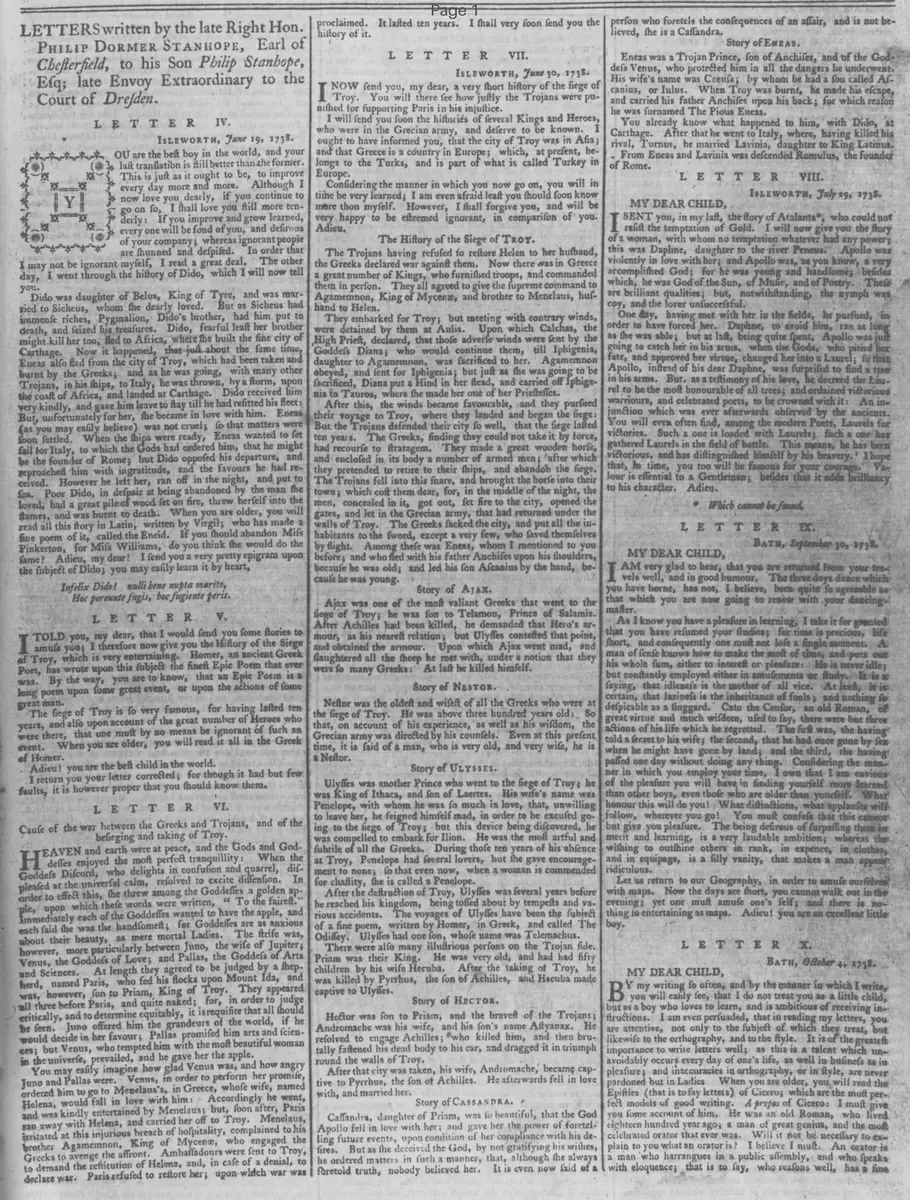
A series of educational letters from Lord Chesterfield to his young son in 1738, recounting classical myths like Dido and Aeneas, the Trojan War, heroes such as Ajax, Ulysses, Hector, and Cassandra, while offering advice on learning, virtue, time management, and eloquence, drawing from Virgil and Homer.
Merged-components note: Merged the image (reading_order 1) with the adjacent literary components (reading_orders 2 and 3) spanning pages 1-2 due to bbox overlap and textual continuation; the image likely serves as an illustration within the literary content.
Clippings
1 of 2
OCR Quality
Full Text
LETTER IV.
Isleworth, June 19, 1738.
You are the best boy in the world, and your last translation is still better than the former. This is just as it ought to be, to improve every day more and more. Although I now love you dearly, if you continue to go on so, I shall love you still more tenderly: If you improve and grow learned, every one will be fond of you, and desirous of your company; whereas ignorant people are shunned and despised. In order that I may not be ignorant myself, I read a great deal. The other day, I went through the history of Dido, which I will now tell you.
Dido was daughter of Belus, King of Tyre, and was married to Sicheus, whom she dearly loved. But as Sicheus had immense riches, Pygmalion, Dido's brother, had him put to death, and seized his treasures. Dido, fearful lest her brother might kill her too, fled to Africa, where she built the fine city of Carthage. Now it happened, that just about the same time, Aeneas also fled from the city of Troy, which had been taken and burnt by the Greeks; and as he was going, with many other Trojans, in his ships, to Italy, he was thrown, by a storm, upon the coast of Africa, and landed at Carthage. Dido received him very kindly, and gave him leave to stay till he had refitted his fleet: But, unfortunately for her, she became in love with him. Aeneas soon settled. When the ships were ready, Aeneas wanted to set sail (as you may easily believe) was not cruel; so that matters were all for Italy, to which the Gods had ordered him, that he might be the founder of Rome; but Dido opposed his departure, and reproached him with ingratitude, and the favours he had received. However he left her, ran off in the night, and put to sea. Poor Dido, in despair at being abandoned by the man she loved, had a great pile of wood set on fire, threw herself into the flames, and was burnt to death. When you are older, you will read all this story in Latin, written by Virgil; who has made a fine poem of it, called the Aeneid. If you should abandon Miss Pinkerton, for Miss Williams, do you think she would do the same? Adieu, my dear! I send you a very pretty epigram upon the subject of Dido; you may easily learn it by heart,
Infelix Dido! nulli bene juncta marito,
Hoc pereunte fleis, hoc fugiente peris.
LETTER V.
I told you, my dear, that I would send you some stories to amuse you; I therefore now give you the History of the Siege of Troy, which is very entertaining. Homer, an ancient Greek poet, has wrote upon this subject the finest Epic Poem that ever was. By the way, you are to know, that an Epic Poem is a long poem upon some great event, or upon the actions of some great man. The siege of Troy is so very famous, for having lasted ten years, and also upon account of the great number of Heroes who were there, that one must by no means be ignorant of such an event. When you are older, you will read it all in the Greek of Homer.
Adieu! you are the best child in the world. I return you your letter corrected; for though it had but few faults, it is however proper that you should know them.
LETTER VI.
Cause of the war between the Greeks and Trojans, and of the besieging and taking of Troy.
Heaven and earth were at peace, and the Gods and Goddesses enjoyed the most perfect tranquillity: When the Goddess Discord, who delights in confusion and quarrel, displeased at the universal calm, resolved to excite dissension. In order to effect this, she threw among the Goddesses a golden apple, upon which these words were written, "To the fairest." Immediately each of the Goddesses wanted to have the apple, and each said she was the handsomest; for Goddesses are as anxious about their beauty, as mere mortal Ladies. The strife was, however, more particularly between Juno, the wife of Jupiter; Venus, the Goddess of Love; and Pallas, the Goddess of Arts and Sciences. At length they agreed to be judged by a shepherd, named Paris, who fed his flocks upon Mount Ida, and was, however, son to Priam, King of Troy. They appeared all three before Paris, and quite naked; for, in order to judge critically, and to determine equitably, it is requisite that all should be seen. Juno offered him the grandeurs of the world, if he would decide in her favour; Pallas promised him arts and sciences; but Venus, who tempted him with the most beautiful woman in the universe, prevailed, and he gave her the apple. You may easily imagine how glad Venus was, and how angry Juno and Pallas were. Venus, in order to perform her promise, ordered him to go to Menelaus's, in Greece, whose wife, named Helena, would fall in love with him: Accordingly he went, and was kindly entertained by Menelaus; but, soon after, Paris ran away with Helena, and carried her off to Troy. Menelaus, irritated at this injurious breach of hospitality, complained to his brother Agamemnon, King of Mycenae, who engaged the Greeks to avenge the affront. Ambassadors were sent to Troy, to demand the restitution of Helena, and, in case of a denial, to declare war. Paris refused to restore her; upon which war was proclaimed. It lasted ten years. I shall very soon send you the history of it.
LETTER VII.
Isleworth, June 30, 1738.
I now send you, my dear, a very short history of the siege of Troy. You will there see how justly the Trojans were punished for supporting Paris in his injustice. I will send you soon the histories of several Kings and Heroes, who were in the Grecian army, and deserve to be known. I ought to have informed you, that the city of Troy was in Asia; and that Greece is a country in Europe; which, at present, belongs to the Turks, and is part of what is called Turkey in Europe.
Considering the manner in which you now go on, you will in time be very learned; I am even afraid lest you should soon know more than myself. However, I shall forgive you, and will be very happy to be esteemed ignorant, in comparison of you.
Adieu,
The History of the Siege of Troy.
The Trojans having refused to restore Helen to her husband, the Greeks declared war against them. Now there was in Greece a great number of Kings, who furnished troops, and commanded them in person. They all agreed to give the supreme command to Agamemnon, King of Mycenae, and brother to Menelaus, husband to Helen.
They embarked for Troy; but meeting with contrary winds, were detained by them at Aulis. Upon which Calchas, the High Priest, declared, that those adverse winds were sent by the Goddess Diana; who would continue them, till Iphigenia, daughter to Agamemnon, was sacrificed to her. Agamemnon obeyed, and sent for Iphigenia; but just as she was going to be sacrificed, Diana put a Hind in her stead, and carried off Iphigenia to Tauris, where she made her one of her Priestesses.
After this, the winds became favourable, and they pursued their voyage to Troy, where they landed and began the siege: But the Trojans defended their city so well, that the siege lasted ten years. The Greeks, finding they could not take it by force, had recourse to stratagem. They made a great wooden horse, and enclosed in its body a number of armed men; after which they pretended to retire to their ships, and abandon the siege. The Trojans fell into this snare, and brought the horse into their town; which cost them dear, for, in the middle of the night, the men, concealed in it, got out, set fire to the city, opened the gates, and let in the Grecian army, that had returned under the walls of Troy. The Greeks sacked the city, and put all the inhabitants to the sword, except a very few, who saved themselves by flight. Among these was Aeneas, whom I mentioned to you before; and who fled with his father Anchises upon his shoulders, because he was old; and led his son Ascanius by the hand, because he was young.
Story of Ajax.
Ajax was one of the most valiant Greeks that went to the siege of Troy: he was son to Telamon, Prince of Salamis. After Achilles had been killed, he demanded that Hero's armour, as his nearest relation; but Ulysses contested that point, and obtained the armour. Upon which Ajax went mad, and slaughtered all the sheep he met with, under a notion that they were so many Greeks: At last he killed himself.
Story of Nestor.
Nestor was the oldest and wisest of all the Greeks who were at the siege of Troy. He was above three hundred years old: So that, on account of his experience, as well as his wisdom, the Grecian army was directed by his counsels. Even at this present time, it is said of a man, who is very old, and very wise, he is a Nestor.
Story of Ulysses.
Ulysses was another Prince who went to the siege of Troy; he was King of Ithaca, and son of Laertes. His wife's name was Penelope, with whom he was so much in love, that, unwilling to leave her, he feigned himself mad, in order to be excused going to the siege of Troy; but this device being discovered, he was compelled to embark for Ilion. He was the most artful and subtle of all the Greeks. During those ten years of his absence at Troy, Penelope had several lovers, but she gave encouragement to none; so that even now, when a woman is commended for chastity, she is called a Penelope.
After the destruction of Troy, Ulysses was several years before he reached his kingdom, being tossed about by tempests and various accidents. The voyages of Ulysses have been the subject of a fine poem, written by Homer, in Greek, and called The Odyssey. Ulysses had one son, whose name was Telemachus.
There were also many illustrious persons on the Trojan side. Priam was their King. He was very old, and had had fifty children by his wife Hecuba. After the taking of Troy, he was killed by Pyrrhus, the son of Achilles, and Hecuba made captive to Ulysses.
Story of Hector.
Hector was son to Priam, and the bravest of the Trojans; Andromache was his wife, and his son's name Astyanax. He resolved to engage Achilles; who killed him, and then brutally fastened his dead body to his car, and dragged it in triumph round the walls of Troy.
After that city was taken, his wife, Andromache, became captive to Pyrrhus, the son of Achilles. He afterwards fell in love with, and married her.
Story of Cassandra.
Cassandra, daughter of Priam, was so beautiful, that the God Apollo fell in love with her; and gave her the power of foretelling future events, upon condition of her compliance with his desires. But as she deceived the God, by not gratifying his wishes, he ordered matters in such a manner, that, although she always foretold truth, nobody believed her. It is even now said of a person who foretels the consequences of an affair, and is not believed, he is a Cassandra.
Story of Aeneas.
Aeneas was a Trojan Prince, son of Anchises, and of the Goddess Venus, who protected him in all the dangers he underwent. His wife's name was Creusa; by whom he had a son called Ascanius, or Iulus. When Troy was burnt, he made his escape and carried his father Anchises upon his back; for which reason he was surnamed The Pious Aeneas.
You already know what happened to him, with Dido, at Carthage. After that he went to Italy, where, having killed his rival, Turnus, he married Lavinia, daughter to King Latinus. From Aeneas and Lavinia was descended Romulus, the founder of Rome.
LETTER VIII.
Isleworth, July 29, 1738.
MY DEAR CHILD,
I sent you, in my last, the story of Atalanta, who could not resist the temptation of Gold. I will now give you the story of a woman, with whom no temptation whatever had any power: this was Daphne, daughter to the river Peneus. Apollo was violently in love with her; and Apollo was, as you know, a very accomplished God; for he was young and handsome; besides which, he was God of the Sun, of Music, and of Poetry. These are brilliant qualities; but, notwithstanding, the nymph was coy, and the lover unsuccessful.
One day, having met with her in the fields, he pursued, in order to have forced her. Daphne, to avoid him, ran as long as she was able; but at last, being quite spent, Apollo was just going to catch her in his arms, when the Gods, who pitied her fate, and approved her virtue, changed her into a Laurel; so that Apollo, instead of his dear Daphne, was surprised to find a tree in his arms. But, as a testimony of his love, he decreed the Laurel to be the most honourable of all trees; and ordained victorious warriors, and celebrated poets, to be crowned with it: An injunction which was ever afterwards observed by the ancients.
You will even often find, among the modern Poets, Laurels for victories. Such a one is loaded with Laurels; such a one has gathered Laurels in the field of battle. This means, he has been victorious, and has distinguished himself by his bravery. I hope that, in time, you too will be famous for your courage. Valour is essential to a Gentleman; besides that it adds brilliancy to his character.
Adieu.
Which cannot be found.
LETTER IX.
Bath, September 30, 1738.
MY DEAR CHILD,
I am very glad to hear, that you are returned from your travels well, and in good humour. The three days dance which you have borne, has not, I believe, been quite so agreeable as that which you are now going to renew with your dancing-master.
As I know you have a pleasure in learning, I take it for granted that you have resumed your studies; for time is precious, life short, and consequently one must not lose a single moment. A man of sense knows how to make the most of time, and puts out his whole sum, either to interest or pleasure: He is never idle; but constantly employed either in amusements or study. It is saying, that idleness is the mother of all vice. At least, it is certain, that laziness is the inheritance of fools; and nothing so despicable as a sluggard. Cato the Censor, an old Roman, of great virtue and much wisdom, used to say, there were but three actions of his life which he regretted. The first was, the having told a secret to his wife; the second, that he had once gone by sea when he might have gone by land; and the third, the having passed one day without doing any thing. Considering the manner in which you employ your time, I own that I am envious of the pleasure you will have in finding yourself more learned than other boys, even those who are older than yourself. What honour this will do you! What distinctions, what applauses will follow, wherever you go! You must confess that this cannot but give you pleasure. The being desirous of surpassing them in merit and learning, is a very laudable ambition; whereas those wishing to outshine others in rank, in expense, in clothes, and in equipage, is a silly vanity, that makes a man appear ridiculous.
Let us return to our Geography, in order to amuse ourselves with maps. Now the days are short, you cannot walk out in the evening; yet one must amuse one's self; and there is nothing so entertaining as maps.
Adieu! you are an excellent little boy.
LETTER X.
Bath, October 4 1738.
MY DEAR CHILD,
By my writing so often, and by the manner in which I write, you will easily see, that I do not treat you as a little child, but as a boy who loves to learn, and is ambitious of receiving instructions. I am even persuaded, that in reading my letters, you are attentive, not only to the subject of which they treat, but likewise to the orthography, and to the style. It is of the greatest importance to write letters well; as this is a talent which unavoidably occurs every day of one's life, as well in business as in pleasure; and inaccuracies in orthography, or in style, are never pardoned but in Ladies. When you are older, you will read the Epistles (that is to say letters) of Cicero; which are the most perfect models of good writing. A propos of Cicero: I must give you some account of him. He was an old Roman, who lived eighteen hundred years ago; a man of great genius, and the most celebrated orator that ever was. Will it not be necessary to explain to you what an orator is? I believe I must. An orator is a man who harangues in a public assembly, and who speaks with eloquence; that is to say, who reasons well, has a fine
style, and chooses his words properly. Now, never man succeeded better than Cicero, in all those different points: He used sometimes to speak to the whole people of Rome assembled; and by the force of his eloquence, persuaded them to whatever he pleased. At other times, he used to undertake causes, and plead for his clients in courts of judicature: And in those causes he generally had all the suffrages, that is to say, all the opinions, all the decisions, in his favour. While the Roman Republic enjoyed its freedom, he did very signal services to his country; but after it was enslaved by Julius Caesar, the first Emperor of the Romans, Cicero became suspected by the tyrants; and was at last put to death by order of Marc Antony, who hated him for the severity of his orations against him, at the time that he endeavoured to obtain the sovereignty of Rome.
In case there should be any words in my letters which you do not perfectly understand, remember always to inquire the explanation of your Mamma, or else to seek for them in the dictionary.
Adieu.
What sub-type of article is it?
What themes does it cover?
What keywords are associated?
What entities or persons were involved?
Literary Details
Title
Letters To His Son
Author
The Late Right Hon. Philip Dormer Stanhope, Earl Of Chesterfield
Subject
Educational Instruction Through Classical Myths And Moral Advice
Form / Style
Epistolary Prose With Embedded Mythological Narratives
Key Lines