Thank you for visiting SNEWPapers!
Sign up free
Daily National Intelligencer
Washington, District Of Columbia
What is this article about?
Mr. Wendover delivers a speech in the U.S. House of Representatives advocating for a bill to alter the U.S. flag, proposing to return to 13 stripes representing the original states while using stars for current and future states, to maintain symbolism and practicality amid growing states.
Merged-components note: These two components are sequential in reading order and contain the continuous remarks of Mr. Wendover on the flag bill, requiring merge for coherence.
Clippings
1 of 2
OCR Quality
Full Text
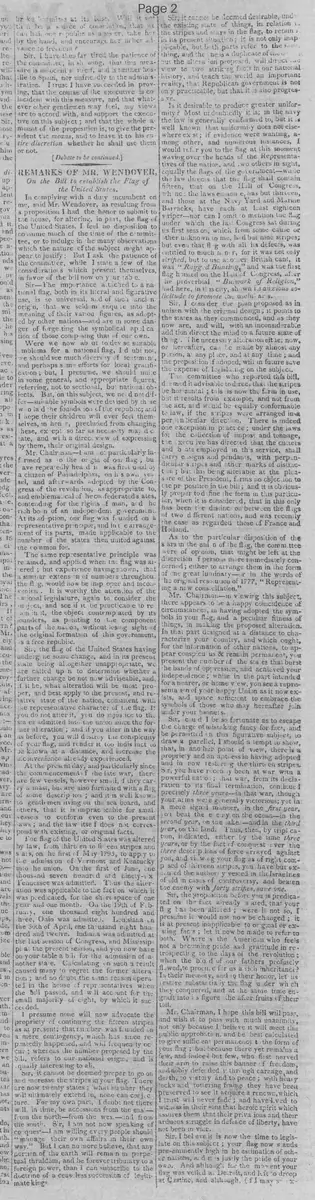
On the Bill to establish the Flag of the United States.
In complying with a duty incumbent on me, said Mr. Wendover, as resulting from a proposition I had the honor to submit to the house, for altering, in part, the flag of the United States, I feel no disposition to consume much of the time of the committee, or to indulge in the many observations which the nature of the subject might appear to justify: But I ask the patience of the committee, while I state a few of the considerations which present themselves, in favor of the bill now on your table.
Sir—the importance attached to a national flag, both in its literal and figurative use, is so universal, and of such ancient origin, that we seldom enquire into the meaning of their various figures, as adopted by other nations—and are in some danger of forgetting the symbolical application of those composing that of our own. Were we now about to devise suitable emblems for a national flag, I doubt not, we should see much diversity of sentiment, and perhaps some efforts for local gratification; but, I presume, we should unite in some general, and appropriate figures, referring, not to sectional, but national objects. But, on this subject, we need not differ—suitable symbols were devised by those who laid the foundation of the republic: and I hope their children will ever feel themselves, in honor, precluded from changing these, except so far as necessity may dictate, and with a direct view of expressing by them, their original design.
Mr. Chairman—I am not particularly informed as to the origin of our flag, but have repeatedly heard it was first used by a citizen of Philadelphia, on his own vessel, and afterwards adopted by the Congress of the revolution, as appropriate to, and emblematical of the confederated states, contending for the rights of man, and the rich boon of an independent government. At its adoption, our flag was founded on a representative principle, and the arrangement of its parts, made applicable to the number of the states then united against the common foe.
The same representative principle was retained, and applied when the flag was altered; but experience having shown, that a similar extension of numbers throughout the flag, would now be improper and inconvenient. It is worthy the attention of the national legislature, again to consider the subject, and see if it be practicable to restore in it, the object contemplated by its founders, as pointing to the component parts of the nation, without losing sight of the original formation of this government, as a free republic.
Sir, the flag of the United States having undergone some change, and in its present state being altogether inappropriate, we are called upon to determine whether a further change be not now advisable, and, if it be, what alteration will be most proper, and best apply to the present, and relative state of the nation, consistent with the representative character of the flag. If you do not alter it, you do injustice to the states admitted into the union since the former alteration; and if you alter in the way as before, you will destroy the conspicuity of your flag, and render it too indistinct to be known at a distance, and increase the inconvenience already experienced.
At the present day, and particularly since the commencement of the late war, there are few vessels, however small, if they carry a mast, but are also furnished with a flag of some description; and it is well known to gentlemen living on the sea board, and others, that it is impracticable for small vessels to conform even to the present laws; and the law itself does not correspond with existing, or original facts.
The flag of the United States was altered by law, from thirteen to fifteen stripes and stars, on the first of May 1795, to apply to the admission of Vermont and Kentucky into the union. On the first of June, one thousand seven hundred and ninety-six Tennessee was admitted. Thus the alteration was applicable to the fact on which it was predicated, for the short space of one year and one month. On the 19th of February, one thousand eight hundred and three, Ohio was admitted. Louisiana on the 30th of April, one thousand eight hundred and twelve. Indiana was admitted at the last session of Congress, and Mississippi at the present session, and you now have on your table a bill, for the admission of another state. Calculating on such a result caused many to regret the former alteration; and no doubt the same reason operated in the house of representatives when the bill passed, and will account for the small majority of eight, by which it succeeded.
I presume none will now advocate the propriety of continuing the fifteen stripes as at present; that number was founded on a mere contingency, which has since repeatedly happened, and will frequently occur; whereas the number proposed by the bill, refers to our national origin, and is equally interesting to all.
Sir, it cannot be deemed proper to go on and increase the stripes in your flag. There are now twenty states; what number they will ultimately extend to, none can conjecture. For my own part, I doubt not there will, in time, be accessions from the east—from the north—from the west—and from the south. Sir, I am not now speaking of conquest—I am willing every people should "manage their own affairs in their own way." But I can no more believe, that any portion of the earth will remain in perpetual thraldom, and be forever tributary to a foreign power, than I can subscribe to the doctrine of a ceaseless succession of legitimate kings.
Sir, it cannot be deemed desirable, under the existing state of things, in relation to the stripes and stars in the flag, to retain it in its present situation; it is not only inapplicable, but both parts refer to the same thing, and the one is a duplicate of the other. But the alteration proposed, will direct the view to two striking facts in our national history, and teach the world an important reality, that Republican government is not only practicable, but that it is also progressive.
Is it desirable to produce greater uniformity? Most undoubtedly it is; in the navy the law is generally conformed to, but it is well known that uniformity does not elsewhere exist; if evidence were wanting, among other, and numerous instances, I would refer you to the flag at this moment waving over the heads of the Representatives of the nation, and two others in sight, equally the flags of the government—while the law directs that the flag shall contain fifteen, that on the Hall of Congress, which the laws enacts, has but thirteen, and those at the Navy Yard and Marine Barracks, have each at least eighteen stripes—nor can I omit to mention the flag under which the last Congress sat during its first session, which from some cause or other unknown to me, had but nine stripes; but even that flag with all its defects, was entitled to much honor, for it was not only striped, but to use another British cant, it was "Rugged Bunting," and was the first flag hoisted on the Hall of Congress, after the proverbial "Bulwark of Religion" had here, in this city, shown its anxious solicitude to promote the useful arts.
Sir, I consider the plan proposed as in unison with the original design; it points to the states as they commenced, and as they now are, and will, with an inconsiderable addition direct the mind to a future state of things. The necessary alteration either now, or hereafter, can be made by almost any person, at any place, and at any time; and the proposition if adopted, will in future save the expense of legislating on the subject.
The committee who reported this bill, deemed it advisable to direct that the stripes be horizontal; this is now the form in use, but it results from example, and not from the act, and would be equally conformable to law, if the stripes were arranged in a perpendicular direction. There is indeed one exception in practice; under the laws for the collection of impost and tonnage, the executive has directed that the cutters and boats employed in this service, shall carry ensigns and pennants, with perpendicular stripes and other marks of distinction; but this being alterable at the pleasure of the President, forms no objection to the proposition in the bill; and it is obviously proper to define the form in this particular, when it is considered, that in this only has been the distinction between the flags of two different nations, and was recently the case as regarded those of France and Holland.
As to the particular disposition of the stars in the union of the flag, the committee were of opinion, that might be left at the discretion of persons more immediately concerned; either to arrange them in the form of one great luminary—or in the words of the original resolution of 1777, "Representing a new constellation."
Mr. Chairman—in viewing this subject, there appears to be a happy coincidence of circumstances, in having adopted the symbols in your flag, and a peculiar fitness of things, in making the proposed alteration. In that part designed at a distance to characterize your country, and which ought, for the information of other nations, to appear conspicuous & remain permanent, you present the number of the states that burst the bands of oppression, and achieved your independence; while in the part intended for a nearer, or home view, you see a representation of your happy Union as it now exists, and space sufficient to embrace the symbols of those who may hereafter join under your banners.
Sir, could I be so fortunate as to escape the charge of mistaking fancy for fact, and be permitted in this figurative subject, to draw a parallel, I should attempt to show, that, in another point of view, there is a propriety and an aptness in having adopted and in now restoring the thirteen stripes. Sir, you have recently been at war with a powerful nation; that war, from its declaration to its final termination, continued precisely three years—in that war, though your arms were generally victorious; yet in a more signal manner, in the first year, you beat the enemy on the ocean—in the second year, on the lakes—and in the third year, on the land. Thus, then, by triplication, indicated, either by the time three years, or by the fact of conquest over the three descriptions of force arrayed against you, and viewing your flag as of right composed of thirteen stripes, you have but executed the authority vested in the Israelites of old in cases of controversy, and beaten the enemy with forty stripes, save one.
Sir, the proposition before you is predicated on the fact already stated, that your flag has been altered; were it not so, I presume it would not now be changed; it is at present inapplicable to original or existing facts; let it now be made to refer to both. Where is the American who feels not a becoming pride and gratitude in retrospecting to the days of the revolution; when the blood of our fathers profusely flowed, to procure for us a rich inheritance? In their memory, and to their honor, let us restore substantially the flag under which they conquered, and at the same time engraft into its figure the after fruits of their toil.
Mr. Chairman, I hope this bill will pass, and wish it to pass with much unanimity, not only because I believe it will meet the public approbation, and be best calculated to give sufficient permanency to the form of your flag; but because there yet remains a few, and indeed but few, who first nerved their arm to raise this banner of freedom, and nobly defended it through carnage, and death, to victory and to peace; with hoary locks and tottering frame they have been preserved to see it acquire a renown, which I trust will never fade; and have lived to witness in their sons that heroic spirit which assures them that their privations and their arduous struggle in defence of liberty, have not been in vain.
Sir, I believe it is now the time to legislate on this subject; your flag now stands pre-eminently high in the estimation of other nations, and it is justly the pride of your own. And although for the moment your flag was veiled at Detroit, and left to droop at Castine, and although, (if I may so express it) it was for a time furled at New Orleans, yet it has since been unfurled to victory, and now floats in triumph over the land and over the main.
press it; it was made to weep at Washington, it has not lost its lustre; it remains unsullied. No disgrace has attached to your "star-spangled banner." It has been the signal of victory on the land—of successful valor on the lakes—and waved triumphantly on the ocean. And even on those who predicted, that in "nine months the striped bunting would be swept from the ocean," it possessed the wonderful charm, that before the nine months had elapsed, "fir-built frigates" and "Yankee cock boats" were magnified into "ships of the line," and his majesty's faithful officers, careful for the preservation of British Oak, sought protection for their frigates under the convoy of seventy-four gun ships.
Sir, this subject has for some time been before the public; it has been examined and approved by many gentlemen of rank and experience in the navy and army of the United States; it meets the approbation of the gentlemen at the head of these departments; and, as far as I am informed, that of the public generally; and I presume none will doubt the propriety of endeavoring to produce greater uniformity in the use of the flag, as well as to give it a more significant application than it now has.
But, sir, whatever be the fate of this bill, I hope the time is not distant, when you will give to your flag its deserved honor, as the guardian of your citizens: When your hardy seamen shall no longer be doomed to the degradation to ask for, nor you to give them, paper protections: But, when they shall point aloft to the flag of their country and say—"This is the protection of Freemen—under this we desire peacefully to traverse the Ocean, and sail to every clime; but perish the arm that shall attempt to seize upon our persons; and woe to the nation that shall dare to infringe our country's rights." And whenever called to the contest by the voice of their country, may they rally round the "star-spangled banner," and emphatically exclaim—
High waving, unsullied, unstruck, proudly showeth,
What each friend, and each foe, and each neutral well knoweth:
That her path is ethereal, high she aspires.
Joined with Stars, "They astonish, dismay or delight,
Her stripes aloft streaming, like boreal fires;"
As the foe, or the friend, may encounter the sight."
Mr. Chairman, I shall add no more; the subject is plain, and well understood; and though not of a character to be classed with those of the highest national importance, is still proper to be acted on, and worthy the attention of the representatives of a people, whose flag will never be insulted for want of protectors, and which, I hope and believe, will never be struck to an inferior or equal force.
What sub-type of article is it?
What keywords are associated?
What entities or persons were involved?
Where did it happen?
Domestic News Details
Primary Location
U.S. House Of Representatives
Key Persons
Event Details
Mr. Wendover speaks in favor of a bill to alter the U.S. flag by returning to 13 stripes for the original states and using stars to represent current and future states, arguing for symbolism, practicality, uniformity, and historical significance amid the admission of new states.