Thank you for visiting SNEWPapers!
Sign up free
Editorial
June 17, 1806
The New Hampshire Gazette
Portsmouth, Rockingham County, New Hampshire
What is this article about?
Editorial from Baltimore Evening Post debunks rumor of Napoleon demanding US embargo on Britain, criticizes opposition for anti-Jefferson insinuations, justifies potential interdiction of British commerce due to US grievances, but strongly advocates peace, commerce, and avoiding war while maintaining independence.
Clipping
OCR Quality
95%
Excellent
Full Text
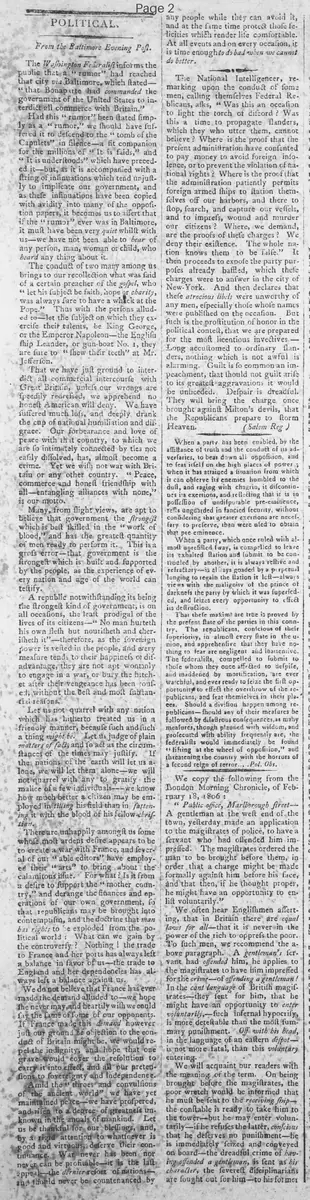
POLITICAL.
From the Baltimore Evening Post.
The Washington Federalist informs the public that a "rumor" had reached that city via Baltimore, which stated—
"that Bonaparte had commanded the government of the United States to interdict all commerce with Britain."
Had this "rumor" been stated simply as a "rumor," we should have suffered it to descend to the "tomb of the Capulets" in silence—a fit companion for the millions of "It is saids," and "It is understoods" which have preceded it—but, as it is accompanied with a string of insinuations which tend unjustly to implicate our government, and as these insinuations have been copied with avidity into many of the opposition papers, it becomes us to assert that if the "rumor" ever was in Baltimore, it must have been very quiet whilst with us—we have not been able to hear of any person, man, woman or child, who heard anything about it.
The conduct of too many among us brings to our recollection what was said of a certain preacher of the gospel, who "let his subject be faith, hope or charity, was always sure to have a whack at the Pope." Thus with the persons alluded to—let the subject on which they exercise their talents, be King George, or the Emperor Napoleon—the English ship Leander, or gun-boat No. I, they are sure to "show their teeth" at Mr. Jefferson.
That we have just ground to interdict all commercial intercourse with Great Britain, unless our wrongs are speedily redressed, we apprehend no honest American will deny. We have suffered much loss, and deeply drank the cup of national humiliation and disgrace. Our forbearance and love of peace with this country, to which we are so intimately connected by ties not easily dissolved, has almost become a crime. Yet we wish not war with Britain or any other country. "Peace, commerce and honest friendship with all—entangling alliances with none," is our motto.
Many, from slight views, are apt to believe that government the strongest which is best skilled in the "work of blood," and has the greatest quantity of men ready to perform it. This is a gross error—that government is the strongest which is built and supported by the people, as the experience of every nation and age of the world can testify.
A republic notwithstanding its being the strongest kind of government, is on all occasions, the least prodigal of the lives of its citizens—"No man hurteth his own flesh but nourisheth and cherisheth it"—therefore, as the sovereign power is vested in the people, and every measure tends to their happiness or disadvantage, they are not apt wantonly to engage in a war, or bury the hatchet after their vengeance has been roused, without the best and most substantial reasons.
Let us not quarrel with any nation which has hitherto treated us in a friendly manner, because such and such a thing might be." Let us judge of plain matters of fact, and so act as the circumstances of the times may justify. If the nations of the earth will let us alone, we will let them alone—we will not quarrel with any to gratify the malice of a few individuals—we know how much better a citizen may be employed in tilling his field than in fattening it with the blood of his fellow-Christian.
There are unhappily amongst us some whose most ardent desire appears to be to create a war with France, and several of our "able editors" have employed their "arts" to bring about the calamitous issue. For what? Is it from a desire to support the "mother country," and derange the finances and operations of our own government, so that republicans may be brought into contempt, and the doctrine that man has rights to be exploded from the political world? What can we gain by the controversy? Nothing! the trade to France and her ports has always left a balance in favor of us—the trade to England and her dependencies has always left a balance against us.
We do not believe that France has ever made the demand alluded to—we hope she never may, and heartily wish we could say the same of some of our opponents. If France made this demand however just our ground of objection to the conduct of Britain might be, we would repel the indignity, and hope that one grave would cover the resolution to carry it into effect, and all our pretensions to sovereignty and independence.
Amid the "throes and convulsions of the ancient world" we have yet maintained peace—we have prospered, and risen to a degree of greatness unknown in the annals of mankind. Let us be thankful for our blessings, and, by a rigid attention to whatsoever is good and virtuous, deserve their continuance. War never has been nor never can be profitable—it is the last appeal—the dernier resort of nations and should never be countenanced by any people while they can avoid it and at the same time protect those felicities which render life comfortable. At all events and on every occasion, it is time enough to do bad when we cannot do better.
From the Baltimore Evening Post.
The Washington Federalist informs the public that a "rumor" had reached that city via Baltimore, which stated—
"that Bonaparte had commanded the government of the United States to interdict all commerce with Britain."
Had this "rumor" been stated simply as a "rumor," we should have suffered it to descend to the "tomb of the Capulets" in silence—a fit companion for the millions of "It is saids," and "It is understoods" which have preceded it—but, as it is accompanied with a string of insinuations which tend unjustly to implicate our government, and as these insinuations have been copied with avidity into many of the opposition papers, it becomes us to assert that if the "rumor" ever was in Baltimore, it must have been very quiet whilst with us—we have not been able to hear of any person, man, woman or child, who heard anything about it.
The conduct of too many among us brings to our recollection what was said of a certain preacher of the gospel, who "let his subject be faith, hope or charity, was always sure to have a whack at the Pope." Thus with the persons alluded to—let the subject on which they exercise their talents, be King George, or the Emperor Napoleon—the English ship Leander, or gun-boat No. I, they are sure to "show their teeth" at Mr. Jefferson.
That we have just ground to interdict all commercial intercourse with Great Britain, unless our wrongs are speedily redressed, we apprehend no honest American will deny. We have suffered much loss, and deeply drank the cup of national humiliation and disgrace. Our forbearance and love of peace with this country, to which we are so intimately connected by ties not easily dissolved, has almost become a crime. Yet we wish not war with Britain or any other country. "Peace, commerce and honest friendship with all—entangling alliances with none," is our motto.
Many, from slight views, are apt to believe that government the strongest which is best skilled in the "work of blood," and has the greatest quantity of men ready to perform it. This is a gross error—that government is the strongest which is built and supported by the people, as the experience of every nation and age of the world can testify.
A republic notwithstanding its being the strongest kind of government, is on all occasions, the least prodigal of the lives of its citizens—"No man hurteth his own flesh but nourisheth and cherisheth it"—therefore, as the sovereign power is vested in the people, and every measure tends to their happiness or disadvantage, they are not apt wantonly to engage in a war, or bury the hatchet after their vengeance has been roused, without the best and most substantial reasons.
Let us not quarrel with any nation which has hitherto treated us in a friendly manner, because such and such a thing might be." Let us judge of plain matters of fact, and so act as the circumstances of the times may justify. If the nations of the earth will let us alone, we will let them alone—we will not quarrel with any to gratify the malice of a few individuals—we know how much better a citizen may be employed in tilling his field than in fattening it with the blood of his fellow-Christian.
There are unhappily amongst us some whose most ardent desire appears to be to create a war with France, and several of our "able editors" have employed their "arts" to bring about the calamitous issue. For what? Is it from a desire to support the "mother country," and derange the finances and operations of our own government, so that republicans may be brought into contempt, and the doctrine that man has rights to be exploded from the political world? What can we gain by the controversy? Nothing! the trade to France and her ports has always left a balance in favor of us—the trade to England and her dependencies has always left a balance against us.
We do not believe that France has ever made the demand alluded to—we hope she never may, and heartily wish we could say the same of some of our opponents. If France made this demand however just our ground of objection to the conduct of Britain might be, we would repel the indignity, and hope that one grave would cover the resolution to carry it into effect, and all our pretensions to sovereignty and independence.
Amid the "throes and convulsions of the ancient world" we have yet maintained peace—we have prospered, and risen to a degree of greatness unknown in the annals of mankind. Let us be thankful for our blessings, and, by a rigid attention to whatsoever is good and virtuous, deserve their continuance. War never has been nor never can be profitable—it is the last appeal—the dernier resort of nations and should never be countenanced by any people while they can avoid it and at the same time protect those felicities which render life comfortable. At all events and on every occasion, it is time enough to do bad when we cannot do better.
What sub-type of article is it?
Foreign Affairs
War Or Peace
Partisan Politics
What keywords are associated?
Napoleon Bonaparte
British Commerce Interdiction
War Avoidance
Jefferson Defense
Republican Peace Policy
Opposition Rumors
French Relations
What entities or persons were involved?
Bonaparte
Mr. Jefferson
Great Britain
France
Opposition Papers
Editorial Details
Primary Topic
Debunking Rumor Of French Demand To Embargo Britain And Advocating Peace
Stance / Tone
Pro Peace, Defensive Of Us Government Against Opposition Criticism
Key Figures
Bonaparte
Mr. Jefferson
Great Britain
France
Opposition Papers
Key Arguments
The Rumor Of Bonaparte Commanding Us To Interdict Commerce With Britain Is Unfounded And Unheard In Baltimore.
Opposition Papers Unjustly Implicate The Us Government And Always Attack Jefferson.
Us Has Grounds To Interdict British Commerce If Wrongs Are Not Redressed, But Prefers Peace.
Republican Government Is Strongest When Supported By The People And Avoids Unnecessary War.
Some Seek War With France To Undermine Republicans And Support Britain, But Trade Favors France.
France Likely Never Made The Demand; Us Would Repel It To Preserve Independence.
Maintain Peace Amid Global Turmoil For Prosperity; War Is The Last Resort.