Thank you for visiting SNEWPapers!
Sign up free
Editorial
June 3, 1961
The Herald
Savannah, Chatham County, Georgia
What is this article about?
This editorial emphasizes the critical role of education in preparing students for a competitive, rapidly changing society, particularly the space age. It argues that formal training must adapt to future challenges, highlighting increasing enrollment, expenditures, and the need for forward-thinking curricula to ensure graduates' success.
Clipping
OCR Quality
95%
Excellent
Full Text
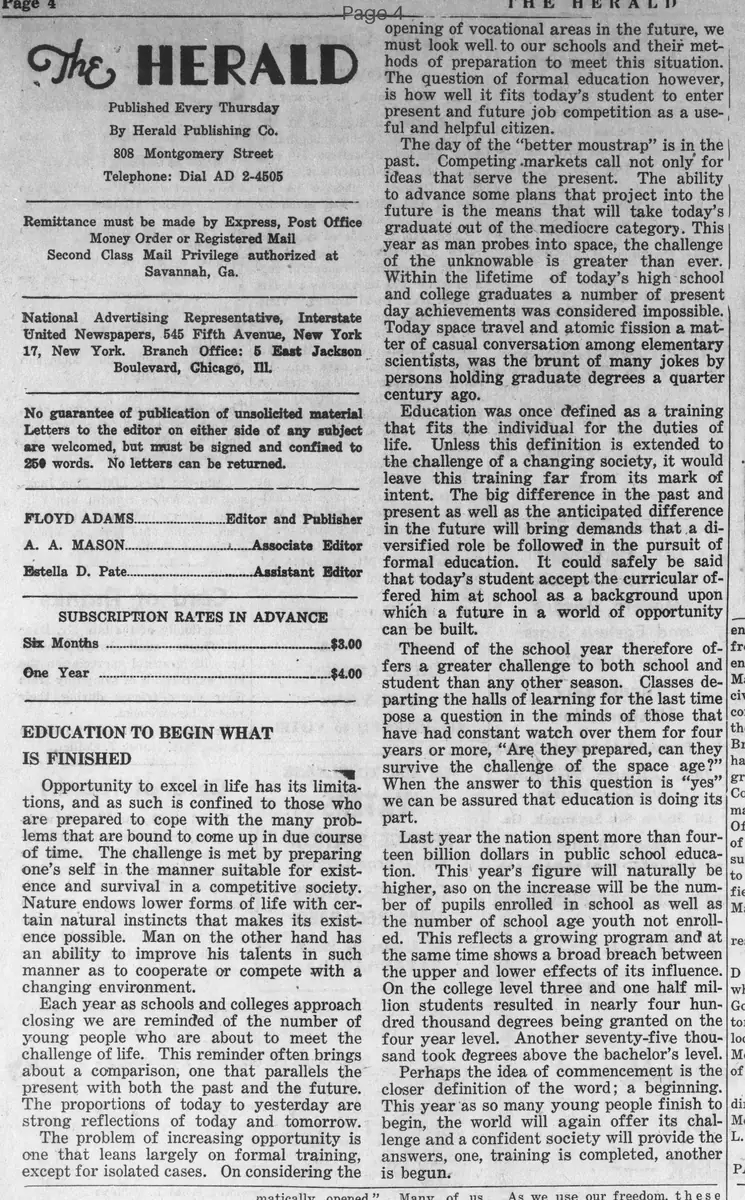
EDUCATION TO BEGIN WHAT IS FINISHED
Opportunity to excel in life has its limitations, and as such is confined to those who are prepared to cope with the many problems that are bound to come up in due course of time. The challenge is met by preparing one's self in the manner suitable for existence and survival in a competitive society.
Nature endows lower forms of life with certain natural instincts that makes its existence possible. Man on the other hand has an ability to improve his talents in such manner as to cooperate or compete with a changing environment.
Each year as schools and colleges approach closing we are reminded of the number of young people who are about to meet the challenge of life. This reminder often brings about a comparison, one that parallels the present with both the past and the future.
The proportions of today to yesterday are strong reflections of today and tomorrow.
The problem of increasing opportunity is one that leans largely on formal training, except for isolated cases. On considering the opening of vocational areas in the future, we must look well to our schools and their methods of preparation to meet this situation.
The question of formal education however, is how well it fits today's student to enter present and future job competition as a useful and helpful citizen.
The day of the "better mousetrap" is in the past. Competing markets call not only for ideas that serve the present. The ability to advance some plans that project into the future is the means that will take today's graduate out of the mediocre category. This year as man probes into space, the challenge of the unknowable is greater than ever.
Within the lifetime of today's high-school and college graduates a number of present day achievements was considered impossible.
Today space travel and atomic fission are a matter of casual conversation among elementary scientists that was the brunt of many jokes by persons holding graduate degrees a quarter century ago.
Education was once defined as a training that fits the individual for the duties of life. Unless this definition is extended to the challenge of a changing society it would leave this training far from its mark of intent. The big difference in the past and present as well as the anticipated difference in the future will bring demands that a diversified role be followed in the pursuit of formal education. It could safely be said that today's student accept the curricular offered him at school as a background upon which a future in a world of opportunity can be built.
The end of the school year therefore offers a greater challenge to both school and student than any other season. Classes departing the halls of learning for the last time pose a question in the minds of those that have had constant watch over them for four years or more, "Are they prepared, can they survive the challenge of the space age?"
When the answer to this question is "yes" we can be assured that education is doing its part.
Last year the nation spent more than fourteen billion dollars in public school education. This year's figure will naturally be higher, as on the increase will be the number of pupils enrolled in school as well as the number of school age youth not enrolled. This reflects a growing program and at the same time shows a broad breach between the upper and lower effects of its influence.
On the college level three and one half million students resulted in nearly four hundred thousand degrees being granted on the four year level. Another seventy-five thousand took degrees above the bachelor's level.
Perhaps the idea of commencement is the closer definition of the word; a beginning. This year's as so many young people finish to begin, the world will again offer its challenge and a confident society will provide the answers, one, training is completed, another is begun.
Opportunity to excel in life has its limitations, and as such is confined to those who are prepared to cope with the many problems that are bound to come up in due course of time. The challenge is met by preparing one's self in the manner suitable for existence and survival in a competitive society.
Nature endows lower forms of life with certain natural instincts that makes its existence possible. Man on the other hand has an ability to improve his talents in such manner as to cooperate or compete with a changing environment.
Each year as schools and colleges approach closing we are reminded of the number of young people who are about to meet the challenge of life. This reminder often brings about a comparison, one that parallels the present with both the past and the future.
The proportions of today to yesterday are strong reflections of today and tomorrow.
The problem of increasing opportunity is one that leans largely on formal training, except for isolated cases. On considering the opening of vocational areas in the future, we must look well to our schools and their methods of preparation to meet this situation.
The question of formal education however, is how well it fits today's student to enter present and future job competition as a useful and helpful citizen.
The day of the "better mousetrap" is in the past. Competing markets call not only for ideas that serve the present. The ability to advance some plans that project into the future is the means that will take today's graduate out of the mediocre category. This year as man probes into space, the challenge of the unknowable is greater than ever.
Within the lifetime of today's high-school and college graduates a number of present day achievements was considered impossible.
Today space travel and atomic fission are a matter of casual conversation among elementary scientists that was the brunt of many jokes by persons holding graduate degrees a quarter century ago.
Education was once defined as a training that fits the individual for the duties of life. Unless this definition is extended to the challenge of a changing society it would leave this training far from its mark of intent. The big difference in the past and present as well as the anticipated difference in the future will bring demands that a diversified role be followed in the pursuit of formal education. It could safely be said that today's student accept the curricular offered him at school as a background upon which a future in a world of opportunity can be built.
The end of the school year therefore offers a greater challenge to both school and student than any other season. Classes departing the halls of learning for the last time pose a question in the minds of those that have had constant watch over them for four years or more, "Are they prepared, can they survive the challenge of the space age?"
When the answer to this question is "yes" we can be assured that education is doing its part.
Last year the nation spent more than fourteen billion dollars in public school education. This year's figure will naturally be higher, as on the increase will be the number of pupils enrolled in school as well as the number of school age youth not enrolled. This reflects a growing program and at the same time shows a broad breach between the upper and lower effects of its influence.
On the college level three and one half million students resulted in nearly four hundred thousand degrees being granted on the four year level. Another seventy-five thousand took degrees above the bachelor's level.
Perhaps the idea of commencement is the closer definition of the word; a beginning. This year's as so many young people finish to begin, the world will again offer its challenge and a confident society will provide the answers, one, training is completed, another is begun.
What sub-type of article is it?
Education
Social Reform
What keywords are associated?
Education
Space Age
Preparation
Graduation
Future Challenges
Formal Training
Competitive Society
Curricula Adaptation
Editorial Details
Primary Topic
Preparing Students For The Space Age Through Adaptive Education
Stance / Tone
Exhortative Support For Evolving Educational Preparation
Key Arguments
Education Must Prepare Individuals For Competitive Society And Changing Environments.
Formal Training Is Essential For Future Opportunities, Especially Vocational Areas.
Curricula Should Focus On Forward Thinking Skills Beyond Present Needs.
Space Age Challenges Require Education To Adapt To The Unknowable Future.
Traditional Definitions Of Education Need Extension To Societal Changes.
Graduation Poses The Question Of Readiness For Space Age Survival.
Increasing Educational Spending And Enrollment Highlight Growing Demands And Disparities.
Commencement Signifies A Beginning, With Society Providing Ongoing Training.