Thank you for visiting SNEWPapers!
Sign up free
Story
April 21, 1841
Alexandria Gazette
Alexandria, Alexandria County, District Of Columbia
What is this article about?
An article from the United States Service Gazette compares British and American naval vessels, correcting prior misconceptions by asserting British superiority in dimensions, armament, and design for line-of-battle ships, frigates, sloops, corvettes, schooners, and steamers.
Clipping
OCR Quality
92%
Excellent
Full Text
From the U. States Service (English) Gazette.
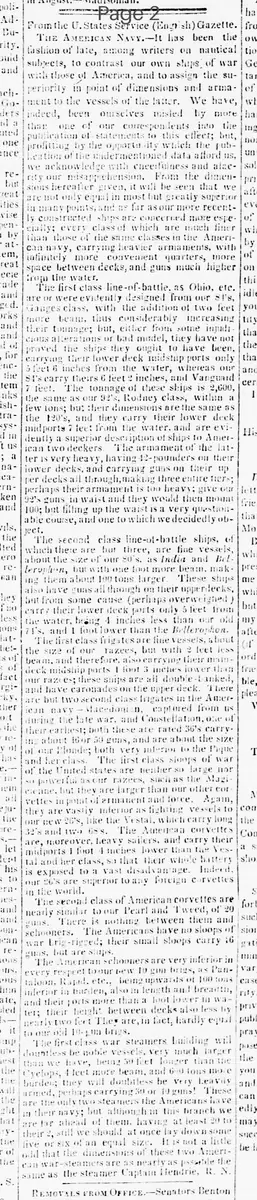
THE AMERICAN NAVY.—It has been the fashion of late, among writers on nautical subjects, to contrast our own ships of war with those of America, and to assign the superiority in point of dimensions and armament to the vessels of the latter. We have, indeed, been ourselves misled by one or more of our correspondents into the publication of statements to this effect; but, profitting by the opportunity which the publication of the undermentioned data afford us, we acknowledge with cheerfulness and candor our misapprehension. From the dimensions hereinafter given, it will be seen that we are not only equal in most but greatly superior in many points, and as far as our more recently constructed ships are concerned more especially: every class of which are much finer than those of the same classes in the American navy, carrying heavier armaments, with infinitely more convenient quarters, more space between decks, and guns much higher from the water.
The first class line-of-battle, as Ohio, etc are or were evidently designed from our first class, with the addition of two feet more beam, thus considerably increasing their tonnage; but, either from some injudicious alterations or bad model, they have not proved the ships they ought to have been, carrying their lower deck midship ports only 5 feet 6 inches from the water, whereas our 90's carry theirs 6 feet 3 inches, and Vanguard 7 feet. The tonnage of these ships is 2,300, the same as our 90's, Rodney class, within a few tons; but their dimensions are the same as the people, and they carry their lower deck midports 7 feet from the water, and are evidently a superior description of ships to American two deckers. The armament of the latter is very heavy, having 84-pounders on their lower decks, and carrying guns on their upper decks all through, making three entire tiers; perhaps their armament is too heavy; give our 92's guns in waist and they would then mount 100: but filling up the waist is a very questionable course, and one to which we decidedly object.
The second class line-of-battle ships, of which there are but three, are fine vessels, about the size of our 80's, as India and Bellerophon, but with one foot more beam, making them about 100 tons larger. These ships also have guns all through on their upper decks, but from some cause (perhaps overweighed) carries their lower deck ports only 5 feet from the water, being 4 inches less than our old 74's, and 1 foot lower than the Bellerophon.
The first class frigates are fine vessels, about the size of our razees, but with 2 feet less beam, and therefore, also carrying their main-deck midship ports 1 foot 3 inches lower than our razees; these ships are all double-banked, and have carronades on the upper deck. There are but two second class frigates in the American navy—Macedonian, captured from us during the late war, and Constellation, one of their earliest; both these are rated 36's carrying in about 16 or 20 guns, and are about the size of our Blonde; both very inferior to the Pique and Leda class. The first class sloops of war of the United States are neither so large nor so powerful as our razees, such as the Magicienne, but they are larger than our other corvettes in point of armament and force. Again, they are vastly inferior as fighting vessels to our new 20's, like the Vestal, which carry long 32's and two 68s. The American corvettes are, moreover, heavy sailers, and carry their midports 1 foot 4 inches lower than the Vestal and her class, so that their whole battery is exposed to a vast disadvantage. Indeed, our 20's are superior to any foreign corvettes in the world.
The second class of American corvettes are nearly similar to our Pearl and Tweed, of 20 guns. There is nothing between them and schooners. The Americans have no sloops of war brig-rigged; their small sloops carry 16 guns, but are ships.
The American schooners are very inferior in every respect to our new 10 gun brigs, as Pantaloon, Rapid, etc., being upwards of 100 tons inferior in burden, also in length and breadth, and their ports more than a foot lower in water; their height between decks also less by nearly two feet. They are, in fact, hardly equal to our old 10-gun brigs.
The first class war steamers building will doubtless be noble vessels, very much larger than we have, being 50 feet longer than the Cyclops, 4 feet more beam, and 650 tons more burden; they will doubtless be very heavily armed, perhaps carrying 30 or 10 guns! These are the only two steamers the Americans have in their navy; but although in this branch we are far ahead of them, having at least 30 to their 2, still we should at once lay down some five or six of an equal size. It is not a little curious that the dimensions of these two American war-steamers are as nearly as possible the same as the steamer Captain Hendrie, R. N.
THE AMERICAN NAVY.—It has been the fashion of late, among writers on nautical subjects, to contrast our own ships of war with those of America, and to assign the superiority in point of dimensions and armament to the vessels of the latter. We have, indeed, been ourselves misled by one or more of our correspondents into the publication of statements to this effect; but, profitting by the opportunity which the publication of the undermentioned data afford us, we acknowledge with cheerfulness and candor our misapprehension. From the dimensions hereinafter given, it will be seen that we are not only equal in most but greatly superior in many points, and as far as our more recently constructed ships are concerned more especially: every class of which are much finer than those of the same classes in the American navy, carrying heavier armaments, with infinitely more convenient quarters, more space between decks, and guns much higher from the water.
The first class line-of-battle, as Ohio, etc are or were evidently designed from our first class, with the addition of two feet more beam, thus considerably increasing their tonnage; but, either from some injudicious alterations or bad model, they have not proved the ships they ought to have been, carrying their lower deck midship ports only 5 feet 6 inches from the water, whereas our 90's carry theirs 6 feet 3 inches, and Vanguard 7 feet. The tonnage of these ships is 2,300, the same as our 90's, Rodney class, within a few tons; but their dimensions are the same as the people, and they carry their lower deck midports 7 feet from the water, and are evidently a superior description of ships to American two deckers. The armament of the latter is very heavy, having 84-pounders on their lower decks, and carrying guns on their upper decks all through, making three entire tiers; perhaps their armament is too heavy; give our 92's guns in waist and they would then mount 100: but filling up the waist is a very questionable course, and one to which we decidedly object.
The second class line-of-battle ships, of which there are but three, are fine vessels, about the size of our 80's, as India and Bellerophon, but with one foot more beam, making them about 100 tons larger. These ships also have guns all through on their upper decks, but from some cause (perhaps overweighed) carries their lower deck ports only 5 feet from the water, being 4 inches less than our old 74's, and 1 foot lower than the Bellerophon.
The first class frigates are fine vessels, about the size of our razees, but with 2 feet less beam, and therefore, also carrying their main-deck midship ports 1 foot 3 inches lower than our razees; these ships are all double-banked, and have carronades on the upper deck. There are but two second class frigates in the American navy—Macedonian, captured from us during the late war, and Constellation, one of their earliest; both these are rated 36's carrying in about 16 or 20 guns, and are about the size of our Blonde; both very inferior to the Pique and Leda class. The first class sloops of war of the United States are neither so large nor so powerful as our razees, such as the Magicienne, but they are larger than our other corvettes in point of armament and force. Again, they are vastly inferior as fighting vessels to our new 20's, like the Vestal, which carry long 32's and two 68s. The American corvettes are, moreover, heavy sailers, and carry their midports 1 foot 4 inches lower than the Vestal and her class, so that their whole battery is exposed to a vast disadvantage. Indeed, our 20's are superior to any foreign corvettes in the world.
The second class of American corvettes are nearly similar to our Pearl and Tweed, of 20 guns. There is nothing between them and schooners. The Americans have no sloops of war brig-rigged; their small sloops carry 16 guns, but are ships.
The American schooners are very inferior in every respect to our new 10 gun brigs, as Pantaloon, Rapid, etc., being upwards of 100 tons inferior in burden, also in length and breadth, and their ports more than a foot lower in water; their height between decks also less by nearly two feet. They are, in fact, hardly equal to our old 10-gun brigs.
The first class war steamers building will doubtless be noble vessels, very much larger than we have, being 50 feet longer than the Cyclops, 4 feet more beam, and 650 tons more burden; they will doubtless be very heavily armed, perhaps carrying 30 or 10 guns! These are the only two steamers the Americans have in their navy; but although in this branch we are far ahead of them, having at least 30 to their 2, still we should at once lay down some five or six of an equal size. It is not a little curious that the dimensions of these two American war-steamers are as nearly as possible the same as the steamer Captain Hendrie, R. N.
What sub-type of article is it?
Curiosity
Historical Event
What themes does it cover?
Triumph
What keywords are associated?
American Navy
British Navy
Ship Comparison
Naval Superiority
Warship Dimensions
Armament
Frigates
Steamers
Story Details
Story Details
British naval publication acknowledges past errors in comparing American and British warships, asserting overall British superiority in design, armament, and construction across various classes including line-of-battle ships, frigates, sloops, corvettes, schooners, and steamers.