Thank you for visiting SNEWPapers!
Sign up free
Gazette Of The United States
New York, New York County, New York
What is this article about?
U.S. House of Representatives proceedings from July 23-30, including debate on Senate amendment to Funding Bill for assuming state debts, led by R. Jackson opposing it on grounds of injustice to certain states; passage of the bill after votes; reports on state ratifications of constitutional amendments; and handling of other bills, petitions, and motions.
Merged-components note: Merging parts of the article on House of Representatives proceedings from July 23 to July 30.
Clippings
1 of 2
OCR Quality
Full Text
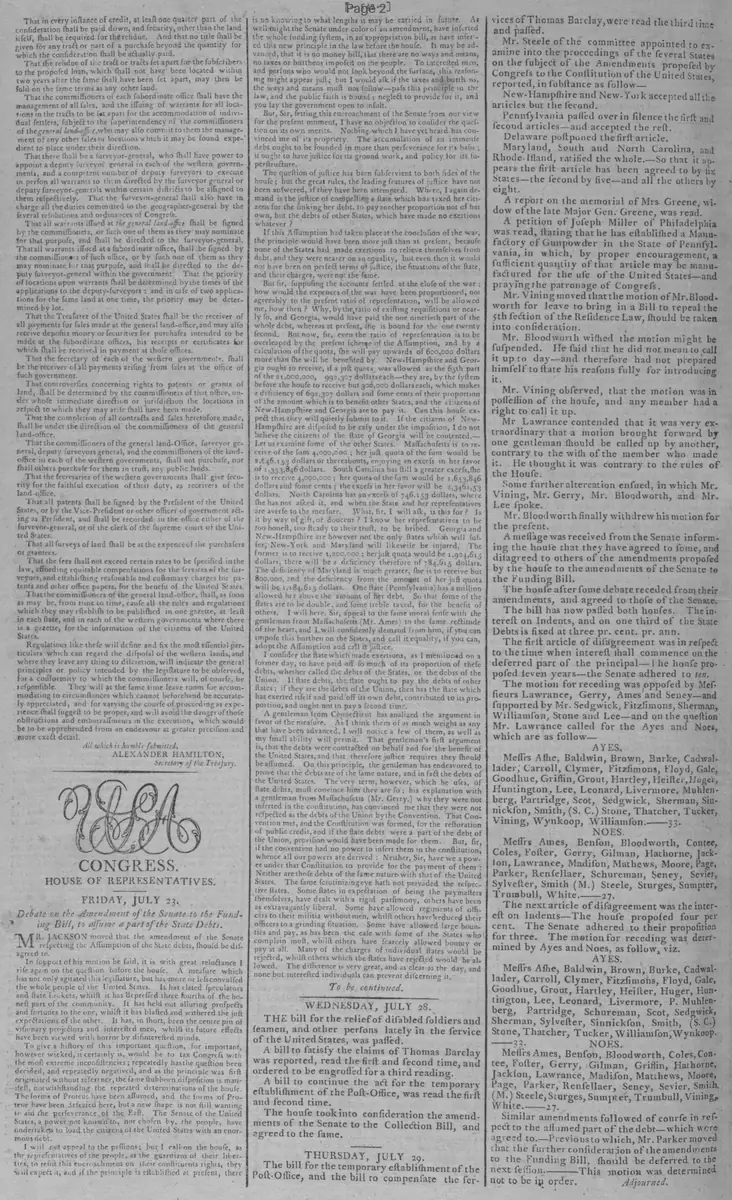
HOUSE OF REPRESENTATIVES.
FRIDAY, JULY 23.
Debate on the Amendment of the Senate to the Funding Bill, to assume a part of the State Debts.
R. JACKSON moved that the amendment of the Senate respecting the Assumption of the State debts, should be disagreed to.
In support of his motion he said, it is with great reluctance I rise again on the question before the house. A measure which has not only agitated this legislature, but has more or less convulsed the whole people of the United States. It has elated speculators and state brokers, whilst it has depressed three fourths of the honest part of the community. It has held out alluring prospects and fortunes to the one, whilst it has blasted and withered the just expectations of the other. It has, in short, been the centre pin of visionary projectors and interested men, whilst its future effects have been viewed with horror by disinterested minds.
To give a history of this important question, for important, however wicked, it certainly is, would be to tax Congress with the most extreme inconsistencies; repeatedly has the question been decided, and repeatedly negatived, and as the principle was first originated without reference, the same stubborn disposition is maintained, notwithstanding the repeated determinations of the house.
The forms of Proteus have been assumed, and the forms of Proteus have been defeated here, but a new shape is not still wanting to aid the perseverance of the East. The Senate of the United States, a power not known to, nor chosen by, the people, have undertaken to load the citizens of the United States with an enormous debt.
I will not appeal to the passions; but I call on the house, as the representatives of the people, as the guardians of their liberties, to resist this encroachment on their constituents rights, they will expect it, and if the principle is established at present, there is no knowing to what lengths it may be carried in future. As well might the Senate under color of an amendment, have inserted the whole funding system, in an appropriation bill, as have entered this new principle in the law before the house. It may be advanced, that it is no money bill, that there are no ways and means, no taxes or burthens imposed on the people. To interested men, and persons who would not look beyond the surface, this reasoning might appear just; but I would ask if the taxes and burthens, the ways and means must not follow—pass this principle in the law, and the public faith is bound; neglect to provide for it, and you lay the government open to insult.
But, Sir, setting this encroachment of the Senate from our view for the present moment, I have no objection to consider the question on its own merits. Nothing which I have yet heard has convinced me of its propriety. The accumulation of an immense debt ought to be founded in more than perseverance for its basis; it ought to have justice for its ground work, and policy for its superstructure.
The question of justice has been subservient to both sides of the house; but the great rules, the leading features of justice have not been answered, if they have been attempted. Where, I again demand is the justice of compelling a state which has taxed her citizens for the sinking her debt, to pay another proportion not of her own, but the debts of other States, which have made no exertions whatever?
If this Assumption had taken place at the conclusion of the war, the principle would have been more just than at present, because none of the States had made exertions to relieve themselves from debt, and they were nearer on an equality, but even then it would not have been on perfect terms of justice, the situations of the states, and their charges, were not the same.
But sir, supposing the accounts settled at the close of the war; how would the expenses of the war have been proportioned, not agreeably to the present ratio of representation, will be allowed me, how then? Why, by the ratio of existing requisitions or nearly so, and Georgia, would have paid the one ninetieth part of the whole debt, whereas at present, she is bound for the one twenty second. But now, sir, even the ratio of representation is to be overleaped by the present scheme of the Assumption, and by a calculation of the quota, she will pay upwards of 600,000 dollars more than she will be benefited by. New-Hampshire and Georgia ought to receive, if a just quota was allowed as the 65th part of the 21,000,000, 992,37 dollars each—they are, by the system before the house to receive but 200,000 dollars each, which makes a deficiency of 692,307 dollars and some cents of their proportion of the amount which is to benefit other States, and the citizens of New-Hampshire and Georgia are to pay it. Can this house expect that they will quietly submit to it. If the citizens of New-Hampshire are disposed to be easy under the imposition, I do not believe the citizens of the state of Georgia will be contented.
Let us examine some of the other States. Massachusetts is to receive of the sum 4,000,000; her just quota of the sum would be 2,646,153 dollars or thereabouts, enjoying an excess in her favor of 1,353,846 dollars. South Carolina has still a greater excess, she is to receive 4,000,000; her quota of the sum would be 1,653,846 dollars and some cents; the excess in her favor will be 2,346,153 dollars. North Carolina has an excess of 746,153 dollars, where she has not asked it, and when the State and her representatives are averse to the measure. What, sir, I will ask, is this for? Is it by way of gift, or douceur? I know her representatives to be too honest, too steady to their trust, to be bribed. Georgia and New-Hampshire are however not the only states which will suffer, New-York and Maryland will likewise be injured. The former is to receive 1,200,000; her just quota would be 1,904,615 dollars, there will be a deficiency therefore of 784,615 dollars. The deficiency of Maryland is much greater, she is to receive but 800,000, and the deficiency from the amount of her just quota will be 1,184,615 dollars. One state (Pennsylvania) has a million allowed her above the amount of her debt, So that some of the states are to be double, and some treble taxed, for the benefit of others. I will here, Sir, appeal to the same moral sense with the gentleman from Massachusetts (Mr. Ames) to the same rectitude of the heart, and I will confidently demand from him, if you can impose this burthen on the States, and call it equality, if you can, adopt the Assumption and call it justice.
I consider the state which made exertions, as I mentioned on a former day, to have paid off so much of its proportion of these debts, whether called the debts of the States, or the debts of the Union. If state debts, the state ought to pay the debts of other states; if they are the debts of the Union, then has the state which has exerted itself and paid off its own debt, contributed to its proportion, and ought not to pay a second time.
A gentleman from Connecticut has analyzed the argument in favor of the measure. As I think them of as much weight as any that have been advanced, I will notice a few of them, as well as my small ability will permit. That gentleman's first argument is, that the debts were contracted on behalf and for the benefit of the United States, and that therefore justice requires they should be assumed. On this principle, the gentleman has endeavored to prove that the debts are of the same nature, and in fact the debts of the United States. The very term, however, which he uses, of state debts, must convince him they are so; his explanation with a gentleman from Massachusetts (Mr. Gerry) why they were not inserted in the constitution, has convinced me that they were not respected as the debts of the Union by the Convention. That Convention met, and the Constitution was formed, for the restoration of public credit, and if the state debts were a part of the debt of the Union, provision would have been made for them. But, sir, if the convention had no power to insert them in the constitution, whence all our powers are derived: Neither, Sir, have we a power under that Constitution to provide for the payment of them: Neither are those debts of the same nature with that of the United States. The same scrutinizing eye hath not pervaded the respective states. Some states in expectation of being the paymasters themselves, have dealt with a rigid parsimony, others have been as extravagantly liberal. Some have allowed regiments of officers to their militia without men, whilst others have reduced their officers to a grinding situation. Some have allowed large bounties and pay, as has been the case with some of the States who complain most, whilst others have scarcely allowed bounty or pay at all. Many of the charges of individual states would be rejected, whilst others which the states have rejected would be allowed. The difference is very great, and as clear as the day, and none but interested individuals can prevent discerning it.
To be continued.
WEDNESDAY, JULY 28.
THE bill for the relief of disabled soldiers and seamen, and other persons lately in the service of the United States, was passed.
A bill to satisfy the claims of Thomas Barclay was reported, read the first and second time, and ordered to be engrossed for a third reading.
A bill to continue the act for the temporary establishment of the Post-Office, was read the first and second time.
The house took into consideration the amendments of the Senate to the Collection Bill, and agreed to the same.
THURSDAY, JULY 29.
The bill for the temporary establishment of the Post-Office, and the bill to compensate the services of Thomas Barclay, were read the third time and passed.
Mr. Steele of the committee appointed to examine into the proceedings of the several States on the subject of the Amendments proposed by Congress to the Constitution of the United States, reported, in substance as follows:
New-Hampshire and New-York accepted all the articles but the second.
Pennsylvania passed over in silence the first and second articles—and accepted the rest.
Delaware postponed the first article.
Maryland, South and North Carolina, and Rhode-Island, ratified the whole.—So that it appears the first article has been agreed to by six States—the second by five—and all the others by eight.
A report on the memorial of Mrs. Greene, widow of the late Major Gen. Greene, was read.
A petition of Joseph Miller of Philadelphia was read, stating that he has established a Manufactory of Gunpowder in the State of Pennsylvania, in which, by proper encouragement, a sufficient quantity of that article may be manufactured for the use of the United States—and praying the patronage of Congress.
Mr. Vining moved that the motion of Mr. Bloodworth for leave to bring in a Bill to repeal the 5th section of the Residence Law, should be taken into consideration.
Mr. Bloodworth wished the motion might be suspended. He said that he did not mean to call it up to day—and therefore had not prepared himself to state his reasons fully for introducing it.
Mr. Vining observed, that the motion was in possession of the house, and any member had a right to call it up.
Mr. Lawrence contended that it was very extraordinary that a motion brought forward by one gentleman should be called up by another, contrary to the wish of the member who made it. He thought it was contrary to the rules of the House.
Some further altercation ensued, in which Mr. Vining, Mr. Gerry, Mr. Bloodworth, and Mr. Lee spoke.
Mr. Bloodworth finally withdrew his motion for the present.
A message was received from the Senate informing the house that they have agreed to some, and disagreed to others of the amendments proposed by the house to the amendments of the Senate to the Funding Bill.
The house after some debate receded from their amendments, and agreed to those of the Senate.
The bill has now passed both houses. The interest on Indents, and on one third of the State Debts is fixed at three pr. cent. pr. ann.
The first article of disagreement was in respect to the time when interest shall commence on the deferred part of the principal. The house proposed seven years—the Senate adhered to ten.
The motion for receding was opposed by Messrs. Lawrence, Gerry, Ames and Seney—and supported by Mr. Sedgwick, Fitzsimons, Sherman, Williamson, Stone and Lee—and on the question Mr. Lawrence called for the Ayes and Noes, which are as follow:
AYES.
Messrs. Ashe, Baldwin, Brown, Burke, Cadwallader, Carroll, Clymer, Fitzsimons, Floyd, Gale, Goodhue, Griffin, Grout, Hartley, Heister, Huger, Huntington, Lee, Leonard, Livermore, Muhlenberg, Partridge, Scott, Sedgwick, Sherman, Sinnickson, Smith, (S. C.) Stone, Thatcher, Tucker, Vining, Wynkoop, Williamson.—33.
NOES.
Messrs. Ames, Benson, Bloodworth, Contee, Coles, Foster, Gerry, Gilman, Hathorne, Jackson, Lawrence, Madison, Mathews, Moore, Page, Parker, Rensselaer, Schureman, Seney, Sevier, Sylvester, Smith (M.) Steele, Sturges, Sumter, Trumbull, White.—27.
The next article of disagreement was the interest on Indents—The house proposed four per cent. The Senate adhered to their proposition for three. The motion for receding was determined by Ayes and Noes, as follow, viz.
AYES.
Messrs. Ashe, Baldwin, Brown, Burke, Cadwallader, Carroll, Clymer, Fitzsimons, Floyd, Gale, Goodhue, Grout, Hartley, Heister, Huger, Huntington, Lee, Leonard, Livermore, P. Muhlenberg, Partridge, Schureman, Scott, Sedgwick, Sherman, Sylvester, Sinnickson, Smith, (S. C.) Stone, Thatcher, Tucker, Williamson, Wynkoop. 33.
NOES.
Messrs. Ames, Benson, Bloodworth, Coles, Contee, Foster, Gerry, Gilman, Griffin, Hathorne, Jackson, Lawrence, Madison, Matthews, Moore, Page, Parker, Rensselaer, Seney, Sevier, Smith (M.) Steele, Sturges, Sumter, Trumbull, Vining, White.—27.
Similar amendments followed of course in respect to the assumed part of the debt—which were agreed to. Previous to which, Mr. Parker moved that the further consideration of the amendments to the Funding Bill, should be deferred to the next session.
—This motion was determined not to be in order.
Adjourned.
FRIDAY, JULY 30.
Sundry petitions and memorials were read and referred to the heads of departments.
The report on the petition of Catherine Greene, widow of the late general Greene, was read the second time; this report was in favor of the prayer of the petition, so far as to indemnify the heirs of general Greene, from demands arising from engagements and contracts made by him on account of the United States.
A motion was made to refer the papers which accompanied the petition to the Secretary of the Treasury—some conversation ensued on this motion; Mr. Stone said he thought it more proper to refer them to the Auditor-General; Mr. Gerry called for the reading the paper:—which was done.
Adopted.
The motion for referring to the Secretary of the Treasury was adopted.
A message was received from the Senate informing that they have passed a bill for the relief of John Stuart and John Davidson, and a bill for the temporary establishment of the Post-Office.
In committee of the whole on the report of the Secretary of the Treasury respecting a plan for the disposition of the lands in the Western Territory—some progress was made in the discussion.
Adjourned till Monday.
What sub-type of article is it?
What keywords are associated?
What entities or persons were involved?
Domestic News Details
Event Date
July 23 To July 30
Key Persons
Outcome
funding bill passed both houses with interest on indents and one third of state debts at 3% per annum; house receded on amendments for 7-year vs. 10-year interest commencement (33-27) and 4% vs. 3% on indents (33-27); other bills passed including relief for disabled soldiers, post-office continuation, thomas barclay claims; state ratifications reported; petitions referred.
Event Details
R. Jackson opposed Senate amendment to Funding Bill for assuming state debts, arguing injustice to states like Georgia and New Hampshire that paid their debts, uneven quotas favoring states like Massachusetts and South Carolina; detailed calculations of excesses and deficiencies; debated constitutional powers and debt nature. House debated and receded on Senate amendments, passing the bill. Additional proceedings: passage of bills for disabled soldiers/seamen, Thomas Barclay claims, Post-Office; agreement to Senate amendments on Collection Bill; report by Mr. Steele on state ratifications of constitutional amendments (first article by 6 states, second by 5, others by 8); reading of Mrs. Greene's memorial and Joseph Miller's gunpowder manufactory petition; altercation over motion to repeal Residence Law section, withdrawn; committee progress on Western Territory lands.