Thank you for visiting SNEWPapers!
Sign up free
Imperial Valley Press
El Centro, Imperial County, California
What is this article about?
On May 2, the National Labor Relations Board ordered a union representation election for Montgomery Ward employees in Chicago within seven days. In Chicago court, arguments concluded on the government's seizure of the company's plants, with Judge William H. Holly to rule on the injunction the following Monday.
Merged-components note: Merged continuation of the Montgomery Ward labor dispute story from page 1 to page 6; changed label from 'story' to 'domestic_news' for consistency.
Clippings
1 of 2
OCR Quality
Full Text
Quiz
Closed
Judge
to
Give
Injunction
Ruling Monday
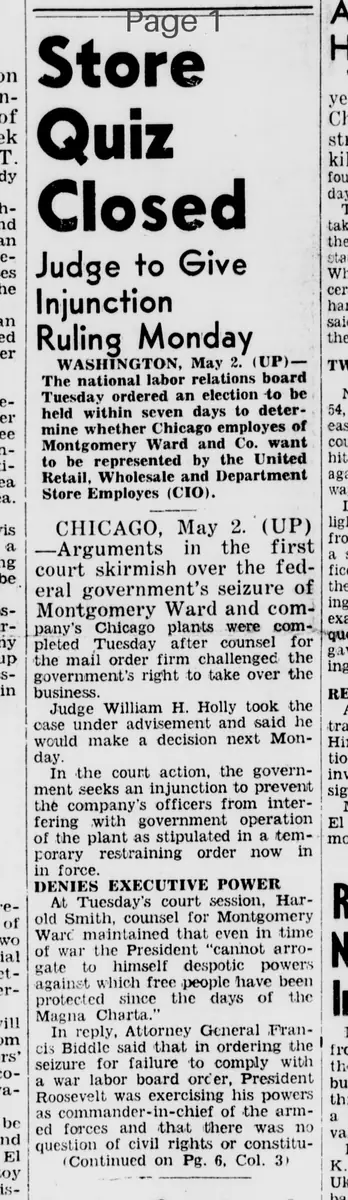
WASHINGTON, May 2. (UP)— The national labor relations board Tuesday ordered an election to be held within seven days to determine whether Chicago employees of Montgomery Ward and Co. want to be represented by the United Retail, Wholesale and Department Store Employees (CIO).
CHICAGO, May 2. (UP) —Arguments in the first court skirmish over the federal government's seizure of Montgomery Ward and company's Chicago plants were completed Tuesday after counsel for the mail order firm challenged the government's right to take over the business.
Judge William H. Holly took the case under advisement and said he would make a decision next Monday.
In the court action, the government seeks an injunction to prevent the company's officers from interfering with government operation of the plant as stipulated in a temporary restraining order now in force.
DENIES EXECUTIVE POWER
At Tuesday's court session, Harold Smith, counsel for Montgomery Ward maintained that even in time of war the President "cannot arrogate to himself despotic powers against which free people have been protected since the days of the Magna Charta."
In reply, Attorney General Francis Biddle said that in ordering the seizure for failure to comply with a war labor board order, President Roosevelt was exercising his powers as commander-in-chief of the armed forces and that there was no question of civil rights or constitutional guarantees.
(Continued on Pg. 6, Col. 3)
Store Hearing Closes, Judge To Rule Monday
(Continued from Page 1)
constitutionality involved.
Smith told the court that the substance of the government's case was:
"That the President has the power to confiscate Ward's private property because of the existence of a national emergency which invests him as commander in chief of the armed forces with an extraordinary and terrifying power of seizure."
NO LAW ON BOOKS
He argued that there is no law or constitutional provision which confers such a power on the chief executive, and he contended:
"That it is an unreasonable seizure contrary to the fourth article of the Bill of Rights and that it deprives them (the company) of liberty and property without due process of law and constitutes the taking of private property for public use without just compensation, in direct violation of article five of the Bill of Rights."
Smith added that unusual times may call for the exercise of otherwise latent powers. "but by the same token, in such times the protection of constitutional guarantees is indispensable to the preservation of a free people."
The Smith-Connally act, Smith said, confers upon the executive the extraordinary power of seizure of private property in certain circumstances without resort to the normal processes of law.
POWERS CONFINED
"But the very language which confers this unusual power specifically confines it to a 'plant, mine, or facility equipped for the manufacture, production, or mining of any articles or materials which may be required for the war effort or which may be useful in connection therewith'." Smith said.
"This is not a case where an unlimited or blanket power has been conferred upon the executive by constitutional or statutory provision: On the contrary, the statute which generates power, at the same time and with good reason circumscribes its extent and exercise . . .
"If congress had intended to subject the entire economy of the country to seizure by presidential proclamation, if it had intended to subject all civilian business and property to presidential fiat, that intention would have been clearly expressed."
What sub-type of article is it?
What keywords are associated?
What entities or persons were involved?
Where did it happen?
Domestic News Details
Primary Location
Chicago
Event Date
May 2
Key Persons
Outcome
judge to make decision next monday; nlrb ordered election within seven days
Event Details
National Labor Relations Board ordered election for Chicago employees of Montgomery Ward and Co. to determine representation by United Retail, Wholesale and Department Store Employees (CIO). In court, arguments completed on government's seizure of Chicago plants; government seeks injunction against interference; counsel challenged executive power under war conditions and Smith-Connally Act.