Thank you for visiting SNEWPapers!
Sign up free
Editorial
July 22, 1867
The Evansville Journal
Evansville, Vanderburgh County, Indiana
What is this article about?
An editorial defends a prior article criticizing Rep. Niblack's support for President Johnson's view on U.S. responsibility for Southern state debts in reconstruction. It reprints critical excerpts from New York Herald, Times, and World, portraying Johnson's message as a misguided attempt to scare Congress into abandoning reconstruction plans.
Clipping
OCR Quality
95%
Excellent
Full Text
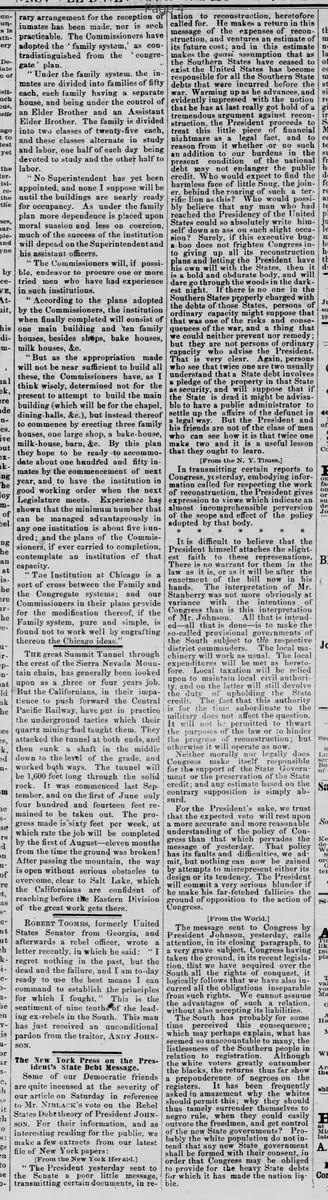
The New York Press on the President's State Debt Message.
Some of our Democratic friends are quite incensed at the severity of our article on Saturday in reference to Mr. Niblack's vote on the Rebel States Debt theory of President Johnson. For their information, and as interesting reading for the public, we make a few extracts from our latest file of New York papers:
[From the New York Herald.]
The President yesterday sent to the Senate a poor little message, transmitting certain documents, in relation to reconstruction, heretofore called for. He makes a return in this message of the expenses of reconstruction, and ventures an estimate of its future cost; and in this estimate makes the quasi assumption that as the Southern States have ceased to exist the United States has become responsible for all the Southern State debts that were incurred before the war. Warming up as he advances, and evidently impressed with the notion that he has at last really got hold of a tremendous argument against reconstruction, the President proceeds to treat this little piece of financial nightmare as a legal fact, and to reason from it whether or no such an addition to our burdens in the present condition of the national debt may not endanger the public credit. Who would expect to find the harmless face of little Snug, the joiner, behind the roaring of such a terrific lion as this? Who would possibly believe that any man who had reached the Presidency of the United States could so absolutely write himself down an ass on such slight occasion? Surely, if this executive bug-a-boo does not frighten Congress into giving up all its reconstruction plans and letting the President have his own will with the States, then it is a bold and obdurate body, and will dare go through the woods in the darkest night. If there is no one in the Southern States properly charged with the debts of those States, persons of ordinary capacity might suppose that that was one of the risks and consequences of the war, and a thing that we could neither prevent nor remedy; but they are not persons of ordinary capacity who advise the President. That is very clear. Again, persons who see that twice one are two usually understand that a State debt involves a pledge of the property in that State as security, and will suppose that if the State is dead it might be advisable to have a public administrator to settle up the affairs of the defunct in a legal way. But the President and his friends are not of the class of men who can see how it is that twice one make two and it is a useful lesson that they ought to learn.
[From the N. Y. Times.]
In transmitting certain reports to Congress, yesterday, embodying information called for respecting the work of reconstruction, the President gives expression to views which indicate an almost incomprehensible perversion of the scope and effect of the policy adopted by that body.
It is difficult to believe that the President himself attaches the slightest faith to these representations. There is no warrant for them in the law as it is, or as it will be after the enactment of the bill now in his hands. The interpretation of Mr. Stanberry was not more obviously at variance with the intentions of Congress than is this interpretation of Mr. Johnson. All that is intended-all that is done-is to make the so-called provisional governments of the South subject to the respective district commanders. The local machinery will work as usual. The local expenditures will be met as heretofore. Local taxation will be relied upon to maintain local civil authority, and on the latter will still devolve the duty of upholding the State credit. The fact that this authority is for the time subordinate to the military does not affect the question. It will not be permitted to thwart the purposes of the law or to hinder the progress of reconstruction; but otherwise it will operate as now. Neither morally nor legally does Congress make itself responsible for the support of the State Government or the preservation of the State credit; and any estimate based on the contrary supposition is simply absurd.
For the President's sake, we trust that the expected veto will rest upon a more accurate and more reasonable understanding of the policy of Congress than that which pervades the message of yesterday. That policy has its faults and difficulties, we admit, but nothing can now be gained by attempts to misrepresent either its design or its tendency. The President will commit a very serious blunder if he make his far-fetched fallacies the ground of opposition to the action of Congress.
[From the World.]
The message sent to Congress by President Johnson, yesterday, calls attention, in its closing paragraph, to a very grave subject. Congress having taken the ground, in its recent legislation, that we have acquired over the South all the rights of conquest, it logically follows that we have also incurred all the obligations inseparable from such rights. We cannot assume the advantages of such a relation, without also accepting its liabilities. The South has probably for some time perceived this consequence; which may perhaps explain, what has seemed so unaccountable to many, the listlessness of the Southern people in relation to registration. Although the white voters greatly outnumber the blacks, the returns thus far show a preponderance of negroes on the registers. It has been frequently asked in amazement why the whites should permit this; why they should thus tamely surrender themselves to negro rule, when they could easily outvote the freedmen, and get control of the new State governments? Probably the white population do not intend that any new State government shall be formed with their consent, in order that Congress may be obliged to provide for the heavy State debts for which it has made the nation liable.
Some of our Democratic friends are quite incensed at the severity of our article on Saturday in reference to Mr. Niblack's vote on the Rebel States Debt theory of President Johnson. For their information, and as interesting reading for the public, we make a few extracts from our latest file of New York papers:
[From the New York Herald.]
The President yesterday sent to the Senate a poor little message, transmitting certain documents, in relation to reconstruction, heretofore called for. He makes a return in this message of the expenses of reconstruction, and ventures an estimate of its future cost; and in this estimate makes the quasi assumption that as the Southern States have ceased to exist the United States has become responsible for all the Southern State debts that were incurred before the war. Warming up as he advances, and evidently impressed with the notion that he has at last really got hold of a tremendous argument against reconstruction, the President proceeds to treat this little piece of financial nightmare as a legal fact, and to reason from it whether or no such an addition to our burdens in the present condition of the national debt may not endanger the public credit. Who would expect to find the harmless face of little Snug, the joiner, behind the roaring of such a terrific lion as this? Who would possibly believe that any man who had reached the Presidency of the United States could so absolutely write himself down an ass on such slight occasion? Surely, if this executive bug-a-boo does not frighten Congress into giving up all its reconstruction plans and letting the President have his own will with the States, then it is a bold and obdurate body, and will dare go through the woods in the darkest night. If there is no one in the Southern States properly charged with the debts of those States, persons of ordinary capacity might suppose that that was one of the risks and consequences of the war, and a thing that we could neither prevent nor remedy; but they are not persons of ordinary capacity who advise the President. That is very clear. Again, persons who see that twice one are two usually understand that a State debt involves a pledge of the property in that State as security, and will suppose that if the State is dead it might be advisable to have a public administrator to settle up the affairs of the defunct in a legal way. But the President and his friends are not of the class of men who can see how it is that twice one make two and it is a useful lesson that they ought to learn.
[From the N. Y. Times.]
In transmitting certain reports to Congress, yesterday, embodying information called for respecting the work of reconstruction, the President gives expression to views which indicate an almost incomprehensible perversion of the scope and effect of the policy adopted by that body.
It is difficult to believe that the President himself attaches the slightest faith to these representations. There is no warrant for them in the law as it is, or as it will be after the enactment of the bill now in his hands. The interpretation of Mr. Stanberry was not more obviously at variance with the intentions of Congress than is this interpretation of Mr. Johnson. All that is intended-all that is done-is to make the so-called provisional governments of the South subject to the respective district commanders. The local machinery will work as usual. The local expenditures will be met as heretofore. Local taxation will be relied upon to maintain local civil authority, and on the latter will still devolve the duty of upholding the State credit. The fact that this authority is for the time subordinate to the military does not affect the question. It will not be permitted to thwart the purposes of the law or to hinder the progress of reconstruction; but otherwise it will operate as now. Neither morally nor legally does Congress make itself responsible for the support of the State Government or the preservation of the State credit; and any estimate based on the contrary supposition is simply absurd.
For the President's sake, we trust that the expected veto will rest upon a more accurate and more reasonable understanding of the policy of Congress than that which pervades the message of yesterday. That policy has its faults and difficulties, we admit, but nothing can now be gained by attempts to misrepresent either its design or its tendency. The President will commit a very serious blunder if he make his far-fetched fallacies the ground of opposition to the action of Congress.
[From the World.]
The message sent to Congress by President Johnson, yesterday, calls attention, in its closing paragraph, to a very grave subject. Congress having taken the ground, in its recent legislation, that we have acquired over the South all the rights of conquest, it logically follows that we have also incurred all the obligations inseparable from such rights. We cannot assume the advantages of such a relation, without also accepting its liabilities. The South has probably for some time perceived this consequence; which may perhaps explain, what has seemed so unaccountable to many, the listlessness of the Southern people in relation to registration. Although the white voters greatly outnumber the blacks, the returns thus far show a preponderance of negroes on the registers. It has been frequently asked in amazement why the whites should permit this; why they should thus tamely surrender themselves to negro rule, when they could easily outvote the freedmen, and get control of the new State governments? Probably the white population do not intend that any new State government shall be formed with their consent, in order that Congress may be obliged to provide for the heavy State debts for which it has made the nation liable.
What sub-type of article is it?
Constitutional
Economic Policy
Partisan Politics
What keywords are associated?
Reconstruction
State Debts
President Johnson
Southern States
Congress Policy
Veto Message
What entities or persons were involved?
President Johnson
Congress
New York Herald
New York Times
New York World
Mr. Niblack
Mr. Stanberry
Editorial Details
Primary Topic
Critique Of President Johnson's Message On Southern State Debts In Reconstruction
Stance / Tone
Critical Of President Johnson, Supportive Of Congress's Reconstruction Policy
Key Figures
President Johnson
Congress
New York Herald
New York Times
New York World
Mr. Niblack
Mr. Stanberry
Key Arguments
President's Message Assumes U.S. Responsibility For Pre War Southern Debts, Misrepresenting Reconstruction Costs.
This Assumption Is A Flawed Argument To Oppose Congress's Plans.
Local Southern Governments Remain Responsible For Their Debts And Operations Under Military Oversight.
Johnson's Views Pervert Congress's Intent; No Federal Liability For State Credits.
Southern Whites May Resist Registration To Force Federal Assumption Of State Debts.