Thank you for visiting SNEWPapers!
Sign up free
The Virginian
Lynchburg, Virginia
What is this article about?
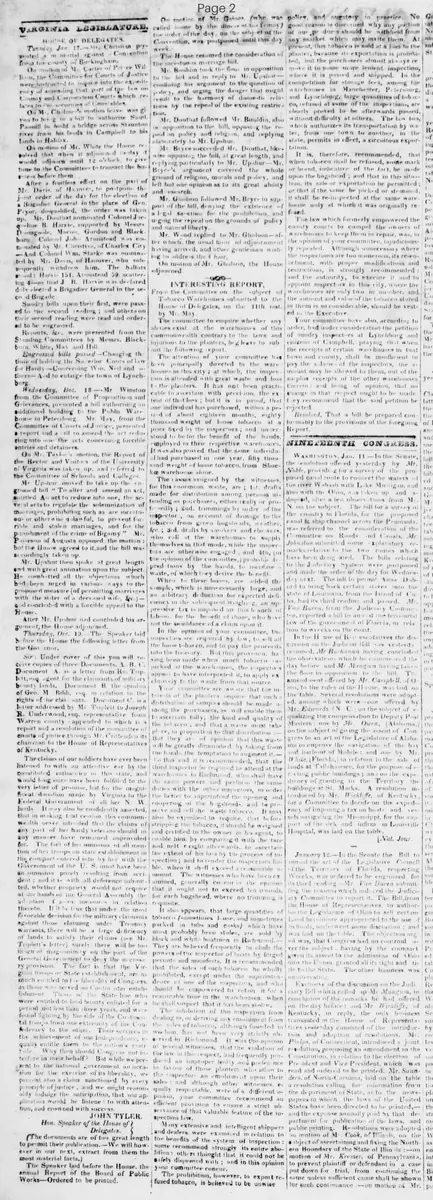
Proceedings of the Virginia House of Delegates from January 17 and December 18-19, covering memorials, bills on bridges and courts, election of Brigadier General James B. Harvie, debates on marriage laws, Governor Tyler's letter on military bounty lands, and a committee report on tobacco warehouse abuses in Richmond.
Clipping
OCR Quality
Full Text
HOUSE OF DELEGATES.
Tuesday, Jan. 17.—Mr. Christian presented a memorial against Convention from the county of Buckingham.
On motion of Mr. Carter, of Prince William, the Committee for Courts of Justice was instructed to inquire into the expediency of suspending that part of the law on County and Corporation Courts which relates to the security of Constables.
On Mr. Chalmers' motion, leave was given to bring in a bill to authorize Samuel Pannill to build a bridge across Staunton river from his lands in Campbell to his lands in Halifax.
On motion of Mr. White, the House resolved that when it adjourned to-day it would adjourn until 12 o'clock, to give time to the Committees to transact the business before them.
After a fruitless effort on the part of Mr. Davis, of Hanover, to postpone the joint order of the day for the election of a Brigadier General in the place of Gen. Pryor, disqualified, the order was taken up. Mr. Douthat nominated Colonel James B. Harvie, supported by Messrs. Dromgoole, Macon, Gordon and Blackburn.
Colonel John Armistead was nominated by Mr. Christian, of Charles City—And Colonel Wm. Starke was nominated by Mr. Davis, of Hanover, who subsequently withdrew him. The ballots stood: Harvie 151, Armistead 59, scattering 4—so that J. B. Harvie was declared duly elected a Brigadier General in the seventh Brigade.
Sundry bills upon their first, were passed to the second reading; and others on their second reading were read and ordered to be engrossed.
Reports, &c. were presented from the Standing Committees by Messrs. Blackburn, White, May and Hill.
Engrossed bills passed—Changing the time of holding the Superior Courts of law for Hardy—Concerning Wm. Neil and others—And to enlarge the town of Lynchburg.
Wednesday, Dec. 18.—Mr. Winston from the Committee of Propositions and Grievances, presented a bill authorising an additional building to the Public Warehouse in Petersburg. Mr. May, from the Committee of Courts of Justice, presented report and a bill to amend the act reducing into one the acts concerning forcible entries and detainers.
On Mr. Taylor's motion, the Report of the Rector and Visitors of the University of Virginia was taken up, and referred to the Committee of Schools and Colleges.
Mr. Upshur moved to take up the engrossed bill "To alter and amend an act entitled An act to reduce into one, the several acts to regulate the solemnization of marriages, prohibiting such as are incestuous—or otherwise unlawful, to prevent forcible and stolen marriages, and for the punishment of the crime of Bigamy." Mr. Fullerton of Augusta opposed the motion; but the House agreed to it, and the bill was accordingly taken up.
Mr. Upshur then spoke at great length and with great animation upon the subject. He combatted all the objections which had been urged in various ways to the proposed measure (of permitting marriages with the sister of a deceased wife, &c.)—and concluded with a forcible appeal to the House.
After Mr. Upshur had concluded his argument, the House adjourned.
Thursday, Dec. 19. The Speaker laid before the House the following letter from the Governor.
Sir: Under cover of this you will receive copies of three Documents. A. B. C.
Document A. Is a letter from R. Triplett, Esq. agent for the claimants of military bounty lands. Document B the opinion of Geo. M. Bibb, Esq. in relation to the rights of the claimants. Document C. is a letter addressed by Mr. Triplett to Joseph R. Underwood, Esq. representative from Warren county—appended to which is a report and a resolution of the committee of courts of justice, through Mr. Crittenden its chairman to the House of Representatives of Kentucky.
The claims of our soldiers have ever been listened to with an attentive ear by the constituted authorities of this state, and would long since have been fulfilled to the very letter of promise, but for, the magnificent donation made by Virginia to the Federal Government in all her N. W. Lands. It may also be confidently asserted, that in making that cession this commonwealth never intended that the claims of any part of her hardy veterans should in any manner have remained unprovided for. The fact of her omission of all mention of her troops on state establishment in the compact entered into by her with the Government of the U. S. must have been an omission purely resulting from accident; and it is with all deference submitted, whether propriety would not require at the hands of the General Assembly the adoption of some measures in relation thereto. If it be true that under the most favorable decision for the military claimants against those claiming under Treasury warrants, there will be a large deficiency of lands to satisfy their claims (see Mr. Triplett's letter) surely there will be too much of magnanimity on the part of the General Government to deny the necessary provision. The fact is that the Virginia troops on State establishment, are as much entitled to the benefits of Congress. as those who served on Continental establishment. Troops of the State line who were entitled to land bounty enlisted for a period not less than three years, and were found fighting by the side of the Continental troops, from one extremity of the Confederacy to the other. Their services in the achievement of our independence, equally entitle them to the nation's gratitude." Why then should Congress not interfere in their behalf? But while we present to the national government an occasion for the exercise of its liberality, we present also a claim sanctioned by every principle of justice, and we might reasonably indulge the anticipation, that our application would be listened to with attention, and crowned with success.
JOHN TYLER.
Hon. Speaker of the House of Delegates.
(The documents are of too great length to permit their publication.—We will however in our next, extract from them the most material facts.)
The Speaker laid before the House, the annual Report of the Board of Public Works—Ordered to be printed.
On motion of Mr. Gaines, (who was called home by the illness at his family) the order of the day, on the subject of the Convention, was postponed until this day week.
The House resumed the consideration of the incestuous marriage bill.
Mr. Bouldin took the floor, in opposition to the bill, and in reply to Mr. Upshur—confining his argument to the question of policy, and urging the danger that might result to the harmony of domestic relations by the repeal of the existing restriction.
Mr. Douthat followed Mr. Bouldin, also in opposition to the bill, opposing the repeal on policy and religion, and replying elaborately to Mr. Upshur.
Mr. Bryce succeeded Mr. Douthat, likewise opposing the bill, at great length, and replying particularly to Mr. Upshur—Mr. Bryce's argument covered the whole ground of religion, morals and policy, and left but one opinion as to its great ability and research.
Mr. Gholson followed Mr. Bryce in support of the bill, denying the existence of a legal sanction for the prohibition, and urging the repeal on the grounds of policy and natural liberty.
Mr. Wood replied to Mr. Gholson—after which, the usual hour of adjournment having arrived, and other gentlemen wishing to address the chair,
On motion of Mr. Gholson, the House adjourned.
INTERESTING REPORT.
From the Committee on the subject of Tobacco Warehouses submitted to the House of Delegates, on the 11th inst. by Mr. May
The committee to enquire whether any abuses exist at the warehouses of this commonwealth contrary to the laws and to injurious to the planters, beg leave to submit the following report.
The attention of your committee has been principally directed to the warehouses in this city; at which, the inspection is attended with great waste and loss to the planters. It has not been practicable to ascertain, with precision, the extent of that loss; but it is in proof, that one individual has purchased, within a period of about eighteen months, eighty thousand weight of loose tobacco at a price fixed by the inspectors; and understood to be for the benefit of the hands employed in their respective warehouses.
It was also proved, that the same individual had purchased within one year, fifty thousand weight of loose tobacco, from Shockoe warehouse alone.
The causes assigned by the witnesses, for this enormous waste, are; 1st. drafts made for distribution among persons attending as purchasers, either really or professedly; 2nd. trimmings by order of the inspector, on account of damage to the tobacco from green hogsheads, weather, &c.; 3rd. drafts by smokers and chewers, who call at the warehouses to supply themselves in that mode, while the inspectors are otherwise engaged, and 4th, (in the opinion of the committee) probably depredations by the hands, to increase a waste, of which they derive the benefit.
When to these losses, are added the sample, which is unnecessarily large, and an arbitrary deduction for expected deficiency in the subsequent weighings, an oppressive tax is imposed on this branch of tobacco, for the benefit of those, who have not the semblance of a claim upon it.
In the opinion of your committee, the inspectors are required by law, to sell all the loose tobacco, and to pay the proceeds into the treasury. But this provision, having been made when much tobacco was picked at the warehouse, the inspectors appear to have interpreted it, to apply exclusively to the waste from that source.
Your committee are aware that the interests of the planters require that such distribution of samples should be made among the purchasers, as will enable them to ascertain fully, the kind and quality of the tobacco; and that a waste must take place, in proportion to that distribution:—But they are of opinion that this waste will be greatly diminished by taking from the hands the temptation to augment it.—
To this end it is recommended, that the third inspector be required to attend at the warehouses to Richmond, who shall have the same powers and perform the same duties with the other inspectors, in order the better to superintend the opening and coopering of the hogsheads, and to preserve and sell the waste tobacco. It may also be expedient to require, that before stripping the tobacco, it should be weighed and certified to the owner or his agent, to enable him, by comparing it with the tare and nett weight afterwards, to ascertain the extent of his loss by the process of inspection; and to render the inspectors liable, when it shall exceed a reasonable amount. The witnesses who have been examined, generally concur in the opinion that it ought not to exceed ten pounds. for each hogshead, where no trimming is requisite.
It also appears, that large quantities of tobacco (sometimes loose, and sometimes packed in tubs and casks) which have most probably been stolen, are sold by black and white boatmen in Richmond.—They are believed frequently to elude the powers of the inspector of boats by forged permits and manifests. It is recommended that the sales of such tobacco be wholly prohibited, except under the superintendence of one of the inspectors, and who should be empowered to retain it for a reasonable time in the warehouses, when he shall suspect that it has been stolen.
The prohibition of the inspectors from dealing in, or deriving an emolument from the sales of tobacco, although founded in wisdom, has not been very strictly observed in Richmond. It was the opinion of several witnesses, that the violation of the law in this respect, had frequently produced an improper lenity and preference in favor of those planters who allow to the inspector—an emolument upon their sales: and although other witnesses, equally respectable, were of a different opinion, your committee recommend an efficient provision to ensure a strict observance of that valuable feature of the inspection law.
Many extensive and intelligent shippers and dealers, were examined in relation to the benefits of the system of inspection: some recommend strongly its entire abolition: others thought that it could not be safely dispensed with; and in this opinion your committee concur.
The prohibition, however, to export refused tobacco, is believed to be unwise policy, and nugatory in practice. No good reason is discerned why any portion of our producers should be withheld from any market which may invite them. At present, this tobacco is sold at a loss to the planter, because its exportation is prohibited, but the purchasers almost always remove it to some more lenient inspection, where it is passed and shipped. In the competition for storage fees, among the warehouses in Manchester, Petersburg, and Lynchburg, large quantities of tobacco, refused at some of the inspections, are clearly proved to be afterwards passed, without difficulty at others. The law too, which authorizes its transportation by water, from one town to another, in the state, permits in effect, a circuitous exportation.
It is, therefore, recommended, that when tobacco shall be refused, some mark or brand, indicative of the fact, be made upon the hogshead; and that in this situation, its sale or exportation be permitted: or that if the same be picked or stemmed, it shall be re-inspected at the same warehouse only at which it was originally refused.
The law which formerly empowered the county courts to compel the owners of warehouses to keep them in repair, was, in the opinion of your committee, too judiciously repealed. Although unnecessary where the inspections are too numerous, its re-enactment, with proper modifications and restrictions, is strongly recommended: and the authority, to execute it and to appoint inspectors in this city, where the warehouses are only two in number, and the amount and value of the tobacco stored in them is so considerable, should be vested in the Executive.
Your committee have also, according to order, had under consideration the petition of sundry inspectors at Lynchburg and citizens of Campbell, praying that when the receipts at certain warehouses in that town and county, shall be insufficient to pay the salary of the inspectors, the amount may be allowed to them, out of the surplus receipts of the other warehouses therein: and being of opinion, that no change in that respect ought to be made they recommend that the said petition be rejected.
Resolved, That a bill be prepared conformably to the provisions of the foregoing Report.
What sub-type of article is it?
What themes does it cover?
What keywords are associated?
What entities or persons were involved?
Where did it happen?
Story Details
Key Persons
Location
Virginia, Richmond
Event Date
Tuesday, Jan. 17; Wednesday, Dec. 18; Thursday, Dec. 19
Story Details
The House of Delegates handles memorials, bills on courts, bridges, and towns; elects Brigadier General James B. Harvie; debates amending marriage laws to allow unions with deceased wife's sister; receives Governor Tyler's letter urging action on military bounty land claims; and reviews a committee report on tobacco warehouse abuses including waste, theft, and inspection issues, recommending reforms.