Thank you for visiting SNEWPapers!
Sign up free
Editorial
April 26, 1937
The Times News
Hendersonville, Henderson County, North Carolina
What is this article about?
Editorial warns Southern senators like Robinson and Harrison against supporting Roosevelt's federal wage-hour regulations, fearing it opens doors to national oversight of Southern elections and education due to racial issues, citing court-packing, negro vote appeals, and Ickes' speeches.
Clipping
OCR Quality
98%
Excellent
Full Text
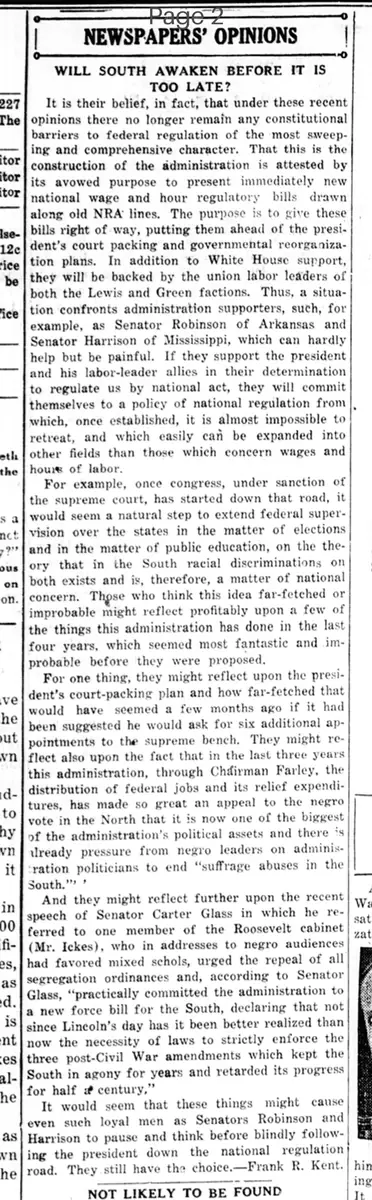
NEWSPAPERS' OPINIONS
WILL SOUTH AWAKEN BEFORE IT IS TOO LATE?
It is their belief, in fact, that under these recent opinions there no longer remain any constitutional barriers to federal regulation of the most sweeping and comprehensive character. That this is the construction of the administration is attested by its avowed purpose to present immediately new national wage and hour regulatory bills drawn along old NRA lines. The purpose is to give these bills right of way, putting them ahead of the president's court packing and governmental reorganization plans. In addition to White House support they will be backed by the union labor leaders of both the Lewis and Green factions. Thus, a situation confronts administration supporters, such, for example, as Senator Robinson of Arkansas and Senator Harrison of Mississippi, which can hardly help but be painful. If they support the president and his labor-leader allies in their determination to regulate us by national act, they will commit themselves to a policy of national regulation from which, once established, it is almost impossible to retreat, and which easily can be expanded into other fields than those which concern wages and hours of labor.
For example, once congress, under sanction of the supreme court, has started down that road, it would seem a natural step to extend federal supervision over the states in the matter of elections and in the matter of public education, on the theory that in the South racial discriminations both exist and is, therefore, a matter of national concern. Those who think this idea far-fetched or improbable might reflect profitably upon a few of the things this administration has done in the last four years, which seemed most fantastic and improbable before they were proposed.
For one thing, they might reflect upon the president's court-packing plan and how far-fetched that would have seemed a few months ago if it had been suggested he would ask for six additional appointments to the supreme bench. They might reflect also upon the fact that in the last three years this administration, through Chairman Farley, the distribution of federal jobs and its relief expenditures, has made so great an appeal to the negro vote in the North that it is now one of the biggest of the administration's political assets and there is already pressure from negro leaders on administration politicians to end "suffrage abuses in the South."
And they might reflect further upon the recent speech of Senator Carter Glass in which he referred to one member of the Roosevelt cabinet (Mr. Ickes), who in addresses to negro audiences had favored mixed schools, urged the repeal of all segregation ordinances and, according to Senator Glass, "practically committed the administration to a new force bill for the South, declaring that not since Lincoln's day has it been better realized than now the necessity of laws to strictly enforce the three post-Civil War amendments which kept the South in agony for years and retarded its progress for half a century."
It would seem that these things might cause even such loyal men as Senators Robinson and Harrison to pause and think before blindly following the president down the national regulation road. They still have the choice.—Frank R. Kent.
WILL SOUTH AWAKEN BEFORE IT IS TOO LATE?
It is their belief, in fact, that under these recent opinions there no longer remain any constitutional barriers to federal regulation of the most sweeping and comprehensive character. That this is the construction of the administration is attested by its avowed purpose to present immediately new national wage and hour regulatory bills drawn along old NRA lines. The purpose is to give these bills right of way, putting them ahead of the president's court packing and governmental reorganization plans. In addition to White House support they will be backed by the union labor leaders of both the Lewis and Green factions. Thus, a situation confronts administration supporters, such, for example, as Senator Robinson of Arkansas and Senator Harrison of Mississippi, which can hardly help but be painful. If they support the president and his labor-leader allies in their determination to regulate us by national act, they will commit themselves to a policy of national regulation from which, once established, it is almost impossible to retreat, and which easily can be expanded into other fields than those which concern wages and hours of labor.
For example, once congress, under sanction of the supreme court, has started down that road, it would seem a natural step to extend federal supervision over the states in the matter of elections and in the matter of public education, on the theory that in the South racial discriminations both exist and is, therefore, a matter of national concern. Those who think this idea far-fetched or improbable might reflect profitably upon a few of the things this administration has done in the last four years, which seemed most fantastic and improbable before they were proposed.
For one thing, they might reflect upon the president's court-packing plan and how far-fetched that would have seemed a few months ago if it had been suggested he would ask for six additional appointments to the supreme bench. They might reflect also upon the fact that in the last three years this administration, through Chairman Farley, the distribution of federal jobs and its relief expenditures, has made so great an appeal to the negro vote in the North that it is now one of the biggest of the administration's political assets and there is already pressure from negro leaders on administration politicians to end "suffrage abuses in the South."
And they might reflect further upon the recent speech of Senator Carter Glass in which he referred to one member of the Roosevelt cabinet (Mr. Ickes), who in addresses to negro audiences had favored mixed schools, urged the repeal of all segregation ordinances and, according to Senator Glass, "practically committed the administration to a new force bill for the South, declaring that not since Lincoln's day has it been better realized than now the necessity of laws to strictly enforce the three post-Civil War amendments which kept the South in agony for years and retarded its progress for half a century."
It would seem that these things might cause even such loyal men as Senators Robinson and Harrison to pause and think before blindly following the president down the national regulation road. They still have the choice.—Frank R. Kent.
What sub-type of article is it?
Constitutional
Economic Policy
Partisan Politics
What keywords are associated?
Federal Regulation
Wage Hour Laws
Court Packing
Southern Autonomy
Racial Discrimination
Negro Vote
Suffrage Abuses
Segregation
What entities or persons were involved?
President Roosevelt
Senator Robinson Of Arkansas
Senator Harrison Of Mississippi
Senator Carter Glass
Mr. Ickes
Chairman Farley
Lewis And Green Labor Leaders
Editorial Details
Primary Topic
Warning Against Federal Regulation Extending To Southern Racial Issues
Stance / Tone
Cautionary Opposition To Federal Overreach
Key Figures
President Roosevelt
Senator Robinson Of Arkansas
Senator Harrison Of Mississippi
Senator Carter Glass
Mr. Ickes
Chairman Farley
Lewis And Green Labor Leaders
Key Arguments
No Constitutional Barriers Remain To Sweeping Federal Regulation Per Recent Supreme Court Opinions
Administration Plans New National Wage And Hour Bills Like Old Nra, Backed By Labor Leaders
Supporting These Commits To Irreversible National Regulation Expandable To Other Fields
Could Extend To Federal Supervision Of Southern Elections And Education Due To Racial Discriminations
Reflect On Improbable Past Actions Like Court Packing Plan
Administration's Appeal To Northern Negro Vote Pressures End To Southern Suffrage Abuses
Ickes Favors Mixed Schools, Repeal Of Segregation, And Enforcement Of Post Civil War Amendments