Thank you for visiting SNEWPapers!
Sign up free
Gazette Of The United States & Evening Advertiser
Philadelphia, Philadelphia County, Pennsylvania
What is this article about?
Mr. Smith of South Carolina argues in the House against striking out a section of a bill punishing crimes against the US, focusing on prohibiting the sale of French prizes in US ports to maintain neutrality, citing treaties with France, Britain, Holland, and authorities like Vattel and Jefferson.
Clipping
OCR Quality
Full Text
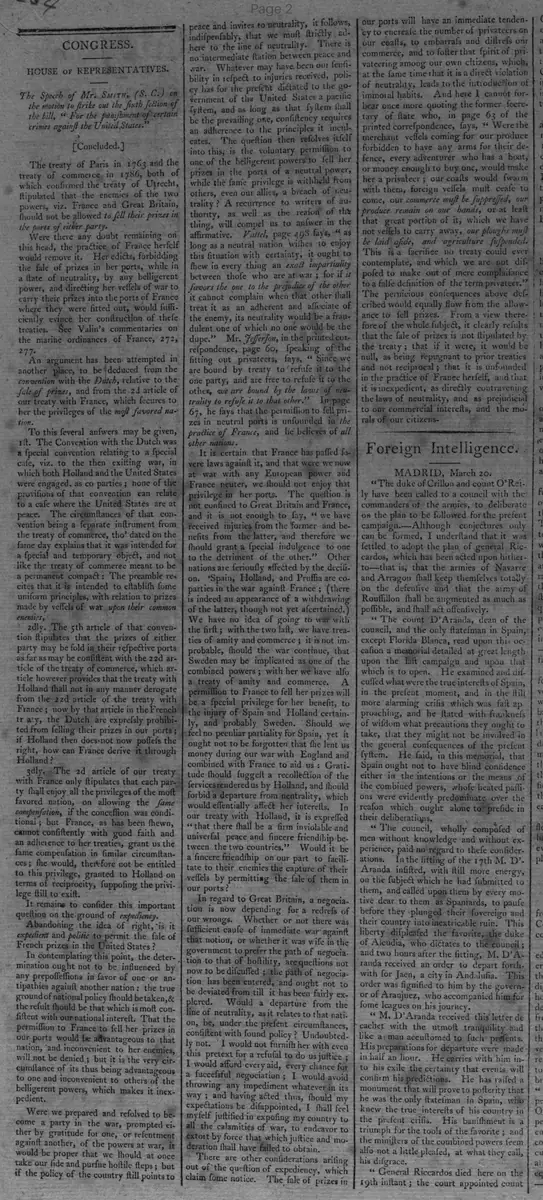
HOUSE OF REPRESENTATIVES.
The Speech of Mr. SMITH, (S. C.) on the motion to strike out the sixth section of the bill, "For the punishment of certain crimes against the United States."
[Concluded.]
The treaty of Paris in 1763 and the treaty of commerce in 1786, both of which confirmed the treaty of Utrecht, stipulated that the enemies of the two powers, viz. France and Great Britain, should not be allowed to sell their prizes in the ports of either party.
Were there any doubt remaining on this head, the practice of France herself would remove it. Her edicts, forbidding the sale of prizes in her ports, while in a state of neutrality, by any belligerent power, and directing her vessels of war to carry their prizes into the ports of France where they were fitted out, would sufficiently evince her construction of these treaties. See Valin's commentaries on the marine ordinances of France, 272, 277.
An argument has been attempted in another place, to be deduced from the convention with the Dutch, relative to the sale of prizes, and from the 2d article of our treaty with France, which secures to her the privileges of the most favored nation.
To this several answers may be given,
1st. The Convention with the Dutch was a special convention relating to a special case, viz. to the then existing war, in which both Holland and the United States were engaged, as co-parties; none of the provisions of that convention can relate to a case where the United States are at peace. The circumstances of that convention being a separate instrument from the treaty of commerce, tho' dated on the same day explains that it was intended for a special and temporary object, and not like the treaty of commerce meant to be a permanent compact: The preamble recites that it is intended to establish some uniform principles, with relation to prizes made by vessels of war upon their common enemies,
2dly. The 5th article of that convention stipulates that the prizes of either party may be sold in their respective ports as far as may be consistent with the 22d article of the treaty of commerce, which article however provides that the treaty with Holland shall not in any manner derogate from the 22d article of the treaty with France; now by that article in the French treaty, the Dutch are expressly prohibited from selling their prizes in our ports; if Holland then does not now possess the right, how can France derive it through Holland?
3dly. The 2d article of our treaty with France only stipulates that each party shall enjoy all the privileges of the most favored nation, on allowing the same compensation, if the concession was conditional; but France, as has been shown, cannot consistently with good faith and an adherence to her treaties, grant us the same compensation in similar circumstances; she would, therefore not be entitled to this privilege, granted to Holland on terms of reciprocity, supposing the privilege still to exist.
It remains to consider this important question on the ground of expediency.
Abandoning the idea of right, is it expedient and politic to permit the sale of French prizes in the United States?
In contemplating this point, the determination ought not to be influenced by any prepossessions in favor of one or antipathies against another nation: the true ground of national policy should be taken, & the result should be that which is most consistent with our national interest. That the permission to France to sell her prizes in our ports would be advantageous to that nation, and inconvenient to her enemies, will not be denied.; but it is the very circumstance of its thus being advantageous to one and inconvenient to others of the belligerent powers, which makes it inexpedient.
Were we prepared and resolved to become a party in the war, prompted either by gratitude for one, or resentment against another, of the powers at war, it would be proper that we should at once take our side and pursue hostile steps; but if the policy of the country still points to peace and invites to neutrality, it follows, indispensably, that we must strictly adhere to the line of neutrality. There is no intermediate station between peace and war. Whatever may have been our sensibility in respect to injuries received, policy has for the present dictated to the government of the United States a pacific system, and as long as that system shall be the prevailing one, consistency requires an adherence to the principles it inculcates. The question then resolves itself into this; is the voluntary permission to one of the belligerent powers to sell her prizes in the ports of a neutral power, while the same privilege is withheld from others, even our allies, a breach of neutrality? A recurrence to writers of authority, as well as the reason of the thing, will compel us to answer in the affirmative. Vattel, page 498 says, "as long as a neutral nation wishes to enjoy this situation with certainty, it ought to show in every thing an exact impartiality between those who are at war ; for if it favors the one to the prejudice of the other it cannot complain when that other shall treat it as an adherent and associate of the enemy, its neutrality would be a fraudulent one of which no one would be the dupe." Mr. Jefferson, in the printed correspondence, page 60, speaking of the fitting out privateers, says, "Since we are bound by treaty to refuse it to the one party, and are free to refuse it to the other, we are bound by the laws of neutrality to refuse it to that other." In page 67, he says that the permission to sell prizes in neutral ports is unfounded in the practice of France, and he believes of all other nations.
It is certain that France has passed severe laws against it, and that were we now at war with any European power and France neuter, we should not enjoy that privilege in her ports. The question is not confined to Great Britain and France, and it is not enough to say, "we have received injuries from the former and benefits from the latter, and therefore we should grant a special indulgence to one to the detriment of the other." Other nations are seriously affected by the decision. Spain, Holland, and Prussia are co-parties in the war against France; (there is indeed an appearance of a withdrawing of the latter, though not yet ascertained.) We have no idea of going to war with the first; with the two last, we have treaties of amity and commerce ; it is not improbable, should the war continue, that Sweden may be implicated as one of the combined powers; with her we have also a treaty of amity and commerce. A permission to France to sell her prizes will be a special privilege for her benefit, to the injury of Spain and Holland certainly, and probably Sweden. Should we feel no peculiar partiality for Spain, yet it ought not to be forgotten that she lent us money during our war with England and combined with France to aid us : Gratitude should suggest a recollection of the services rendered us by Holland, and should forbid a departure from neutrality, which would essentially affect her interests. In our treaty with Holland, it is expressed "that there shall be a firm inviolable and universal peace and sincere friendship between the two countries." Would it be a sincere friendship on our part to facilitate to their enemies the capture of their vessels by permitting the sale of them in our ports?
In regard to Great Britain, a negotiation is now depending for a redress of our wrongs. Whether or not there was sufficient cause of immediate war against that nation, or whether it was wise in the government to prefer the path of negotiation to that of hostility, are questions not now to be discussed ; the path of negotiation has been entered, and ought not to be deviated from till it has been fairly explored. Would a departure from the line of neutrality, as it relates to that nation, under the present circumstances, be consistent with sound policy? Undoubtedly not. I would not furnish her with even this pretext for a refusal to do us justice ; I would afford every aid, every chance for a successful negotiation ; I would avoid throwing any impediment whatever in its way ; and having acted thus, should my expectations be disappointed, I shall feel myself justified in exposing my country to all the calamities of war, to endeavor to extort by force that which justice and moderation shall have failed to obtain.
There are other considerations arising out of the question of expediency, which claim some notice. The sale of prizes in our ports will have an immediate tendency to increase the number of privateers on our coasts, to embarrass and distress our commerce, and to foster that spirit of privateering among our own citizens, which, at the same time that it is a direct violation of neutrality, leads to the introduction of immoral habits. And here I cannot forbear once more quoting the former secretary of state who, in page 63 of the printed correspondence, says, "Were the merchant vessels coming for our produce forbidden to have any arms for their defence, every adventurer who has a boat, or money enough to buy one, would make her a privateer ; our coasts would swarm with them, foreign vessels must cease to come, our commerce must be suppressed, our produce remain on our hands, or at least that great portion of it, which we have not vessels to carry away, our ploughs must be laid aside, and agriculture suspended. This is a sacrifice no treaty could ever contemplate, and which we are not disposed to make out of mere complaisance to a false definition of the term privateer."
The pernicious consequences above described would equally flow from the allowance to sell prizes. From a view therefore of the whole subject, it clearly results that the sale of prizes is not stipulated by the treaty; that if it were, it would be null, as being repugnant to prior treaties and not reciprocal; that it is unfounded in the practice of France herself, and that it is inexpedient, as directly contravening the laws of neutrality, and as prejudicial to our commercial interests, and the morals of our citizens.
What sub-type of article is it?
What themes does it cover?
What keywords are associated?
What entities or persons were involved?
Where did it happen?
Story Details
Key Persons
Location
United States Ports
Story Details
Mr. Smith argues that treaties prohibit selling enemy prizes in allied ports, refutes claims based on Dutch convention and French most-favored-nation status, and asserts that allowing French prizes sales breaches neutrality, harms allies like Spain and Holland, risks commerce, and contradicts expediency for peace.