Thank you for visiting SNEWPapers!
Sign up free
The Sun
New York, New York County, New York
What is this article about?
Rome is expected to uphold the French Christian Brothers' ban on teaching classics in U.S. schools, despite appeals from American bishops like Archbishop Riordan and Bishop Byrne. The Brothers may withdraw from the French order to form an American community, as classics are essential for their colleges.
Clipping
OCR Quality
Full Text
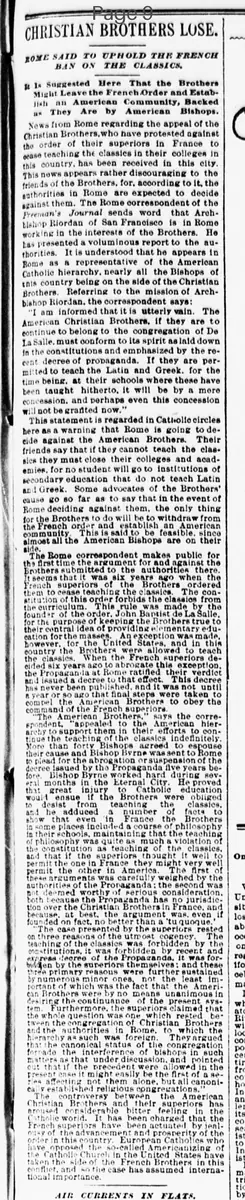
ROME SAID TO UPHOLD THE FRENCH BAN ON THE CLASSICS.
It Is Suggested Here That the Brothers Might Leave the French Order and Establish an American Community, Backed as They Are by American Bishops.
News from Rome regarding the appeal of the Christian Brothers, who have protested against the order of their superiors in France to cease teaching the classics in their colleges in this country, has been received in this city.
This news appears rather discouraging to the friends of the Brothers, for, according to it, the authorities in Rome are expected to decide against them. The Rome correspondent of the Freeman's Journal sends word that Archbishop Riordan of San Francisco is in Rome working in the interests of the Brothers. He has presented a voluminous report to the authorities. It is understood that he appears in Rome as a representative of the American Catholic hierarchy, nearly all the Bishops of this country being on the side of the Christian Brothers. Referring to the mission of Archbishop Riordan, the correspondent says:
"I am informed that it is utterly vain. The American Christian Brothers, if they are to continue to belong to the congregation of De La Salle, must conform to its spirit as laid down in the constitutions and emphasized by the recent decree of propaganda. If they are permitted to teach the Latin and Greek, for the time being, at their schools where these have been taught hitherto, it will be by a mere concession, and perhaps even this concession will not be granted now."
This statement is regarded in Catholic circles here as a warning that Rome is going to decide against the American Brothers. Their friends say that if they cannot teach the classics they must close their colleges and academies, for no student will go to institutions of secondary education that do not teach Latin and Greek. Some advocates of the Brothers' cause go so far as to say that in the event of Rome deciding against them, the only thing for the Brothers to do will be to withdraw from the French order and establish an American community. This is said to be feasible, since almost all the American Bishops are on their side.
The Rome correspondent makes public for the first time the argument for and against the Brothers submitted to the authorities there.
It seems that it was six years ago when the French superiors of the Brothers ordered them to cease teaching the classics. The constitution of this order forbids the classics from the curriculum. This rule was made by the founder of the order, John Baptist de La Salle, for the purpose of keeping the Brothers true to their central idea of providing elementary education for the masses. An exception was made, however, for the United States, and in this country the Brothers were allowed to teach the classics. When the French superiors decided six years ago to abrogate this exception, the Propaganda at Rome ratified their verdict and issued a decree to that effect. This decree has never been published, and it was not until a year or so ago that final steps were taken to compel the American Brothers to obey the command of the French superiors.
The American Brothers, says the correspondent, "appealed to the American hierarchy to support them in their efforts to continue the teaching of the classics indefinitely. More than forty Bishops agreed to espouse their cause and Bishop Byrne was sent to Rome to plead for the abrogation or suspension of the decree issued by the Propaganda five years before. Bishop Byrne worked hard during several months in the Eternal City. He proved that great injury to Catholic education would ensue if the Brothers were obliged to desist from teaching the classics, and he adduced a number of facts to show that even in France the Brothers in some places included a course of philosophy in their schools, maintaining that the teaching of philosophy was quite as much a violation of the constitution as teaching of the classics, and that if the superiors thought it well to permit the one in France they might very well permit the other in America. The first of these arguments was carefully weighed by the authorities of the Propaganda; the second was not deemed worthy of serious consideration, both because the Propaganda has no jurisdiction over the Christian Brothers in France, and because, at best, the argument was, even if founded on fact, no better than a tu quoque."
"The case presented by the superiors rested on three reasons of the utmost cogency. The teaching of the classics was forbidden by the constitutions, it was forbidden by recent and express decree of the Propaganda, it was forbidden by the superiors themselves; and these three primary reasons were further sustained by numerous minor ones, not the least important of which was the fact that the American Brothers were by no means unanimous in desiring the continuance of the present system. Furthermore, the superiors claimed that the whole question was one which rested between the congregation of Christian Brothers and the authorities in Rome, to which the hierarchy as such was foreign. They argued that the canonical status of the congregation forbade the interference of bishops in such matters as that under discussion, and pointed out that if the precedent were allowed in the present case it might easily be the first of a series affecting not them alone, but all canonical established religious congregations."
The controversy between the American Christian Brothers and their superiors has aroused considerable bitter feeling in the Catholic world. It has been charged that the French superiors have been actuated by jealousy of the advancement and prosperity of the order in this country. European Catholics who have opposed the so-called Americanizing of the Catholic Church in the United States have taken the side of the French Brothers in this conflict, and so the case has assumed international importance.
What sub-type of article is it?
What keywords are associated?
What entities or persons were involved?
Where did it happen?
Domestic News Details
Primary Location
United States
Key Persons
Outcome
rome expected to uphold french ban on teaching classics; american brothers may close colleges or withdraw from french order to establish american community.
Event Details
American Christian Brothers appealed to Rome against French superiors' order to cease teaching classics in U.S. schools, supported by American bishops including Archbishop Riordan and Bishop Byrne. Rome likely to decide against them, enforcing order's constitution forbidding classics except previously allowed in U.S. Controversy involves jealousy and Americanizing of Catholic Church.