Thank you for visiting SNEWPapers!
Sign up free
The Lakeland Evening Telegram
Lakeland, Polk County, Florida
What is this article about?
Biographical revelation of O. Henry's three-year imprisonment in Columbus Penitentiary for embezzlement, his flight to Central America, return for trial, and how prison life inspired his renowned short stories, transforming adversity into literary success.
Clipping
OCR Quality
Full Text
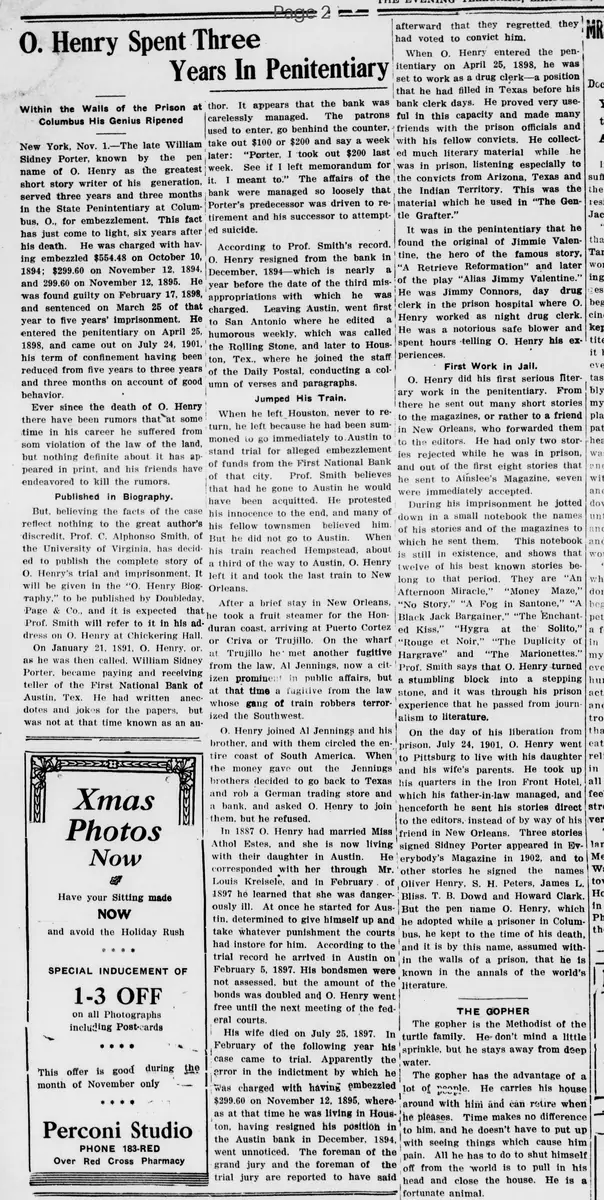
Within the Walls of the Prison at Columbus His Genius Ripened
New York, Nov. 1.—The late William Sidney Porter, known by the pen name of O. Henry as the greatest short story writer of his generation, served three years and three months in the State Penitentiary at Columbus, O., for embezzlement. This fact has just come to light, six years after his death. He was charged with having embezzled $554.48 on October 10, 1894; $299.60 on November 12, 1894, and $299.60 on November 12, 1895. He was found guilty on February 17, 1898, and sentenced on March 25 of that year to five years' imprisonment. He entered the penitentiary on April 25, 1898, and came out on July 24, 1901, his term of confinement having been reduced from five years to three years and three months on account of good behavior.
Ever since the death of O. Henry there have been rumors that at some time in his career he suffered from some violation of the law of the land, but nothing definite about it has appeared in print, and his friends have endeavored to kill the rumors.
Published in Biography.
But, believing the facts of the case reflect nothing to the great author's discredit, Prof. C. Alphonso Smith, of the University of Virginia, has decided to publish the complete story of O. Henry's trial and imprisonment. It will be given in the "O. Henry Biography," to be published by Doubleday, Page & Co., and it is expected that Prof. Smith will refer to it in his address on O. Henry at Chickering Hall.
On January 21, 1891, O. Henry, or, as he was then called, William Sidney Porter, became paying and receiving teller of the First National Bank of Austin, Tex. He had written anecdotes and jokes for the papers, but was not at that time known as an author. It appears that the bank was carelessly managed. The patrons used to enter, go behind the counter, take out $100 or $200 and say a week later: "Porter, I took out $200 last week. See if I left memorandum for it. I meant to." The affairs of the bank were managed so loosely that Porter's predecessor was driven to retirement and his successor to attempted suicide.
According to Prof. Smith's record, O. Henry resigned from the bank in December, 1894, which is nearly a year before the date of the third misappropriation with which he was charged. Leaving Austin, went first to San Antonio where he edited a humorous weekly, which was called the Rolling Stone, and later to Houston, Tex., where he joined the staff of the Daily Post, conducting a column of verses and paragraphs.
Jumped His Train.
When he left Houston, never to return, he left because he had been summoned to go immediately to Austin to stand trial for alleged embezzlement of funds from the First National Bank of that city. Prof. Smith believes that had he gone to Austin he would have been acquitted. He protested his innocence to the end, and many of his fellow townsmen believed him. But he did not go to Austin. When his train reached Hempstead, about a third of the way to Austin, O. Henry left it and took the last train to New Orleans.
After a brief stay in New Orleans, he took a fruit steamer for the Honduras coast, arriving at Puerto Cortez or Ceiba or Trujillo. On the wharf at Trujillo he met another fugitive from the law, Al Jennings, now a citizen prominent in public affairs, but at that time a fugitive from the law whose gang of train robbers terrorized the Southwest.
O. Henry joined Al Jennings and his brother, and with them circled the entire coast of South America. When the money gave out the Jennings brothers decided to go back to Texas and rob a German trading store and a bank, and asked O. Henry to join them, but he refused.
In 1887 O. Henry had married Miss Athol Estes, and she is now living with their daughter in Austin. He corresponded with her through Mr. Louis Kreise, and in February of 1897 he learned that she was dangerously ill. At once he started for Austin, determined to give himself up and take whatever punishment the courts had in store for him. According to the trial record he arrived in Austin on February 5, 1897. His bondsmen were not assessed, but the amount of the bonds was doubled and O. Henry went free until the next meeting of the federal courts.
His wife died on July 25, 1897. In February of the following year his case came to trial. Apparently the error in the indictment by which he was charged with having embezzled $299.60 on November 12, 1895, whereas at that time he was living in Houston, having resigned his position in the Austin bank in December, 1894, went unnoticed. The foreman of the grand jury and the foreman of the trial jury are reported to have said afterward that they regretted they had voted to convict him.
When O. Henry entered the penitentiary on April 25, 1898, he was set to work as a drug clerk—a position that he had filled in Texas before his bank clerk days. He proved very useful in this capacity and made many friends with the prison officials and with his fellow convicts. He collected much literary material while he was in prison, listening especially to the convicts from Arizona, Texas and the Indian Territory. This was the material which he used in "The Gentle Grafter."
It was in the penitentiary that he found the original of Jimmie Valentine, the hero of the famous story, "A Retrieved Reformation" and later of the play "Alias Jimmy Valentine." He was Jimmy Connors, day drug clerk in the prison hospital where O. Henry worked as night drug clerk. He was a notorious safe blower and spent hours telling O. Henry his experiences.
First Work in Jail.
O. Henry did his first serious literary work in the penitentiary. From there he sent out many short stories to the magazines, or rather to a friend in New Orleans, who forwarded them to the editors. He had only two stories rejected while he was in prison, and out of the first eight stories that he sent to Ainslee's Magazine, seven were immediately accepted.
During his imprisonment he jotted down in a small notebook the names of his stories and of the magazines to which he sent them. This notebook is still in existence, and shows that twelve of his best known stories belong to that period. They are "An Afternoon Miracle," "Money Maze," "No Story," "A Fog in Santone," "A Black Jack Bargainer," "The Enchanted Kiss," "Hyggra at the Solito," "Rouge et Noir," "The Duplicity of Hargraves" and "The Marionettes."
Prof. Smith says that O. Henry turned a stumbling block into a stepping stone, and it was through his prison experience that he passed from journalism to literature.
On the day of his liberation from prison, July 24, 1901, O. Henry went to Pittsburg to live with his daughter and his wife's parents. He took up his quarters in the Iron Front Hotel, which his father-in-law managed, and henceforth he sent his stories direct to the editors, instead of by way of his friend in New Orleans. Three stories signed Sidney Porter appeared in Everybody's Magazine in 1902, and to other stories he signed the names Oliver Henry, S. H. Peters, James L. Bliss, T. B. Dowd and Howard Clark. But the pen name O. Henry, which he adopted while a prisoner in Columbus, he kept to the time of his death, and it is by this name, assumed within the walls of a prison, that he is known in the annals of the world's literature.
What sub-type of article is it?
What themes does it cover?
What keywords are associated?
What entities or persons were involved?
Where did it happen?
Story Details
Key Persons
Location
Columbus Penitentiary, Ohio; Austin, Texas; Houston, Texas; New Orleans; Honduras Coast; South America
Event Date
1887 1901
Story Details
William Sidney Porter (O. Henry) was convicted of embezzling from a bank in Austin, Texas, served time in Columbus Penitentiary where he developed his writing career, drawing inspiration from prison life and convicts, leading to his fame as a short story writer.