Thank you for visiting SNEWPapers!
Sign up free
The Virginia Gazette
Richmond, Williamsburg, Richmond County, Virginia
What is this article about?
Detailed account of Algiers' geography, climate, agriculture, manufactures, commerce, revenue, military forces, constitution, and population, noting its reliance on piracy and trade, with references to Spanish defeat and naval decline by 1732.
Clipping
OCR Quality
Full Text
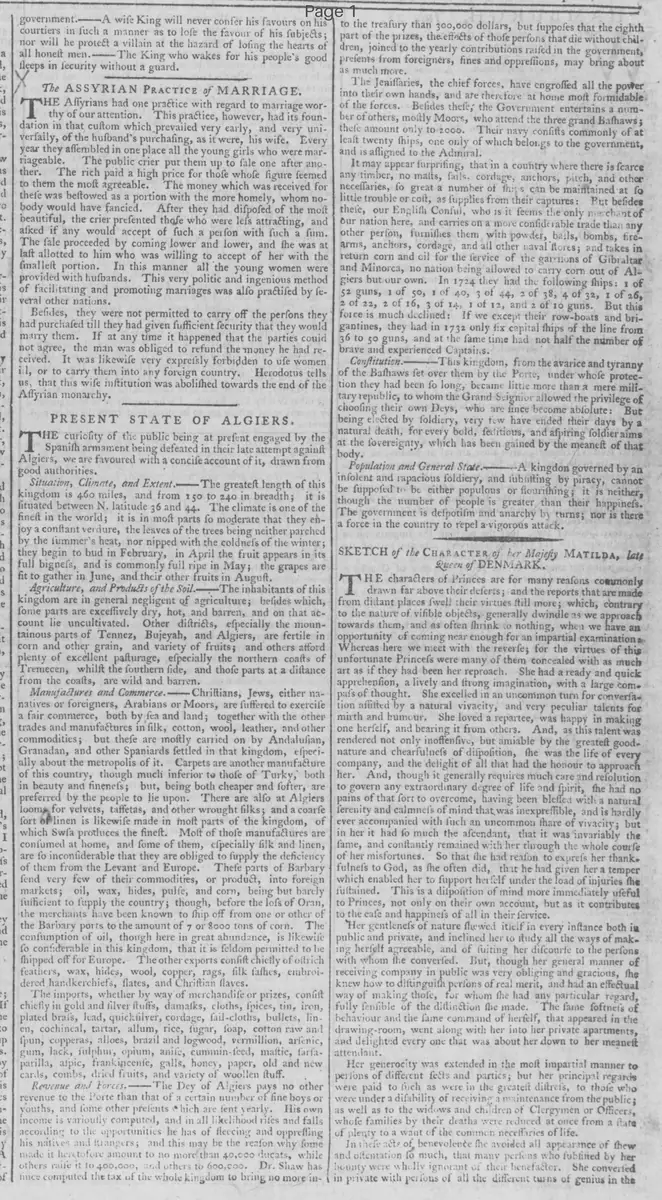
THE curiosity of the public being at present engaged by the Spanish armament being defeated in their late attempt against Algiers, we are favoured with a concise account of it, drawn from good authorities.
Situation, Climate, and Extent.
The greatest length of this kingdom is 460 miles, and from 150 to 240 in breadth; it is situated between N. latitude 36 and 44. The climate is one of the finest in the world; it is in most parts so moderate that they enjoy a constant verdure, the leaves of the trees being neither parched by the summer's heat, nor nipped with the coldness of the winter; they begin to bud in February, in April the fruit appears in its full bigness, and is commonly full ripe in May; the grapes are fit to gather in June, and their other fruits in August.
Agriculture, and Products of the Soil.
The inhabitants of this kingdom are in general negligent of agriculture; besides which, some parts are excessively dry, hot, and barren, and on that account lie uncultivated. Other districts, especially the mountainous parts of Tenez, Bugheyah, and Algiers, are fertile in corn and other grain, and variety of fruits; and others afford plenty of excellent pasture, especially the northern coasts of Tremecen, whilst the southern side, and those parts at a distance from the coasts, are wild and barren.
Manufactures and Commerce.
Christians, Jews, either natives or foreigners, Arabians or Moors, are suffered to exercise a fair commerce, both by sea and land; together with the other trades and manufactures in silk, cotton, wool, leather, and other commodities; but these are mostly carried on by Andalusian, Granadan, and other Spaniards settled in that kingdom, especially about the metropolis of it. Carpets are another manufacture of this country, though much inferior to those of Turkey, both in beauty and fineness; but, being both cheaper and softer, are preferred by the people to lie upon. There are also at Algiers looms for velvets, taffetas, and other wrought silks; and a coarse sort of linen is likewise made in most parts of the kingdom, of which Sufa produces the finest. Most of those manufactures are consumed at home, and some of them, especially silk and linen, are so inconsiderable that they are obliged to supply the deficiency of them from the Levant and Europe. These parts of Barbary send very few of their commodities, or product, into foreign markets; oil, wax, hides, pulse, and corn, being but barely sufficient to supply the country; though, before the loss of Oran, the merchants have been known to ship off from one or other of the Barbary ports to the amount of 7 or 8000 tons of corn. The consumption of oil, though here in great abundance, is likewise so considerable in this kingdom, that it is seldom permitted to be shipped off for Europe. The other exports consist chiefly of ostrich feathers, wax, hides, wool, copper, rags, silk sashes, embroidered handkerchiefs, salts, and Christian slaves.
The imports, whether by way of merchandise or prizes, consist chiefly in gold and silver stuffs, damasks, cloths, spices, tin, iron, plated brass, lead, quicksilver, cordage, sail-cloths, bullets, linen, cochineal, tartar, alum, rice, sugar, soap, cotton raw and spun, copperas, aloes, brazil and logwood, vermilion, arsenic, gum, lack, sulphur, opium, anise, cummin-seed, mastic, sarsaparilla, frankincense, galls, honey, paper, old and new cards, combs, dried fruits, and variety of woollen stuff.
Revenue and Forces.
The Dey of Algiers pays no other revenue to the Porte than that of a certain number of fine boys or youths, and some other presents which are sent yearly. His own income is variously computed, and in all likelihood rises and falls according to the opportunities he has of fleecing and oppressing his natives and strangers; and this may be the reason why some made it heretofore amount to no more than 40,000 ducats, while others raise it to 400,000, and others to 600,000. Dr. Shaw has likewise computed the tax of the whole kingdom to bring no more into the treasury than 300,000 dollars, but supposes that the eighth part of the prizes, the effects of those persons that die without children, joined to the yearly contributions raised in the government, presents from foreigners, fines and oppressions, may bring about as much more.
The Janizaries, the chief forces, have engrossed all the power into their own hands, and are therefore at home most formidable of the forces. Besides these, the Government entertains a number of others, mostly Moors, who attend the three grand Bashaws; these amount only to 2000. Their navy consists commonly of at least twenty ships, one only of which belongs to the government, and is assigned to the Admiral.
It may appear surprising, that in a country where there is scarce any timber, no masts, sails, cordage, anchors, pitch, and other necessaries, so great a number of ships can be maintained at so little trouble or cost, as supplies from their captures: But besides these, our English Consul, who is it seems the only merchant of our nation here, and carries on a more considerable trade than any other person, furnishes them with powder, balls, bombs, fire-arms, anchors, cordage, and all other naval stores; and takes in return corn and oil for the service of the garrisons of Gibraltar and Minorca, no nation being allowed to carry corn out of Algiers but our own. In 1724 they had the following ships: 1 of 52 guns, 1 of 50, 1 of 40, 3 of 34, 2 of 38, 4 of 32, 1 of 26, 2 of 22, 2 of 16, 3 of 14, 1 of 12, and 2 of 10 guns. But this force is much declined: If we except their row-boats and brigantines, they had in 1732 only six capital ships of the line from 36 to 20 guns, and at the same time had not half the number of brave and experienced Captains.
Constitution.
This kingdom, from the avarice and tyranny of the Bashaws set over them by the Porte, under whose protection they had been so long, became little more than a mere military republic, to whom the Grand Seignior allowed the privilege of choosing their own Deys, who are since become absolute: But being elected by soldiery, very few have ended their days by a natural death, for every bold, seditious, and aspiring soldier aims at the sovereignty, which has been gained by the meanest of that body.
Population and General State.
A kingdom governed by an insolent and rapacious soldiery, and subsisting by piracy, cannot be supposed to be either populous or flourishing; it is neither, though the number of people is greater than their happiness. The government is despotism and anarchy by turns; nor is there a force in the country to repel a vigorous attack.
What sub-type of article is it?
What keywords are associated?
What entities or persons were involved?
Where did it happen?
Foreign News Details
Primary Location
Algiers
Key Persons
Event Details
Comprehensive description of Algiers' geography, mild climate, limited agriculture, local manufactures in textiles and leather, commerce dominated by exports like oil, wax, hides, and imports of European goods, revenue from taxes and prizes estimated at 300,000-600,000 dollars, military reliant on Janizaries and a declining navy of about 20 ships supplied by captures and English trade, government as a military republic under the Dey elected by soldiers, and a population suffering under piracy-based despotism and anarchy.