Thank you for visiting SNEWPapers!
Sign up free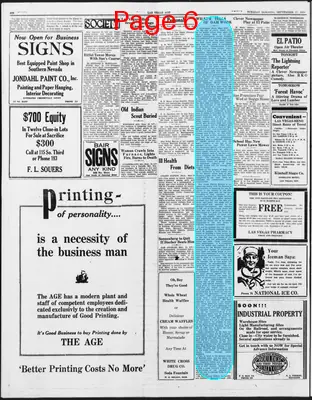
Domestic News
September 17, 1929
Las Vegas Age
Las Vegas, Clark County, Lincoln County, Nevada
What is this article about?
Ray Lyman Wilbur outlines Boulder Dam project plans in Sept. 1929, covering power agreements, design expansions, diversion structures, rail access, and worker accommodations for efficient construction in the Southwest.
Clipping

OCR Quality
98%
Excellent
Full Text
WILBUR TELLS OF DAM WORK
(Continued From Page One)
for the sale of power, which must be let before actual work upon the dam is begun. Each of the proposed participants, except Arizona, has submitted a statement outlining views as to what the plant should be, how much power each wants, and what this power is considered to be worth. Consideration is now being given to these various statements. I may say that I was very favorably impressed with the constructive attitude taken by all the individuals participating in these conferences, and am confident that in the near future a scheme of organization will be outlined for the operation of the plant and the distribution of the power among the various prospective participants.
In order to cope with the many problems connected with the design of the dam and appurtenant structures, the force of employees in the Denver office of the Bureau of Reclamation, the headquarters of Chief Engineer Walker and his technical advisers, will shortly be increased from 60 to more than 100. This is necessitated because of the immense amount of paper work that must be done in calculating stresses and drawing designs.
In addition to the dam proper, it is necessary to plan for and construct two cofferdams, one above the dam and one below, to provide for the diversion of the river during the period of construction, or until the main dam shall have reached a height sufficient to prevent its being over-topped by floods, and to keep the dam site dry. The upper cofferdam will be 80 feet high—a small dam in itself. Four great tunnels, each 50 feet in diameter and between 4,000 and 5,000 feet in length, will be designed and constructed to pass a flood of 200,000 second feet, with a freeboard of 20 feet remaining on the upper cofferdam and 10 feet on the lower.
Two of these 50-foot diversion tunnels will be used as permanent spillways, with a combined capacity of 338,000 second feet, with the water surface at the top of the parapet on the dam. The other two diversion tunnels and two power penstock tunnels will be used as main supply tunnels for the needle valve outlets, each of the four conduits supplying ten 72-inch needle valves. The discharge from the spillways, combined with that from the outlet works, will permit a total discharge capacity of about 450,000 second feet for passing the largest floods.
Work on the designs of these various structures is well under way in the Denver office, and all preliminary paper work will have been completed by the time funds are available for commencing actual construction.
The Union Pacific System is co-operating closely with the Bureau of Reclamation in planning for rail facilities to the vicinity of the dam. The present plan calls for the construction by that company of a branch line from Las Vegas, Nevada, to a switching yard about midway between that city and the dam site. From this point, two roads will be constructed and operated by the Federal Government, one running to the rim of the canyon above the dam site and the other down into the canyon to a point just below the dam. The location of these railroads has already been surveyed and practically decided upon. The grades are heavy, but by no means impossible to the new forms of traction equipment available.
It will be recalled that the failure of the great French engineer, Ferdinand de Lesseps, in his heroic attempt at building a canal across the Isthmus of Panama, was due largely to the fact that the health of the workmen was not adequately protected and their living conditions were unendurable. It is recognized that the health and comfort of the workmen on the Boulder Dam are factors that cannot be overlooked, and plans are being made to provide these essentials to effective and economical construction. The dam will be built in a canyon 1,600 feet deep. For four or five months in the summer, life in that gorge will necessarily be uncomfortable because of the intense heat. The cost of the dam would be largely increased if we have a high turnover of employees. To guard against this, we must provide against the discomforts of climate and make life there as satisfactory as possible. The eight-year construction period makes this of the utmost importance, and special attention is now being given to these problems.
During my recent trip to the dam site plans were outlined for the construction of a camp for the engineers and workmen. There will be about 1,000 employees in that camp, with a total population of three or four thousand. We have selected a site, open to the breezes that sweep down the valley, with a fine view. The camp buildings will be constructed of a type suitable to the climatic conditions. The plans call for the construction of a refrigeration plant, and for pumping a domestic water supply from the Colorado river 1,000 feet below. As the workmen will toil at the bottom of the canyon, we propose to construct great elevators twice as high as the Woolworth Building, with a lift of 1,000 feet, to carry the men to and from their work.
Upon completion of the dam, the construction camp will be a permanent town located on the margin of an artificial lake 100 miles in length, and will be a natural health and scenic resort, situated on the connecting roadway over the completed dam from Kingman, Arizona, to Las Vegas, Nevada, and forming a link in the great chain of automobile travel routes through scenic America.
This, in brief, is the present story of Boulder Dam, and our plans for its construction. What it means to the Imperial Valley and to the industrial development of the Southwest is well known. Certainly it marks a great forward step in the conservation of our natural resources and in putting them to constructive use.
—By Ray Lyman Wilbur, in "Southern California Business," Sept. 1929
(Continued From Page One)
for the sale of power, which must be let before actual work upon the dam is begun. Each of the proposed participants, except Arizona, has submitted a statement outlining views as to what the plant should be, how much power each wants, and what this power is considered to be worth. Consideration is now being given to these various statements. I may say that I was very favorably impressed with the constructive attitude taken by all the individuals participating in these conferences, and am confident that in the near future a scheme of organization will be outlined for the operation of the plant and the distribution of the power among the various prospective participants.
In order to cope with the many problems connected with the design of the dam and appurtenant structures, the force of employees in the Denver office of the Bureau of Reclamation, the headquarters of Chief Engineer Walker and his technical advisers, will shortly be increased from 60 to more than 100. This is necessitated because of the immense amount of paper work that must be done in calculating stresses and drawing designs.
In addition to the dam proper, it is necessary to plan for and construct two cofferdams, one above the dam and one below, to provide for the diversion of the river during the period of construction, or until the main dam shall have reached a height sufficient to prevent its being over-topped by floods, and to keep the dam site dry. The upper cofferdam will be 80 feet high—a small dam in itself. Four great tunnels, each 50 feet in diameter and between 4,000 and 5,000 feet in length, will be designed and constructed to pass a flood of 200,000 second feet, with a freeboard of 20 feet remaining on the upper cofferdam and 10 feet on the lower.
Two of these 50-foot diversion tunnels will be used as permanent spillways, with a combined capacity of 338,000 second feet, with the water surface at the top of the parapet on the dam. The other two diversion tunnels and two power penstock tunnels will be used as main supply tunnels for the needle valve outlets, each of the four conduits supplying ten 72-inch needle valves. The discharge from the spillways, combined with that from the outlet works, will permit a total discharge capacity of about 450,000 second feet for passing the largest floods.
Work on the designs of these various structures is well under way in the Denver office, and all preliminary paper work will have been completed by the time funds are available for commencing actual construction.
The Union Pacific System is co-operating closely with the Bureau of Reclamation in planning for rail facilities to the vicinity of the dam. The present plan calls for the construction by that company of a branch line from Las Vegas, Nevada, to a switching yard about midway between that city and the dam site. From this point, two roads will be constructed and operated by the Federal Government, one running to the rim of the canyon above the dam site and the other down into the canyon to a point just below the dam. The location of these railroads has already been surveyed and practically decided upon. The grades are heavy, but by no means impossible to the new forms of traction equipment available.
It will be recalled that the failure of the great French engineer, Ferdinand de Lesseps, in his heroic attempt at building a canal across the Isthmus of Panama, was due largely to the fact that the health of the workmen was not adequately protected and their living conditions were unendurable. It is recognized that the health and comfort of the workmen on the Boulder Dam are factors that cannot be overlooked, and plans are being made to provide these essentials to effective and economical construction. The dam will be built in a canyon 1,600 feet deep. For four or five months in the summer, life in that gorge will necessarily be uncomfortable because of the intense heat. The cost of the dam would be largely increased if we have a high turnover of employees. To guard against this, we must provide against the discomforts of climate and make life there as satisfactory as possible. The eight-year construction period makes this of the utmost importance, and special attention is now being given to these problems.
During my recent trip to the dam site plans were outlined for the construction of a camp for the engineers and workmen. There will be about 1,000 employees in that camp, with a total population of three or four thousand. We have selected a site, open to the breezes that sweep down the valley, with a fine view. The camp buildings will be constructed of a type suitable to the climatic conditions. The plans call for the construction of a refrigeration plant, and for pumping a domestic water supply from the Colorado river 1,000 feet below. As the workmen will toil at the bottom of the canyon, we propose to construct great elevators twice as high as the Woolworth Building, with a lift of 1,000 feet, to carry the men to and from their work.
Upon completion of the dam, the construction camp will be a permanent town located on the margin of an artificial lake 100 miles in length, and will be a natural health and scenic resort, situated on the connecting roadway over the completed dam from Kingman, Arizona, to Las Vegas, Nevada, and forming a link in the great chain of automobile travel routes through scenic America.
This, in brief, is the present story of Boulder Dam, and our plans for its construction. What it means to the Imperial Valley and to the industrial development of the Southwest is well known. Certainly it marks a great forward step in the conservation of our natural resources and in putting them to constructive use.
—By Ray Lyman Wilbur, in "Southern California Business," Sept. 1929
What sub-type of article is it?
Infrastructure
Economic
What keywords are associated?
Boulder Dam
Construction Plans
Bureau Of Reclamation
Power Distribution
Diversion Tunnels
Worker Camp
Rail Facilities
What entities or persons were involved?
Ray Lyman Wilbur
Chief Engineer Walker
Where did it happen?
Boulder Dam Site
Domestic News Details
Primary Location
Boulder Dam Site
Event Date
Sept. 1929
Key Persons
Ray Lyman Wilbur
Chief Engineer Walker
Event Details
Ray Lyman Wilbur discusses ongoing planning for Boulder Dam construction, including power sales agreements among participants, expansion of design staff in Denver, cofferdams and diversion tunnels, rail facilities cooperation with Union Pacific, and provisions for worker health and camp facilities to ensure efficient construction over eight years.