Thank you for visiting SNEWPapers!
Sign up free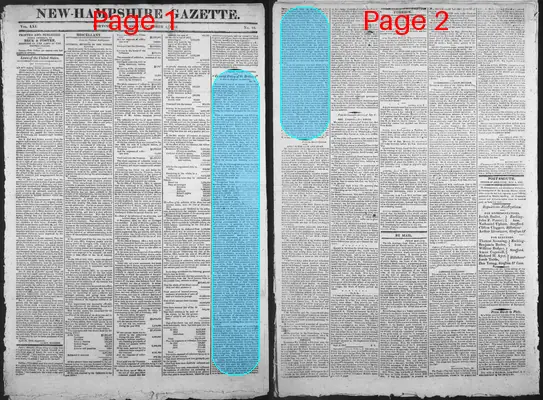
The New Hampshire Gazette
Portsmouth, Rockingham County, New Hampshire
What is this article about?
An article from the New-York Columbian critiques a British work on colonial policy portraying America as a rival. It discusses the flour trade, European wars boosting American exports, British corn laws restricting imports, and implications for American agriculture and emigration, suggesting reliance on Canadian colonies as granaries.
Merged-components note: Continuation of the article 'Colonial Policy of G. Britain; or War in Disguise on America. No. V.' across pages; original 'story' label changed to 'foreign_news' to match the international policy content.
Clippings

1 of 2
OCR Quality
Full Text
“ Colonial Policy of G. Britain ;"
or War in Disguise on America.
No. V.
We intend to travel at leisure through this
invidious work, which proposes (as already
seen) the most eligible measures, political, com-
mercial, and military. for checking the growth
and power of America. It represents her as
the " most insidious" and " aspiring rival." and
her inhabitants as the " natural born foes" of
England. We will occasionally pause in our
exposition for a reflection or two, or to allow
time to the reader to forget his indignation at
one passage, and attend to another. Indeed,
the worst is past. From perusing the be-
ginning, the reader is prepared for the remain-
der.
When a celebrated prisoner was following
the triumphers through the streets of Rome,
and saw the magnificence and riches around
him, he could not but wonder, that a people
who possessed so much should envy him of a lit-
tle cottage in Britain. When we recollect, that
modern England stands almost in the predica-
ment of old Rome. at the greatest extent of
the empire; that she has above eighty millions
of men directly subject to her, and directs, be-
sides, the courts of France, Portugal, &c &c.
by bribery, or overawes them by force; when
we minutely examine the map, and see the
vast acquisitions made by an island so small.
and that island still unsatisfied—we may well
give vent to wonder and indignation. On a
view of all this, we must deliberately conclude,
that as ambition and avarice are insatiable. we
have no safety from British artifice and rapaci-
ty, but in cultivating our own resources, mar-
shalling our means, and fostering a national
spirit.
We take the following extracts from the 15th
chapter, " on the flour trade ;" barely remark-
ing, that some excellent hints may now and
then be taken from this author. Enemy as he
is, we must give him credit for a few truths.
The intelligent reader will easily distinguish
between his falsehood and veracity, propriety
and absurdity :
" Europe has been desolated by bloody and
protracted wars, which : >e long since de-
stroyed the labor of the agriculturist, and this
country, in particular, has been compelled to
maintain large armies and numerous fleets,
which have equally contributed to advance the
price of field labor, and increase the demand
for flour ; thus producing an artificial scarcity
which the Americans alone could remedy. En-
joying the repose of peace, possessing an ex-
tensive and fertile country, sufficiently peopled
for the purposes of agriculture, they have raised
corn sufficient for the purposes of an extensive exportation ; and alive to the advantages
which the circumstances of the times had giv-
en them, of extending widely a lucrative com-
merce, both the general and particular govern-
ments of the United States held out the most
flattering encouragement to all who entered
their territories, by assigning them lands for
cultivation, or employing their labor. Thus,
the French revolution was not only attended
with the most dreadful consequences to the Eu-
ropean nations, but it paved the way for Amer-
ican aggrandizement. Multitudes escaping
from tyranny, oppression, and famine, in Eu-
rope, have sought an asylum on the shores of
America; in addition to which, revolutionary
principles, inculcated by insidious demagogues,
and animated by French example, had intoxica-
ted a large portion of the British poor. Chan-
ges in the mode of manufactures, by the intro.
duction of machinery. as well in the system of
farming in the highlands of Scotland. with dis-
contents in Ireland, and consequent rebellion,
have all severely contributed to pour considera-
ble numbers of the British population into the
bosom of the United States : and, swelled by
these tributary streams, the agriculture and
commerce of America rolled her confident
strength,like a mighty river,inundating Europe!
" The United States erroneously supposed,
that the people of Europe. and particularly
Great Britain, could not be supported indepen-
dent of their supplies of flour, and despising
the supposed incompetency.of their resources,
they presumptuously anticipated our prostra-
tion to her " rising empire." But while it must
be admitted that these foreign supports were
necessary during the rage of battle, and the de-
vasations of war, yet in times of peace the
measure is impolitic and absurd. Hence the
author is compelled to express his warmest ap-
probation of the late act of the British legisla-
ture, restraining the importation of corn, and
which, in his humble opinion, is fraught with
solid advantages to the country, though he
does not inquire how far this measure may be
abused by the rich, to the detriment of the
poor: His views are directed to the consolida-
tion of the strength of the empire, by employ-
ing its resources, which consequence must
follow, as the corn bill will check the over-
whelming torrent resulting from American ag-
riculture.
" In this country. the wants of an overflowing population preclude the possibility of corn
remaining on hand. The grower may always
ensure a market with ready payments ; and in-
stead of soliciting purchasers, the latter are
more inclined to apply themselves to him ; the
consequence is, he gradually attains to affluent
circumstances; and, generally speaking, the
whole body of agriculturists are, as they should
be, opulent. On the contrary, the American
farmers, comprehending them in the same gen-
eral view, are poor. Raised but little above a
state of indigence, they are nevertheless free-
holders, and can, with due attention, procure
ample subsistence for their families, but that is
all." Indeed, money is of little use to persons
who reside in the woods, manufacture their own
apparel, and live upon the produce of their
farms. The proportion of such cultivators as
these is very great; and the bulk of settlers
have not so much in view to enrich themselves,
as to be barely raised above a state of depen.
dence. Indeed, were my so inclined, unless great exportations were going on, it would be useless; since the collective amount of the small surplus of each farmer, without any extra arrangement, would be more than adequate to the home consumption. They therefore quietly repose on their own freeholds, feeling no want, acquiring little money, strengthening and feeding the nation, but not enriching it.
Distinct from these are the planters of Virginia, Maryland, and others who employ negro labor and embark large capitals. The southern climate like that of the West-Indies, disposes the white population to habits of indolence, which with the burdensome expense of maintaining negroes, and other circumstances, keep them in a state of dependence on the merchant.
When his staple commodities find a ready sale, he indulges in every species of extravagance; but should the foreign market be closed, he immediately ceases to raise articles for exportation, or they perish on his hands; while such is his depression, that he can scarcely obtain credit of the merchant for his negro clothing.
From the premises now laid down, it is evident that commerce is more essential to the American, than to the British agriculturist, inasmuch as it stimulates him to produce greater crops than he otherwise could do; introduces specie, not procurable through any other medium, procures foreign luxuries, gives an impetus to the whole country, converting the woods into productive fields and populous towns. But let the flour trade to this country and her dependencies cease, the political growth of the United States would be repressed; and in consequence of this diminished exportation, emigration from them, would to a large extent immediately ensue. It is in this view of the subject, that the author admires the political sagacity, evinced by the framers of the corn bill; and is led to hope that other measures, equally wise, will be adopted according to the circumstances of the times. But while this bill upholds the agriculture of the mother country, it is hoped it may be so modified, as not to check the colonies. This country may raise sufficient corn, in favorable seasons, to enable us to export considerable quantities of her native growth; but, in peculiar exigencies, this may not only be impossible, but she may unhappily experience an actual scarcity. It is therefore prudent to provide a granary, from whence regular supplies might be procured, in order to prevent the possibility of such an evil; and where can this be so well reposed, as in the Canadas, Nova Scotia and New-Brunswick!
What sub-type of article is it?
What keywords are associated?
Where did it happen?
Foreign News Details
Primary Location
Great Britain
Outcome
british corn bill restrains flour imports from america, potentially repressing us growth and prompting emigration; suggests using canadian colonies as granaries.
Event Details
Critique of British publication proposing measures to check American power through trade restrictions, focusing on chapter about flour trade. Discusses how European wars increased demand for American flour, immigration to US, British corn laws approvingly viewed to bolster empire, contrasts British and American farmers' conditions, and southern planters' dependence on exports.