Thank you for visiting SNEWPapers!
Sign up free
Virginia Argus
Richmond, Virginia
What is this article about?
Lieut. Gen. Graham reports a victorious British-Spanish action on March 5, 1811, at Barrosa Heights against Marshal Victor's French forces. Despite disadvantages, British troops routed the enemy, capturing an eagle, cannons, and prisoners, with heavy French losses estimated at 2000.
Clipping
OCR Quality
Full Text
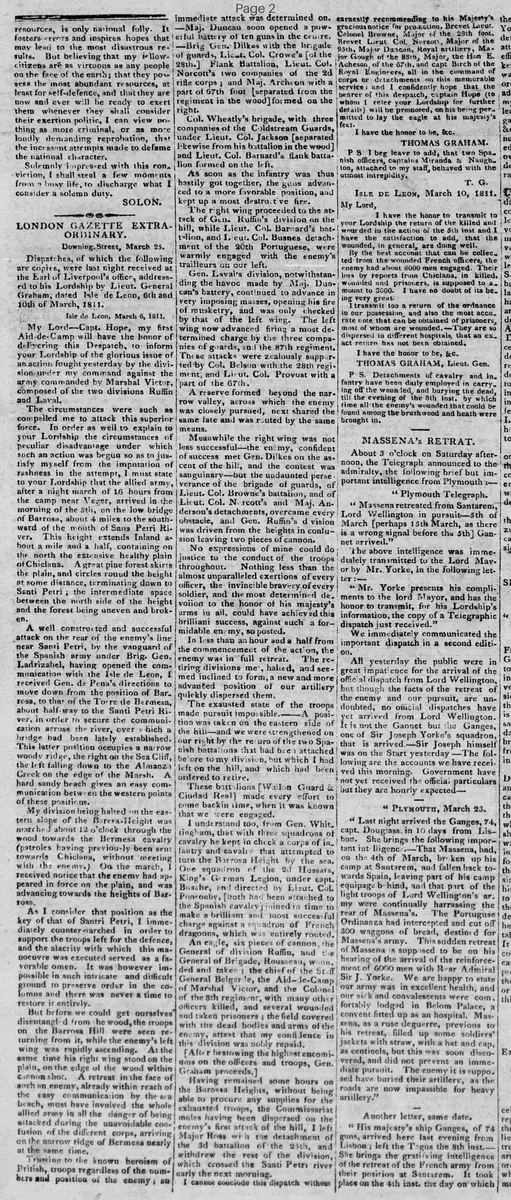
ORDINARY.
Downing Street, March 25.
Dispatches, of which the following are copies, were last night received at the Earl of Liverpool's office, addressed to his Lordship by Lieut. General Graham, dated Isle de Leon, 6th and 10th of March, 1811.
Isle de Leon, March 6, 1811.
My Lord--Capt. Hope, my first Aid-de-Camp will have the honor of delivering this Despatch, to inform your Lordship of the glorious issue of an action fought yesterday by the division under my command against the army commanded by Marshal Victor, composed of the two divisions Ruffin and Laval.
The circumstances were such as compelled me to attack this superior force. In order as well to explain to your Lordship the circumstances of peculiar disadvantage under which such an action was begun so as to justify myself from the imputation of rashness in the attempt, I must state to your Lordship that the allied army, after a night march of 16 hours from the camp near Veger, arrived in the morning of the 5th, on the low bridge of Barrosa, about 4 miles to the southward of the mouth of Santi Petri River. This height extends inland about a mile and a half, containing on the north the extensive healthy plain of Chiclana. A great pine forest skirts the plain, and circles round the height at some distance, terminating down to Santi Petri : the intermediate space between the north side of the height and the forest being uneven and broken,
A well constructed and successful attack on the rear of the enemy's line near Santi Petri, by the vanguard of the Spanish army under Brig. Gen. Ladruzabal, having opened the communication with the Isle de Leon, I received Gen. de la Pena's directions to move down from the position of Barrosa, to that of the Torre de Bermesa, about half-way to the Santi Petri River, in order to secure the communication across the river, over which a bridge had been lately established.
This latter position occupies a narrow woody ridge, the right on the Sea Cliff, the left falling down to the Almanzora Creek on the edge of the Marsh. A hard sandy beach gives an easy communication between the western points of these positions.
My division being halted on the eastern slope of the Barrosa Height was marched about 12 o'clock through the wood towards the Bermesa cavalry (patroles having previously been sent towards Chiclana, without meeting with the enemy.) On the march, I received notice that the enemy had appeared in force on the plain, and was advancing towards the heights of Barrosa.
As I consider that position as the key of that of Santi Petri, I immediately countermarched in order to support the troops left for the defence, and the alacrity with which this manoeuvre was executed served as a favorable omen. It was however impossible in such intricate and difficult ground to preserve order in the columns and there was never a time to restore it entirely.
But before we could get ourselves disentangled from the wood, the troops on the Barrosa Hill were seen returning from it, while the enemy's left wing was rapidly ascending. At the same time his right wing stood on the plain, on the edge of the wood within cannon shot. A retreat in the face of such an enemy, already within reach of the easy communication by the sea beach, must have involved the whole allied army in all the danger of being attacked during the unavoidable confusion of the different corps, arriving on the narrow ridge of Bermesa nearly at the same time.
Trusting to the known heroism of British troops regardless of the numbers and position of the enemy; an immediate attack was determined on.
-Maj. Duncan soon opened a powerful battery of ten guns in the centre.
-Brig Gen. Dilkes with the brigade of guards, Lieut. Col. Crowe's Flank Battalion, Lieut. Col. Norcott's two companies of the 2d rifle corps; and Maj. Archer with a part of 67th foot [separated from the regiment in the wood] formed on the right.
Col. Wheatley's brigade, with three companies of the Coldstream Guards, under Lieut. Col. Jackson [separated likewise from his battalion in the wood] and Lieut. Col. Barnard's flank battalion formed on the left.
As soon as the infantry was thus hastily got together, the guns advanced to a more favorable position, and kept up a most destructive fire.
The right wing proceeded to the attack of Gen. Ruffin's division on the hill, while Lieut. Col. Barnard's battalion, and Lieut. Col. Bunney's detachment of the 2d Portuguese, were warmly engaged with the enemy's tirailleurs on our left.
Gen. Laval's division, notwithstanding the havoc made by Maj. Duncan's battery, continued to advance in very imposing masses, opening his fire of musketry, and was only checked by that of the left wing. The left wing now advanced firing a most determined charge by the three companies of guards, and the 87th regiment.
These attacks were zealously supported by Col. Belson with the 28th regiment. and Lieut. Col. Provost with a part of the 67th.
A reserve formed beyond the narrow valley, across which the enemy was closely pursued, next shared the same fate and was routed by the same means.
Meanwhile the right wing was not less successful-the enemy, confident of success met Gen. Dilkes on the ascent of the hill, and the contest was sanguinary-but the undaunted perseverance of the brigade of guards, of Lieut. Col. Browne's battalion, and of Lieut. Col. Norcott's and Maj. Anderson's detachments, overcame every obstacle, and Gen. Ruffin's division was driven from the heights in confusion leaving two pieces of cannon.
No expressions of mine could do justice to the conduct of the troops throughout. Nothing less than the almost unparalleled exertions of every officer, the invincible bravery of every soldier, and the most determined devotion to the honor of his majesty's arms in all, could have achieved this brilliant success, against such a formidable enemy, so posted.
In less than an hour and a half from the commencement of the action, the enemy was in full retreat. The retiring divisions met, halted, and seemed inclined to form, a new and more advanced position of our artillery quickly dispersed them.
The exhausted state of the troops made pursuit impossible.--A position was taken on the eastern side of the hill-and we were strengthened on our right by the return of the two Spanish battalions that had been attached before to my division, but which I had left on the hill, and which had been ordered to retire.
These battalions Wallon Guard & Ciudad Reall made every effort to come back in time, when it was known that we were engaged.
I understand too, from Gen. Whittingham, that with three squadrons of cavalry he kept in check a corps of infantry and cavalry that attempted to turn the Barrosa Height by the sea.
One squadron of the 2d Hussars, King's German Legion, under capt. Busche, and directed by Lieut. Col. Ponsonby, [both had been attached to the Spanish cavalry] joined in time to make a brilliant and most successful charge against a squadron of French dragoons, which was entirely routed.
An eagle, six pieces of cannon, the General of division Ruffin, and the General of Brigade, Rousseau, wounded and taken ; the chief of the Staff General Belgrard, the Aid-de-Camp of Marshal Victor, and the Colonel of the 8th regiment, with many other officers killed, and several wounded and taken prisoners : the field covered with the dead bodies and arms of the enemy, attest that my confidence in this division was nobly repaid.
After bestowing the highest encomiums on the officers and troops, Gen. Graham proceeds.]
Having remained some hours on the Barrosa Heights, without being able to procure any supplies for the exhausted troops, the Commissariat mules having been dispersed on the enemy's first attack of the hill, I left Major Ross with the detachment of the 3d battalion of the 25th, and withdrew the rest of the division, which crossed the Santi Petri river early the next morning.
I cannot conclude this dispatch without earnestly recommending to his Majesty's gracious notice for promotion, Brevet Lieut. Colonel Browne, Major of the 28th foot, Brevet Lieut. Col. Norcott, Major of the 95th, Major Duncan, Royal Artillery, Major Gough of the 88th, Major, the Hon E. Acheson, of the 67th, and capt Birch of the Royal Engineers, all in the command of corps or detachments on this memorable service; and I confidently hope that the bearer of this despatch, captain Hope (to whom I refer your Lordship for further details) will be promoted, on his being permitted to lay the eagle at his majesty's feet.
I have the honor to be, &c.
THOMAS GRAHAM.
P S I beg leave to add, that two Spanish officers, captains Miranda & Naughton, attached to my staff, behaved with the utmost intrepidity.
r. G.
Isle De Leon, March 10, 1811.
My Lord,
I have the honor to transmit to your Lordship the return of the killed and wounded in the action of the 5th inst and I have the satisfaction to add, that the wounded, in general, are doing well.
By the best account that can be collected from the wounded French officers, the enemy had about 8000 men engaged. Their loss by reports from Chiclana, in killed, wounded and prisoners, is supposed to amount to 2000. I have no doubt of its being very great.
I transmit too a return of the ordnance in our possession, and also the most accurate note that can be obtained of prisoners, most of whom are wounded.-They are so dispersed in different hospitals, that an exact return has not been obtained.
I have the honor to be, &c.
THOMAS GRAHAM, Lieut. Gen.
P S. Detachments of cavalry and infantry have been daily employed in carrying off the wounded, and burying the dead, till the evening of the 5th inst. by which time all the enemy's wounded that could be found among the brushwood and heath were brought in.
What sub-type of article is it?
What keywords are associated?
What entities or persons were involved?
Where did it happen?
Foreign News Details
Primary Location
Barrosa Heights
Event Date
5th March 1811
Key Persons
Outcome
british and allied victory; enemy retreated with estimated 2000 killed, wounded, and prisoners; captured an eagle, six pieces of cannon, generals ruffin and rousseau (wounded and taken), other officers killed or captured; british casualties include killed and wounded (returns transmitted but not detailed here).
Event Details
Allied forces under Graham, after marching to Barrosa, faced superior French forces under Victor. Compelled to attack to prevent retreat risks, British troops formed lines, artillery opened fire, and infantry charged, routing Ruffin's and Laval's divisions in under 1.5 hours. Pursuit limited by exhaustion; position held with Spanish support; cavalry charges routed French dragoons.