Thank you for visiting SNEWPapers!
Sign up free
The Ely Miner
Ely, Saint Louis County, Minnesota
What is this article about?
US Department of Agriculture reports renewed interest in Jerusalem artichoke, a native US plant, for producing sweeter levulose sugar from tubers. Details cultivation similar to corn, wide uses including for diabetics, and publishes bulletin on varieties and economic potential.
Clipping
OCR Quality
Full Text
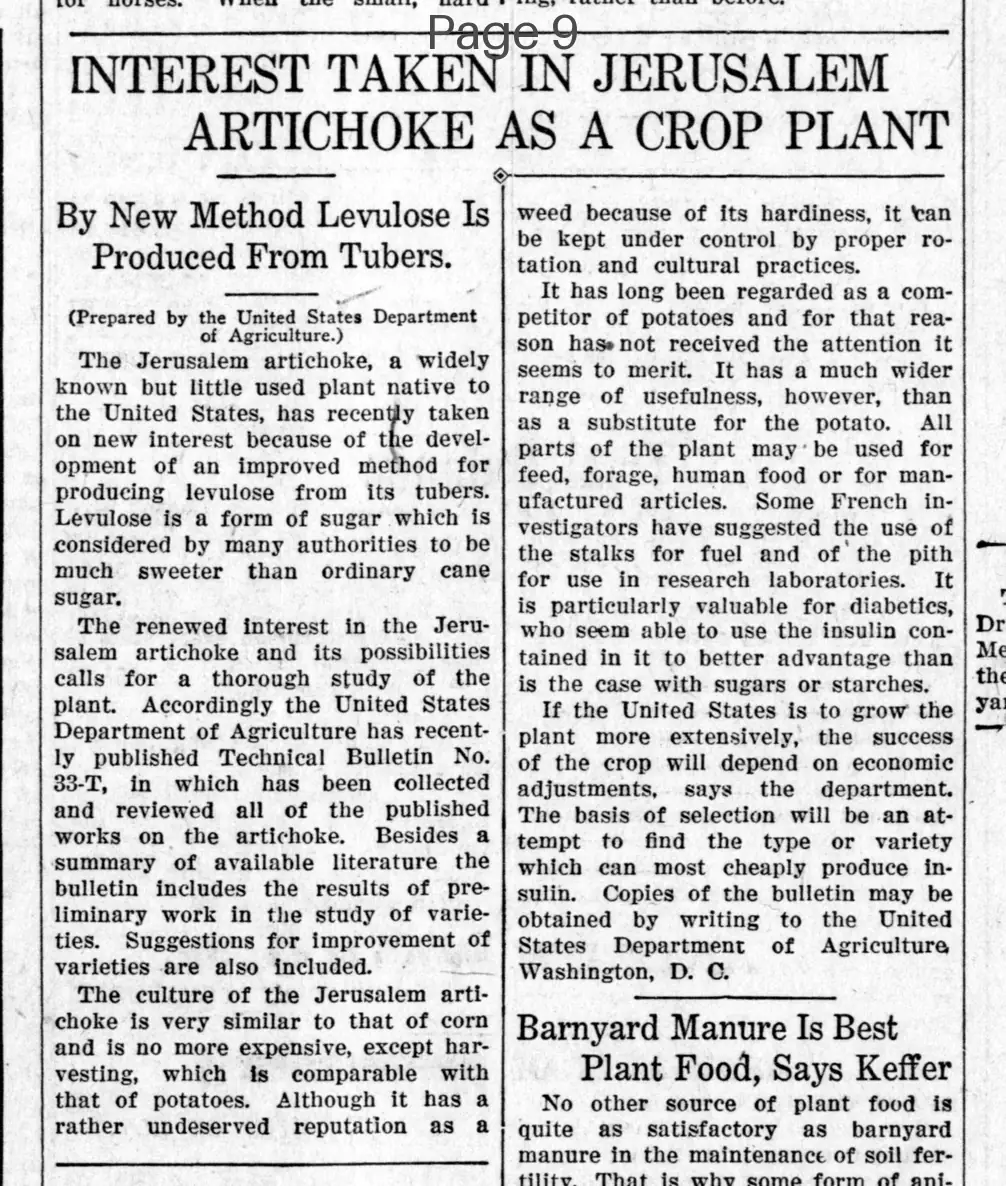
ARTICHOKE AS A CROP PLANT
By New Method Levulose Is
Produced From Tubers.
It is a weed because of its hardiness. It can
be kept under control by proper ro-
tation and cultural practices.
(Prepared by the United States Department
of Agriculture.)
The Jerusalem artichoke, a widely
known but little used plant native to
the United States, has recently taken
on new interest because of the devel-
opment of an improved method for
producing levulose from its tubers.
Levulose is a form of sugar which is
considered by many authorities to be
much sweeter than ordinary cane
sugar.
The renewed interest in the Jeru-
salem artichoke and its possibilities
calls for a thorough study of the
plant. Accordingly the United States
Department of Agriculture has recent-
ly published Technical Bulletin No.
33-T, in which has been collected
and reviewed all of the published
works on the artichoke. Besides a
summary of available literature the
bulletin includes the results of pre-
liminary work in the study of varie-
ties. Suggestions for improvement of
varieties are also included
The culture of the Jerusalem arti-
choke is very similar to that of corn
and is no more expensive, except har-
vesting, which is comparable with
that of potatoes. Although it has a
rather undeserved reputation as a
It has long been regarded as a com-
petitor of potatoes and for that rea-
son has not received the attention it
seems to merit. It has a much wider
range of usefulness, however, than
as a substitute for the potato. All
parts of the plant may be used for
feed, forage, human food or for man-
ufactured articles. Some French in-
vestigators have suggested the use of
the stalks for fuel and of the pith
for use in research laboratories. It
is particularly valuable for diabetics.
who seem able to use the insulin con-
tained in it to better advantage than
is the case with sugars or starches.
If the United States is to grow the
plant more extensively, the success
of the crop will depend on economic
adjustments, says the department.
The basis of selection will be an at-
tempt to find the type or variety
which can most cheaply produce in-
sulin. Copies of the bulletin may be
obtained by writing to the United
States Department of Agriculture
Washington, D. C.
What sub-type of article is it?
What keywords are associated?
Where did it happen?
Domestic News Details
Primary Location
United States
Outcome
renewed interest due to improved method for producing levulose; publication of usda technical bulletin no. 33-t with literature review, variety studies, and improvement suggestions; potential for extensive growth depending on economic adjustments and selection for cheap insulin production.
Event Details
The Jerusalem artichoke, native to the United States, has gained new interest from an improved method to produce levulose from its tubers, a sugar sweeter than cane sugar. The USDA published Technical Bulletin No. 33-T reviewing literature, preliminary variety studies, and suggestions for improvements. Cultivation is similar to corn, less expensive except for harvesting like potatoes. It is controlled by rotation and cultural practices despite reputation as a weed. It competes with potatoes but has wider uses: all parts for feed, forage, food, manufactured articles, fuel from stalks, pith for labs, and valuable for diabetics due to insulin it contains.