Thank you for visiting SNEWPapers!
Sign up free
The Evening Herald
Klamath Falls, Klamath County, Oregon
What is this article about?
Henrik Thornblom, a Swedish businessman, reports from Omsk, Siberia, that trade prospects with Soviet Russia are limited due to the revolution and war, with only 10,000 tons of raw materials like wool and hides available for export, far below expectations. Rebuilding will take years.
Clipping
OCR Quality
Full Text
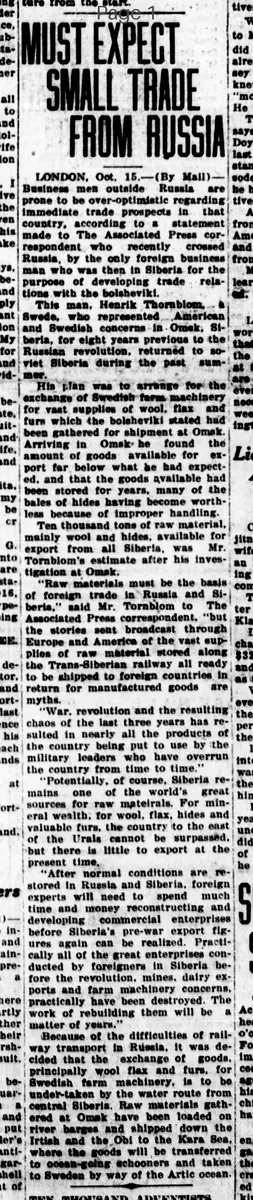
SMALL TRADE
FROM RUSSIA
LONDON, Oct. 15.-(By Mail)-
Business men outside Russia are prone to be over-optimistic regarding immediate trade prospects in that country, according to a statement made to The Associated Press correspondent who recently crossed Russia, by the only foreign business man who was then in Siberia for the purpose of developing trade relations with the bolsheviki.
This man, Henrik Thornblom, a Swede, who represented American and Swedish concerns in Omsk, Siberia, for eight years previous to the Russian revolution, returned to soviet Siberia during the past summer.
His plan was to arrange for the exchange of Swedish farm machinery for vast supplies of wool, flax and furs which the bolsheviki stated had been gathered for shipment at Omsk.
Arriving in Omsk he found the amount of goods available for export far below what he had expected, and that the goods available had been stored for years, many of the bales of hides having become worthless because of improper handling.
Ten thousand tons of raw material, mainly wool and hides, available for export from all Siberia, was Mr. Thornblom's estimate after his investigation at Omsk.
"Raw materials must be the basis of foreign trade in Russia and Siberia," said Mr. Thornblom to The Associated Press correspondent, "but the stories sent broadcast through Europe and America of the vast supplies of raw material stored along the Trans-Siberian railway all ready to be shipped to foreign countries in return for manufactured goods are myths.
"War, revolution and the resulting chaos of the last three years has resulted in nearly all the products of the country being put to use by the military leaders who have overrun the country from time to time."
"Potentially, of course, Siberia remains one of the world's great sources for raw materials. For mineral wealth, for wool, flax, hides and valuable furs, the country to the east of the Urals cannot be surpassed, but there is little to export at the present time.
"After normal conditions are restored in Russia and Siberia, foreign experts will need to spend much time and money reconstructing and developing commercial enterprises before Siberia's pre-war export figures again can be realized. Practically all of the great enterprises conducted by foreigners in Siberia before the revolution, mines, dairy exports and farm machinery concerns, practically have been destroyed. The work of rebuilding them will be a matter of years."
Because of the difficulties of railway transport in Russia, it was decided that the exchange of goods, principally wool flax and furs, for Swedish farm machinery, is to be undertaken by the water route from central Siberia. Raw materials gathered at Omsk have been loaded on river barges and shipped down the Irtish and the Obi to the Kara Sea, where the goods will be transferred to ocean-going schooners and taken to Sweden by way of the Arctic ocean.
What sub-type of article is it?
What keywords are associated?
What entities or persons were involved?
Where did it happen?
Foreign News Details
Primary Location
Siberia
Event Date
Past Summer
Key Persons
Outcome
only 10,000 tons of raw materials available for export from siberia; many goods worthless due to improper storage; rebuilding trade will take years.
Event Details
Henrik Thornblom returned to Omsk, Siberia, to arrange exchange of Swedish farm machinery for wool, flax, and furs, but found far less goods available than expected, mostly deteriorated. He estimates 10,000 tons of raw materials for export. War and revolution have depleted supplies and destroyed foreign enterprises. Goods to be shipped via river barges to Kara Sea and then to Sweden by Arctic Ocean route due to rail difficulties.