Thank you for visiting SNEWPapers!
Sign up free
Gazette Of The United States, & Philadelphia Daily Advertiser
Philadelphia, Philadelphia County, Pennsylvania
What is this article about?
Transcript of U.S. House of Representatives debates on June 8 and 10, 1798, focusing on arming merchant vessels for West Indies trade amid French and British depredations, with discussions on legal rights, risks of war, insurance data on captures, and resolutions for militia readiness, fortifications reports, claims agents, coastal defense vessels, and a ways and means committee.
Merged-components note: These components form a continuous report on congressional proceedings from Thursday, June 8, through Saturday, June 10, spanning multiple columns and pages.
Clippings
1 of 2
OCR Quality
Full Text
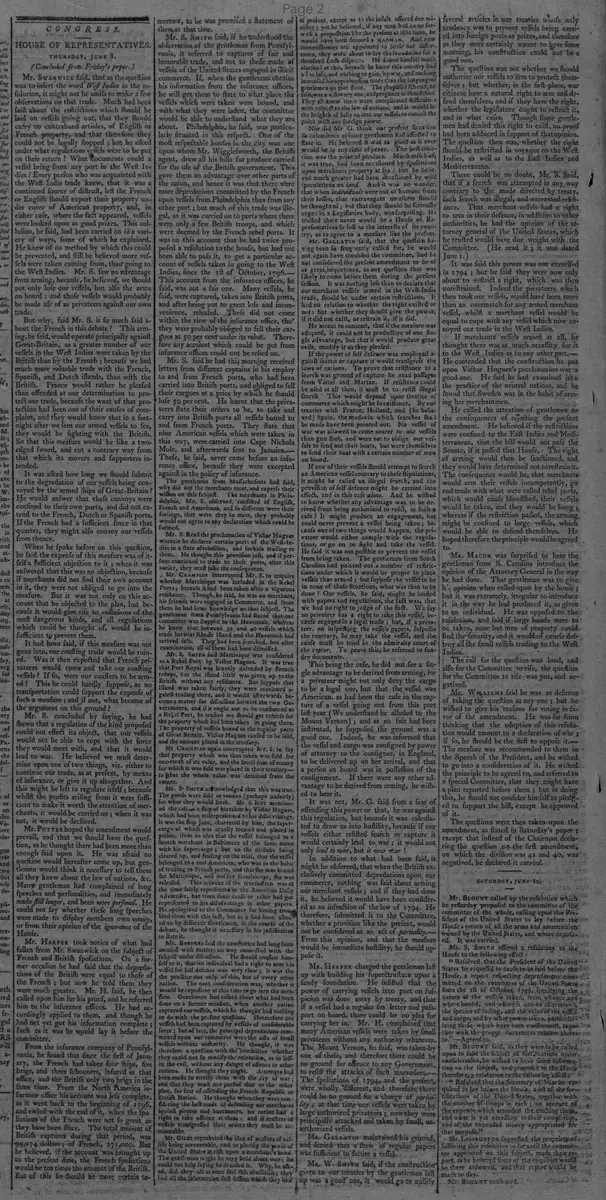
HOUSE OF REPRESENTATIVES
THURSDAY, June 8.
(Concluded from Friday's paper.)
Mr. Swanwick said, that as the question was to insert the word West Indies in the resolution, it might not be amiss to make a few observations on that trade. Much had been said about the restrictions which should be laid on vessels going out, that they should carry no contraband articles, of English or French property, and that therefore they could not be legally stopped; but he asked under what regulations vessels were to be put on their return? What documents could a vessel bring from any port in the West Indies? Every person who was acquainted with the West India trade knew, that it was a continued source of distrust, let the French or English should export their property under cover of American property, and, in either case, where the fact appeared, vessels were looked upon as good prizes. This collusion, he said, had been carried on in a variety of ways, some of which he explained. He knew of no method by which this could be prevented, and still he believed more vessels were taken coming from, than going to the West Indies. Mr. S. saw no advantage from arming, because, he believed, we should not only lose our vessels, but also the arms on board: and those vessels would probably be made use of as privateers against our own trade.
But why, said Mr. S. is so much said about the French in this debate? This arming, he said, would operate principally against Great-Britain, as a greater number of our vessels in the West Indies were taken by the British than by the French; because we had much more valuable trade with the French, Spanish, and Dutch islands, than with the British. France would rather be pleased than offended at our determination to protect our trade, because the want of that protection had been one of their causes of complaint, and they would know that in a fortnight after we sent our armed vessels to sea, they would be fighting with the British. So that this measure would be like a two-edged sword, and cut a contrary way from that which its movers and supporters intended.
It was asked how long we should submit to the degradation of our vessels being convoyed by the armed ships of Great-Britain? He would answer that these convoys were confined to their own ports, and did not extend to the French, Dutch or Spanish ports. If the French had a sufficient force in that quarter, they might also convoy our vessels from thence.
When he spoke before on this question, he said the expense of this measure was of itself a sufficient objection to it; when it was answered that this was no objection, because if merchants did not find their own account in it, they were not obliged to go into the measure. But it was not only on this account that he objected to the plan, but because it would give rise to collusions of the most dangerous kinds, and all regulations which could be thought of, would be insufficient to prevent them.
It had been said, if this measure was not gone into, our coasting trade would be ruined. Was it then expected that French privateers would come and take our coasting vessels? If so, were our coasters to be armed? This he could hardly suppose, as no transportation could support the expense of such a measure; and if not, what became of the argument on this ground?
Mr. S. concluded by saying, he had shown that a regulation of the kind proposed could not effect its object, that our vessels would not be able to cope with the force they would meet with, and that it would lead to war. He believed we must determine upon one of two things, viz. either to continue our trade, as at present, by means of insurance, or give it up altogether. And this might be left to regulate itself; because whilst the profits arising from it were sufficient to make it worth the attention of merchants, it would be carried on; when it was not, it would be declined.
Mr. Porter hoped the amendment would prevail, and that we should have the question, as he thought there had been more than enough said upon it. He was afraid no question would hereafter come up, but gentlemen would think it necessary to tell them all they knew about the law of nations, &c. Many gentlemen had complained of long speeches and personalities, and immediately made still longer, and been more personal. He could not say whether these long speeches were made to display members own vanity, or from their opinion of the ignorance of the House.
Mr. Harper took notice of what had fallen from Mr. Swanwick on the subject of French and British spoliations. On a former occasion he had said that the depredations of the British were equal to those of the French; but now he told them they were much greater. Mr. H. said, he then called upon him for his proof, and he referred him to the insurance offices. He had accordingly applied to them, and though he had not yet got his information complete; such as it was he would lay it before the committee.
From the insurance company of Pennsylvania, he found that since the first of January, the French had taken four ships, five brigs, and three schooners, insured in that office, and the British only two brigs in the same time. From the North America insurance office his account was less complete, as it went back to the beginning of 1796, and ended with the end of it, when the spoliations of the French were not so great as they have been since. The total amount of British captures during that period, was 99,274 dollars; of French, 271,000. But he believed, if the account was brought up to the present date, the French spoliations would be ten times the amount of the British. But of this he should be more certain tomorrow, as he was promised a statement of them at that time.
Mr. S. Smith said, if he understood the observation of the gentleman from Pennsylvania, it referred to captures of fair and honorable trade, and not to those made of vessels of the United States engaged in illicit commerce. If, when the gentleman obtains his information from the insurance offices, he will get them to state to what place the vessels which were taken were bound, and with what they were laden, the committee would be able to understand what they are about. Philadelphia, he said, was particularly situated in this respect. One of the most respectable houses in the city was one upon whom Mr. Wigglesworth, the British agent, drew all his bills for produce carried for the use of the British government. This gave them an advantage over other parts of the union, and hence it was that there were more depredations committed by the French upon vessels from Philadelphia than from any other port; but much of this trade was illegal, as it was carried on to ports where there were only a few British troops, and which were deemed by the French rebel ports. It was on this account that he had twice proposed a resolution to the house, but had not been able to pass it, to get a particular account of vessels taken in going to the West Indies, since the 1st of October, 1796.
This account from the insurance offices, he said, was not a fair one. Many vessels, he said, were captured, taken into British ports, and after being put to great loss and inconvenience, released. These did not come within the view of the insurance office, though they were probably obliged to sell their cargoes at 50 per cent under its value. Therefore any account which could be got from insurance offices could not be relied on.
Mr. S. said he had this morning received letters from different captains in his employ to and from French ports, who had been carried into British ports, and obliged to sell their cargoes at a price by which he should lose 50 per cent. He learnt that the privateers state their orders to be, to take and carry into British ports all vessels bound to and from French ports. They state that nine American vessels which were taken in this way, were carried into Cape Nicholas Mole, and afterwards sent to Jamaica.
These, he said, never came before an insurance office, because they were excepted against in the policy of insurance.
The gentleman from Massachusetts had said, why did not the merchants meet, and express their wishes on this subject. The merchants in Philadelphia, Mr. S. observed, consisted of English, French and Americans, and so different were their feelings, that were they to meet, they probably would not agree to any declaration which could be formed.
Mr. S. Read the proclamation of Victor Hugues wherein he declares certain ports of the West-Indies in a state of rebellion, and forbids trading to them. He thought this provision just, and if persons continued to trade to these ports, after this notice, they must take the consequence.
Mr. Champlin interrupted Mr. S. to enquire whether Martinique was included in the Rebel Ports; because it had been taken after a vigorous resistance. Though, he said, he was no merchant, his friends were engaged in Commerce, and from them he had some knowledge on that subject. The gentleman from Pennsylvania had stated that our commerce was stopped to the Havannah, whereas he knew that between 30 and 40 vessels which trade betwixt Rhode Island and the Havannah had arrived safe. They had been searched, but after examination, all of them had been dismissed.
Mr. S. Smith said Martinique was considered as a Rebel Port by Victor Hugues. It was true that Port Royal was bravely defended by French troops, but the island itself was given up to the British without any resistance. But suppose that Island was taken fairly, they were cautioned against trading there, and it would afterwards become a matter for discussion betwixt the two Governments, and if it ought not to be considered as a Rebel Port, he trusted we should get redress for the property which had been taken in going there.
The property of vessels bound to the regular ports of Great Britain, Victor Hugues caused to be sold. and the amount placed in the treasury.
Mr Champlin again interrupted Mr. S. to say that property which was thus taken was sold for one-tenth of its value, and the small sum of money for which it was sold was placed in their treasury—so that the whole value was detained from the owner.
Mr. S. Smith acknowledged that this was true. The goods were sold at vendue (perhaps unfairly) for what they would fetch. Mr. S. here mentioned the case of a ship of his taken by Victor Hugues, which had been misrepresented to his disadvantage. It was the ship Jane, chartered by him, the supercargo of which was cruelly treated and placed in prison, from an idea that the vessel belonged to a Scotch merchant in Baltimore of the same name with his supercargo; but on the mistake being cleared up, and finding on the trial, that the vessel belonged to a real American, who was in the habit of trading to French ports, and that she was bound for Martinique, and not for Guadaloupe, she was released. This account of the transaction was at the time fairly represented in the American Daily Advertiser, but from some cause or other had got represented to his disadvantage in other papers.
He apologized to the Committee for having troubled them with this fact, but as it had been alluded to by different Gentlemen, in the course of the debate, he thought it necessary in his justification to state it.
Mr. Brooks said the committee had long been amused with matters no way connected with the subject under discussion. He should confine himself to it, that an individual had a right to arm his vessel for self defence was very clear; it was the practice not only of this, but of every other nation. The next consideration was, whether it would be expedient at this time to go into the measure. Gentlemen had talked about what had been done on a former occasion, when another nation captured our vessels, which he thought had nothing to do with the present question. Heretofore our vessels had been captured by vessels of considerable force; but of late, the principal depredations committed upon our commerce were the acts of small vessels without authority. He thought, it was therefore a question with the committee whether they could not so modify the resolution, as to lessen the evil, without any danger of offence to other nations. He thought they might. Attempts had been made to terrify them with the cry of war; and that they must not pursue that or the other plan, for fear of offending the French Republic or British Nation. He thought when they were considering the best mode of defending our merchants against pirates and buccaneers, no nation had a right to take offence at them: and if masters of vessels transgressed their orders they must be accountable.
Mr. Giles reprobated the idea of masters of vessels being accountable, and at placing the peace of the United States at risk upon a merchant's bond. The gentleman might be very bold about war; he could not help saying he dreaded it. Why, he asked, did they all at once feel this ebullition; they had all the information at session which they had at present, except as to the insult offered our minister; yet he believed, if any man had come forward with a proposition like the present at that time, he would have been deemed a Madman. And now commissioners are appointed to settle our differences, they were about to lay the foundation for a thousand fresh disputes, He found himself much alarmed at this, because he knew this country had all to lose, and nothing to gain, by war, and nothing increased his apprehension more than the language of gentlemen on that floor. The proposed scheme, he said, was a visionary one, and pregnant with mischief. They all knew these were complicated difficulties with respect to the law of nations, and it would be the height of folly to arm our vessels to contest the point with any foreign power.
Nor did Mr G. think our present situation so calamitous as some gentlemen had affected to state it. He believed it was as good as it ever would be in any time of peace. The best criterion was the price of produce. Much mischief, it was true, had been occasioned by spoliations upon merchants property at sea: but he believed much greater had been occasioned by wild speculations on land. And it was no wonder, that when individuals were out of humour from their losses, that extravagant measures should be thought of; but that they should be seriously urged in a Legislative body, was surprising. He trusted there never would be a House of Representatives so lost to the interests of its country, as to agree to a measure like the present.
Mr. Gallatin said, that the question having been so frequently called for, he would not again have troubled the committee, had he not considered the present amendment to be of as great importance, as any question that was likely to come before them during the present session. It was nothing less than to declare that our merchant vessels armed in the West-India trade, should be under certain restrictions, It had no relation to whether the right existed or not; but whether they should give the power, if it did not exist. or restrain it. if it did.
He meant to contend, that if the measure was adopted, it could not be productive of one single advantage, but that it would produce great evils, modify it as they pleased.
If the power of self defence was employed against search or capture it would transgress the laws of nations. To prove that resistance to a search was ground of capture he read passages from Vattel and Marten. If resistance could be used at all then, it must be to resist illegal search. This would depend upon treaties of commerce which might be in existence, By our treaties with France, Holland, and (he believed) Spain, the modes in which searches shall be made have been pointed out. No vessel of war was allowed to come nearer to our vessels than gun shot, and were not to oblige our vessels to send out their boats, but were themselves to send their boat with a certain number of men on board.
If one of their vessels should attempt to search an American vessel contrary to these stipulations, it might be called an illegal search, and the provision of self defence might be carried into effect, and in this case alone. And he wished to know whether any advantage was to be derived from being authorized to resist, in such a case? It might produce an engagement, but could never prevent a vessel being taken; because one of two things would happen, the privateer would either comply with the regulations, or go on to fight and take the vessel.
He said it was not possible to prevent the vessel from being taken. The gentleman from South Carolina had pointed out. a number of restrictions under which it would be proper to place vessels thus armed; but suppose the vessel to be in none of these situations, what was then to be done? Our vessels, he said, might be loaded with papers and regulations, the fact was, that we had no right to judge of the fact. We say no privateer has a right to take this vessel, because engaged in a legal trade; but, if a privateer, on inspecting the vessels papers, suspects the contrary, he may take the vessel, and the cause must be tried in the admiralty court of the captor. To prove this, he referred to sundry documents.
This being the case, he did not see a single advantage to be derived from arming, for a privateer might not only deny the cargo to be a legal one, but that the vessel was American. as had been the case in the capture of a vessel going out from this port last year (We understand he alluded to the Mount Vernon) : and as no suit had been instituted, he supposed the ground was a good one. Indeed, he was informed that the vessel and cargo was consigned by power of attorney to the consignee, in England, to be delivered up on her arrival, and that a person on board was in possession of the consignment. If there were any other advantage to be derived from arming, he wished to hear it.
It was not, Mr. G. said from a fear of offending this power or that, he was against this regulation, but because it was calculated to draw us into hostility, because if our vessels either resisted search or capture it would certainly lead to war ; it would not only lead to war, but it was war!
In addition to what had been said, it might be observed, that when the British exclusively committed depredations upon our commerce, nothing was said about arming our merchant vessels ; and if they had done it, he believed it would have been considered as an infraction of the law of 1794. He therefore, submitted it to the Committee, whether a provision like the present, would not be considered as an act of partiality.
From this opinion, and that the measure would be immediate hostility, he should oppose it.
MR. Harper charged the gentleman last up with building his superstructure upon a sandy foundation. He insisted that the power of carrying vessels into port on suspicion was done away by treaty, and that if a vessel had a regular sea letter and passport on board, there could be no plea for carrying her in. Mr. H. complained that many American vessels were taken by small privateers without any authority whatever. The Mount Vernon, he said, was taken by one of these, and therefore there could be no ground for offence to any Government, to resist the attacks of such marauders.
The spoliations of 1794, and the present, were wholly different, and. therefore there could be no ground for a charge of partiality ; at that time our vessels were taken by large authorized privateers ; now they were principally attacked and taken by small, unauthorized vessels.
Mr. Gallatin maintained his ground, and denied that a shew of regular papers was sufficient to secure a vessel..
MR. W. Smith said, if the construction given to our treaties by the gentleman last up was a good one, it would go to nullify several articles in our treaties whose only tendency was to prevent vessels being carried into foreign ports as prizes, and therefore as they were certainly meant to have some meaning, his construction could not be a good one.
The question was not whether we should authorize our vessels to arm to protect themselves ; but whether, in the first place, our citizens have a natural right to arm and defend themselves, and if they have the right, whether the legislature ought to restrict it, and in what cases. Though some gentlemen had denied this right to exist, no proof had been adduced in support of that opinion.
The question then was, whether the right should be restricted in voyages to the West Indies, as well as to the East Indies and Mediterranean.
There could be no doubt, Mr. S. Said, that if a search was attempted in any way contrary to the mode directed by treaty, such search was illegal, and warranted resistance. That merchant vessels had a right to arm in their defence, in addition to other authorities, he had the opinion of the attorney general of the United States, which he trusted would have due weight with the Committee. (He read it ; it was dated June 1.)
It was said this power was not exercised in 1794 ; but he said they were now only about to restrict a right, which was then unrestrained. Indeed the privateers which then took our vessels, would have been more than an overmatch for any armed merchant vessel, whilst a merchant vessel would be equal to cope with any vessel which now annoyed our trade in the West Indies.
If merchants vessels armed at all, he thought there was as much, necessity for it to the West Indies as to any other part.—
He contended that the construction he put upon Victor Hugues's proclamation was a good one. He said he had examined into the practice of the neutral nations, and he found that Sweden was in the habit of arming her merchantmen.
He called the attention of gentlemen to the consequences of rejecting the present amendment. He believed if the restrictions were confined to the East Indies and Mediterranean, that the bill would not pass the Senate, if it passed that House. The right of arming would then be sanctioned, and they' would have determined not to restrain it. The consequence would be, that merchants would arm their vessels incompetently, go and trade with what were called rebel ports, which would cause bloodshed, their vessels- would be taken, and they would be hung ; whereas if the restriction passed, the arming might be confined to large vessels, which would be able to defend themselves. He hoped therefore the principle would be agreed to.
Mr. Macon was surprised to hear the. gentleman from S. Carolina introduce the opinion of the Attorney General in the way he had done. That gentleman was to give h'e opinion when called upon by the house ; but it was extremely, irregular to introduce. it in the way he had produced it, as given to an individual. He was opposed: to the resolution, and said if large bonds were to; be taken, none but men of property could find the security, and it would of course de- stroy all the small vessels trading to the West Indies.
The call for the question was loud, and also for the Committee to' rise, the question for the Committee to rise was put, and ne- gatived.
Mr. Williams said he was as desirous of taking the question as any one ; but he wished to give his reasons for voting in fa- vor of the amendment. He was far from thinking that the adoption of this resolution would amount to a declaration of war ; if so, he should be the first to oppose it.— The measure was recommended to them in the Speech of the President, and he wished. to go into a consideration of it. He wished... the principle to be agreed to, and referred to a special Committee, that they might have, a plan reported before them ; but in doing this, he should not consider himself as pledged- to support the bill,-except he approved of it.
The questions were then taken upon. the amendment, as stated in Saturday's paper; except that instead of the Chairman decla- ring the question on the first amendment, on which the division was 41 and 40, was negatived, he declared it carried.
SATURDAY, JUNE 10.
Mr. Blount called up the resolution which he yesterday proposed to the committee of the committee of the whole, calling upon the Pre- sident of the United States to lay before the House a return of all the arms and ammunition owned by the United States, and where deposited. It was carried.
Mr. S, Smith offered a. resolution to the House to the following effect :
" Resolved. that the President of the United States be requested to cause to be laid before this House, a report respecting depredations committed on. the commerce of the United-States since the 1st of October 1796, specifying the. names of the vessels taken, from whence and the species of lading the value of the where bound and where it can be and cargo, and by what power taken, particularizing those- which have been condemned, together with the proper. documents relative thereto." Agreed to.
Mr. Blount said, as they were to be called upon to take the subject of fortifications under consideration, he wished to have some informa- tion on the subject, and proposed to the House therefore, a resolution to the following effect.
Resolved that the Secretary of War be required to lay before the House, a list of the for- tifications of the United States, together with the number of troops in each ; an account of the expense which attended the erecting them, and what is yet necessary to their completion, and of the expended money appropriated for that purpose."
Mr. Livingston suggested the propriety of.- suffering this resolution to lie until the commit- tee appointed on this subject, made their re- port, as he believed some of the enquiries would be there answered, and that report would be made to day.
Mr. Blount consented.
Mr. Livingston then called up the resolution which he had laid upon the table of appointing an agent to defend before the commissioners now sitting, the citizens of the United States against the claims made upon them by Great Britain, in pursuance of the late treaty.
Mr. W. Smith submitted to the consideration of the House, whether it would not be best to place this business under the Attorney General. It might, in that case, be proper to afford him a sum of money to enable him to employ additional clerks for the purpose.
Mr. Livingston had no objection to modify the resolution in this way, 'to appoint an agent to assist the Attorney General in the defence of,' &c.
Mr. Macon said this might be a good proposition, but it did not strike him as necessary. He thought the commissioners would be competent to do the business.
Mr. Goodrich thought the business would be best referred to a select committee.
Mr. Livingston saw no use in referring the matter to a select committee, except it were to report a bill. When gentlemen reflected upon the nature of these debts, and the time at which they were contracted, they would see the opportunity for collusion. He did not mean that an agent should be appointed to reside at Philadelphia, but a person who might be employed to investigate, in the best manner, the justice of the claims. The President might, perhaps, think it necessary to appoint a person near to the places where the debts were contracted.
Mr. Nicholas thought this a more serious business than was generally supposed, and that it would be found so, when the money came to be paid. He knew not whether two or three agents would not be necessary.
The resolution was referred to a select committee, to report by bill or otherwise.
Mr. Livingston, from the committee appointed on the subject of fortifications, reported sundry documents; together with a bill to provide for the fortifications of the ports and harbors of the United States, in which it is provided that the money necessary for carrying it into effect, shall be borrowed of the bank of the United States, or in such other way as shall be found best. The bill was twice read and referred to a committee of the whole on Monday.
The House took up the resolution agreed to in the committee of the whole yesterday, authorizing the President to call on the Executives of the several States, to hold 80,000 militia in readiness, apportioned according to the number of white inhabitants in each State.
Mr. W. Smith wished one part of the resolution to be modified or omitted. He meant that part which directed the men to be apportioned according to the number of white inhabitants in each State: This, he said, might have an injurious effect. For, in case an invasion were to take place in a State where white population was the weakest, the proportion of men detached would be so small as to be, in a great degree, useless: and in other States, the number would be greater than there was any necessity for. For instance, if Georgia were to be the place of attack (and if an invasion did take place that was the most likely quarter for it) where the white population is small, there would not be a sufficient number of men to afford any protection, on the plan proposed. He thought if they fixed upon the proportion, the constitutional estimation would be best, viz. to add to the white population three-fifths of the number of negroes. He moved to strike out the apportionment, in order to have the regulation to be inserted in the bill.
Mr. Macon did not think there was any weight in the objection of the gentleman last up; as, in case of invasion, the Executive of the State might call out more than the number here contemplated, or even the whole of the militia, until assistance could be got from the neighbouring states. The resolution, being in the form of that agreed to on a former occasion, could not reasonably be objected to.
Mr. Thatcher enquired whether it had been customary to train blacks to arms?
Mr. W. Smith said he was not understood. He meant that the number of whites to be detached, should be in proportion to the number of whites, with three fifths of the blacks added to the number.
Mr. Venable did not think there would be justice in such a regulation, as the duty would lie heavier upon states thinly inhabited than upon others. In case of invasion he said, the neighbouring states would be called upon.
Mr. M'Dowell said, that should the gentleman from South Carolina's proposition be agreed to, the duty would fall heavier upon his (Mr. S's) constituents than upon any other part of the Union; besides, when so many whites were taken from home on this business, the rest would be exposed to the blacks. He trusted therefore he would not press it.
Mr. W. Smith wished only for the subject to be left open, that the apportionment might have been left to the President. [He read the form of an amendment which he would have proposed.] He did not at present contemplate an invasion, though it might be necessary to adopt this cautionary measure. He withdrew his amendment.
The question was about to be put on the resolution; when
Mr. Varnum said he did not see any occasion for this resolution. He did not think they had any reason to suppose an invasion probable; but if it should take place, there was sufficient power in the Executive of the different governments to call out the militia. He did not know how the militia was regulated in other States, but in the Eastern states, he knew it was always in readiness, and that 20,000 men could be landed in a few days, at any point, from Portsmouth to Rhode Island. This being the case, he did not think it necessary to make any detachment from them. It was true, an invasion might take place from France, but he tho't it was as probable it might come from England; though he believed it was equally probable it might be from Nootka Sound.
It was said that this regulation would be no expense to the United States: -It might be no expense to the government, but it will be a serious expense to the people. He thought the situation of the United States very different now from what it was in 1794. The British were at that time, not only taking our property at sea, but they had large provinces adjoining upon the United States, and could have brought large bodies of troops against us. It also appeared that they had hostile intentions against us; it appeared from the Proclamation of the Governor of Canada, that Great Britain meant to declare war: that the Indians were prepared to make attacks on our frontiers; and fortifications were erecting within our territory. In this case it became prudent to have a detachment of militia in perfect readiness. But said Mr. V. the situation of the United States is now very different. The nation with whom we have now a misunderstanding, had no possessions adjoining upon us, and there was not much probability of troops being sent against us from France. He did not wish, therefore, to go into the present measure. It might be well to call upon the Secretary at War to know the condition in which the militia was in the different parts of the Union; but he did not think more was necessary.
Mr. Blount agreed with gentlemen in opinion, that they had no reason to expect any invasion, But it was well known the President of the United States, in his speech had spoken of raising a provisional army; but if he had not done this, he thought the measure now before them was at all times proper. The expense would depend upon the time at which the regulation was carried into effect. If the States did not call extraordinary sessions, no expense would be incurred. He believed we ought at all times to have a military force standing in readiness, which would at any time convince the world that we were not a divided people. The best defence, he said, was to be always prepared to meet the attacks of an enemy. When the measure was formerly gone into, he had as little apprehension of an invasion as at present; and if we had no misunderstanding with any nation, he should be in favour of it.
Mr. Thatcher believed it was true (as his colleague had stated) that the Massachusetts militia could at any time be called out at a moment's warning: but if the Militia in the Southern States were not in this readiness, he thought it would be well that they should be put into such a state.
Mr. I. Williams thought it would be proper to have a select corps of militia in readiness; but he denied that this could be done without expense. The expense of the corps which he commanded, when called out in 1794, was very considerable. If the gentleman from Massachusetts thought there was no immediate necessity for the measure, he might move to have the power of making the call whenever the President should see it necessary.
The question was put on the resolution and carried.
The resolution reported by the committee of the whole, proposing to authorize the President to provide galleys or other vessels for the defence of our coast, was next taken up.
Mr. Giles wished to have it clearly ascertained what was to be the employment of these vessels. 'Coast,' he said was an indefinite phrase and liable to be misunderstood, He was decidedly against their being employed as a convoy In order to make the meaning clear, he should move to strike out the words 'for defending our sea coast,' to be employed within the jurisdiction of the United States.'
Mr. Rutledge supposed, if the resolution stood as it was reported, the vessels would be employed within the jurisdiction of the United States; but he thought it would be absurd to say, these vessels should on no account pass the limits of the jurisdiction. -The pirates would know this, and our vessels might have the mortification of seeing our merchant ships taken or plundered, without having the power of affording them relief. Or, if one of these pirates were to come within the line, and be pursued by one of these vessels, though he might be on the point of taking her, yet he must not venture across the line. He did not wish these vessels to be employed as convoys; but he thought their destination might be safely left to the executive; and had no notion of doing the business by halves.
Mr. Brooks said, it appeared to him, that this principle had been decided yesterday, and did not require farther discussion
Mr. Nicholas supposed it was not from an apprehension that the executive would not do his duty, that it was wished this business should be put into a definitive form. No one, he believed, would put the same construction upon the amendment that the gentleman from S. Carolina had done. It could not be supposed to be the intention of the supporters of this amendment, that these vessels should be prevented from crossing the line in pursuit of a pickaroon which had come within the jurisdiction of the United States Indeed the gentleman himself had concluded, that such an idea would be absurd. To do away all objection, he proposed to insert the words, 'for the defence of the sea coast within the jurisdiction of the United States,' instead of Mr. Giles's amendment
Mr. Giles thought the phrase sea coast indefinite. It might be supposed, perhaps, to extend to Bermuda.
Mr. W. Smith said the gentleman last up had supposed the sea coast might extend to Bermuda, yet our vessels were not to go beyond the jurisdiction of the United States, for the defence of the coast. This, he said, involved a contradiction. He wished the gentleman to define what he meant by jurisdiction of the United States; he believed it was not decided whether it extended three or nine miles. If it were even nine miles, he said, these vessels might sometimes be obliged to go beyond the line merely for the purpose of avoiding shoals Why, then, confine them so very tightly, When the purpose was expressly for the defence of the coast, it could not be expected they would be employed in any other way; to employ them as convoys would be unlawful
Mr. Sewall proposed the following -' To defend the sea coast of the United States, and to repel any hostility to their vessels and commerce within their jurisdiction.'
Mr. R. Williams thought this amendment more objectionable than any other which had been proposed. The jurisdiction not being ascertained, disputes would of course be the consequence. He thought the resolution better without any of its amendments. He was disposed to defend our commerce wherever attacked; but, if we had not the means to do this, he would not do any thing which would seem to infer that we had not the wish to do it, by confining our defence of it without our own territory.
Mr. Nicholas was in favor of the amendment,
Mr. Allen thought the whole of the business trifling, and wished to postpone the business, until the bill came down from the Senate; or, if they did pass the resolution, they ought not to confine it within such narrow bounds. After alluding to the various amendments which had been proposed and opposed, which he called 'catches at phraseology,' he moved to postpone the subject till Monday.
Mr. S. Smith agreed with the gentleman from Connecticut that the present was a trifling business, and he would agree to extend his motion till next session. It was a lilliputian concern. It was the British navy, he said, which kept possession of our coast, and whatever we asked, would these small vessels have upon them? Some of our deserters had lately gone on board one of the British ships of war at Norfolk. and when they were demanded back, they were refused; and suppose, said he, one of these vessels had been there to have enforced the demand, could any one suppose, it would have produced any thing more than insult upon insult? They could not ? He wished to leave these trifling subjects for the Senate, and to go on to substantial business; he meant the Finances of the country
Mr. Brookes was in favor of coming to a decision at present, since the business had been fully discussed.
Mr. Allen wished it postponed till Monday; by that time, he thought, the House would have come to its senses.
Mr. Giles also thought the business trifling, and proposed to postpone it till the first Monday in November next.
Mr. Harper said, if he was of opinion with the gentleman from Connecticut, that the House would have more understanding on Monday than at present, he would agree to postpone the question till that time; but he believed gentlemen must receive some lessons of experience before they could be convinced of their error. The arguments of the gentleman from Maryland went to this; if we cannot resist a British 74, we will not resist a French pirate. But Mr. H. trusted they should not be diverted by a jest from doing what he believed good sense and good policy require them to do.
Mr. S. Smith said he did not mean to make a jest of the business; but merely to express his desire to go on to more important business.
Mr. Thatcher asked, if this business was postponed, whether when the bill came from the Senate, they could not proceed with it?
The Speaker answering in the affirmative. Mr. Giles recalled his motion.
Mr. Sewall said the bill in the Senate had not the same object in view with this measure. It was their intention to provide vessels as a convoy.
Mr. Giles believed it was not very orderly to refer to business doing in the Senate. He believed that bill was recommitted.
The question for postponing the business till Monday was put and negatived; Mr. Sewall's amendment was then put and carried without a division.
The question was then taken on the resolution as amended, by yeas and nays, as follow:
YEAS. Messrs. Allen, Baer, Baldwin, Bayard, Bradbury, Brookes, Bullock, Cabell, Champlin, Clay, Clopton, Cochran, Craik, Dana, Davenport, Dennis, Dent, Ege, Elmendorf, Evans, Findley, A. Foster, D. Foster, Fowler, J. Freeman, Gallatin, Gillespie, Glenn, Goodrich, Gordon, Hanna, Harper, Harrison, Hindman, Holmes, Homer, Imlay, Livingston, S. Lyman, Machir, Mathews, M'Clenachan, Milledge, Morgan, Nicholas, Parker, Potter, Reed, Rutledge, Sewall, Shepard, Skinner, Sinnickson, Jer. Smith, N. Smith, S. Smith, W. Smith, (C.) W. Smith, (P.) Stanford, Swanwick, Thatcher, Thomas, Thompson, Van Allen, Van Cortlandt, Wadsworth, J. Williams, R. Williams. 68.
NAYS. Messrs. Blount, Brent, Bryan, Chapman, Claiborne, Coit, Dawson, N. Freeman, Giles, Gregg, Griswold, Havens, Jones, Locke, Lyon, Macon, M'Dowell, New, Sprigg, Varnum, Venable.-21
Committees were appointed to report bills in pursuance to the two resolutions which had been agreed to.
Mr. Varnum said there was a subject of importance referred to in the President's speech, which had not yet been touched upon, he meant the revision of the militia laws. In order to bring the business before the House, he moved a resolution for the appointment of a committee to report whether any and what alterations in them were necessary. Agreed to, and a committee appointed.
Mr. W. Smith called for the order of the day on the bill from the Senate for raising an additional corps of artillerists and engineers.
Mr. Blount asked whether it was not necessary, when they were going into these expenses, to go into an enquiry on the subject of ways and means. He moved that a Committee of Ways and Means be appointed.
Mr. W. Smith thought it better to proceed with the business in the way he proposed. Before they went into the subject of ways and means, he thought it was necessary they should know what money would be wanted, that they might provide accordingly; and they could not know this, until they had gone through the several measures which lay before them.
Mr. Nicholas said if it was necessary to have additional revenue, it would be well to appoint a Committee to be casting about as to the proper way of raising it. If the money were to be borrowed, they might be enquiring upon what terms it could be got.-- If they did not do this, when all the other business was done, they would have to wait until these enquiries were made.
Mr. Giles thought the bill for raising additional troops might be very well put off till next session. He did not believe there was any necessity at present for an increase of the military establishment. He thought this was the proper time for taking up the subject of the revenue, since they must either borrow, or raise money by taxes, and he trusted a Committee would now be appointed.
Mr. W. Smith withdrew his motion, to give way to the appointment of a Committee of Ways and Means.
Mr. Blount said money would certainly be wanted. It was presumed it might be borrowed; but no enquiry had been made on the subject. He was of opinion that the difficulties which would present themselves on this subject, would throw out of view a number of measures which he thought might very well be dispensed with.
Mr. J. Williams thought if they appointed a Committee of Ways and Means, and were to go into the Militia Laws, they might sit all summer. He hoped they should have gone on with the bill for raising men, and if they had rejected that, and declined furnishing convoys, and the measure of purchasing vessels for the defence of the coast, was left to the discretion of the President that a Committee of Ways and Means would not have been necessary.
A Committee of Ways and Means, consisting of seven members (after 15 and 13 had been proposed and negatived) was appointed.
Adjourned.
What sub-type of article is it?
What themes does it cover?
What keywords are associated?
What entities or persons were involved?
Where did it happen?
Story Details
Key Persons
Location
House Of Representatives
Event Date
Thursday, June 8; Saturday, June 10
Story Details
Debate on inserting 'West Indies' into resolution allowing arming of merchant vessels, with arguments on trade risks, depredations by French and British privateers, legal rights under treaties and law of nations, insurance data on captures, potential for war; amendment passes 68-21. Saturday proceedings include resolutions for presidential reports on arms, depredations since Oct 1796, fortifications; referral of agent for British claims; bill for fortifications; militia readiness resolution passes; coastal defense vessels resolution amended and passes; committee on militia laws; appointment of Ways and Means Committee.