Thank you for visiting SNEWPapers!
Sign up free
Wheeling Register
Wheeling, Ohio County, West Virginia
What is this article about?
In San Francisco on August 23, Rev. J. S. Kalloch, Workingmen's mayoral candidate, was shot twice by Charles DeYoung after criticizing the DeYoung family in a speech. Kalloch's condition was critical but showed signs of improvement. The city erupted in excitement; mobs surrounded the jail demanding DeYoung, but leaders like Kearney urged restraint to avoid violence and focus on the election. Political fallout favored Workingmen.
Clipping
OCR Quality
Full Text
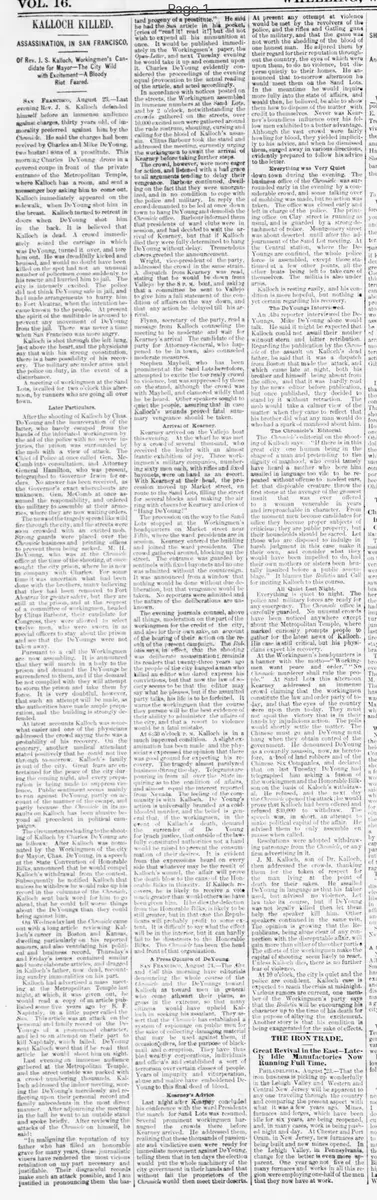
ASSASSINATION IN SAN FRANCISCO,
Of Rev. J. S. Kalloch, Workingmen's Candidate for Mayor—The City Wild with Excitement—A Bloody Riot Feared.
San Francisco, August 23.—Last evening Rev. J. S. Kalloch defended himself before an immense audience against charges, thirty years old, of immorality preferred against him by the Chronicle. He said the charges had been revived by Charles and Mike De Young, two bastard sons of a prostitute. This morning Charles DeYoung drove in a covered coupe in front of the private entrance of the Metropolitan Temple, where Kalloch has a room, and sent a messenger boy asking him to come out. Kalloch immediately appeared on the sidewalk, when De Young shot him in the breast. Kalloch turned to retreat indoors when DeYoung shot him in the back. It is believed that Kalloch is dead. A crowd immediately seized the carriage in which was DeYoung, turned it over, and tore him out. He was dreadfully kicked and bruised, and would no doubt have been killed on the spot had not an unusual number of policemen come suddenly to his rescue and hurried him to jail. The city is intensely excited. The police did not think DeYoung safe in jail, and had made arrangements to hurry him to Fort Alcatraz, when the intention became known to the people. At present the spirit of the multitude is aroused to prevent any movement of DeYoung from the jail. There was never a time when San Francisco was more angry. Kalloch is shot through the left lung, just above the heart, and the physicians say that with his strong constitution, there is a bare possibility of his recovery. The military are under arms and the police on duty, in the event of a disturbance.
A meeting of workingmen at the Sand Lots, is called for two o'clock this afternoon, by runners who are going all over town.
Later Particulars.
After the shooting of Kalloch by Chas. DeYoung and the incarceration of the latter, who barely escaped from the hands of the infuriated workingmen by the aid of the police with no severe injuries, the prison was surrounded by the mob with a view of attack. The Chief of Police at once called Gen. McComb into consultation, and Attorney General Hamilton, who was present, telegraphed to Governor Irwin for orders. No answer has been received, as the Governor's exact whereabouts are unknown. Gen. McComb at once assumed the responsibility, and ordered the military to assemble at their armories, where they are now waiting orders. The news of the tragedy spread like wildfire through the city, and the streets were soon crowded with an excited mob. Strong guards were placed over the Chronicle business and printing offices to prevent their being sacked. M. H. DeYoung, who was at the Chronicle office at the time of the shooting, at once sought the city prison, where he is now in company with Charles. For some time it was uncertain what had been done with the brothers, many believing that they had been removed to Fort Alcatraz for greater safety, but they are still at the prison, and at the request of a committee of workingmen, headed by Clitus Barbour, their candidate for Congress, they were allowed to select twelve men, who were sworn in as special officers to stay about the prison and see that the DeYoungs were not taken away.
Pursuant to a call the Workingmen are now assembling. It is announced that they will march in a body to the prison and demand the DeYoungs be surrendered to them, and if the demand be not complied with they will attempt to storm the prison and take them by force. It is very doubtful, however, that such an attempt will be made, as the authorities have made ample preparation, and the building is strongly defended.
At latest accounts Kalloch was somewhat easier and one of the physicians addressed the crowd saying there was a probability of his recovery. On the contrary, another medical attendant stated positively that he could not live through to-morrow. Kalloch's family is out of the city. Great fears are entertained for the peace of the city during the coming night, and every preparation is being made to suppress violence. Public sentiment seems mainly to run against DeYoung, partly on account of the manner of the escape, and partly because the Chronicle in its assaults on Kalloch has been abusive beyond all precedent in political campaigns.
The circumstances leading to the shooting of Kalloch by Charles DeYoung are as follows: After Kalloch was nominated by the Workingmen of the city for Mayor, Chas. DeYoung, in a speech at the State Convention of Honorable Bilks, announced that he would compel Kalloch's withdrawal from the contest. Subsequently he notified Kalloch that unless he withdrew he would rake up his record in the columns of the Chronicle. Kalloch sent back word for him to go ahead, that he could tell worse things about the De Youngs than they could bring against him.
On Wednesday last the Chronicle came out with a long article reviewing Kalloch's career in Boston and Kansas, dwelling particularly on his reported amours, and also ventilating his political and business record. Thursday's and Friday's issues contained similar and more elaborate articles, and dragged in Kalloch's father, now dead, recounting sundry immoralities on his part.
Kalloch had advertised a mass meeting at the Metropolitan Temple last night, at which, it was given out, he would read a copy of an article published some five years ago by B. F. Naphtaly, in a little paper called the Sun. This article was an attack on the personal and family record of the DeYoungs of a pronounced character, and led to an attempt on their part to kill Naphtaly, which failed. DeYoung sent Kalloch word that if he read that article he would shoot him on sight.
Last evening an immense audience gathered at the Metropolitan Temple, and the street outside was packed with a crowd numbering thousands. Kalloch addressed the indoor meeting, scoring the DeYoungs mercilessly and reflecting upon their personal record and family antecedents in the most direct manner. After adjourning the meeting in the hall he went to an outside stand and spoke briefly. After reviewing the attacks of the Chronicle on himself, he said:
"In maligning the reputation of my father who has filled an honorable grave for many years, these journalistic vipers have rendered the most vicious retaliation on my part necessary and justifiable. Their disgraceful records make such an attack possible, and I am justified in pronouncing them the bastard progeny of a prostitute."
He said he had the Sun article in his pocket. Cries of "read it! read it!" but did not wish to expend all his ammunition at once. It would be published immediately in the Workingmen's paper, the Open-Letter, and next Tuesday evening he would take it up and comment upon it. Charles DeYoung evidently considered the proceedings of the evening equal provocation to the actual reading of the article, and acted accordingly.
In accordance with notices posted on the streets, the Workingmen assembled in immense numbers at the Sand Lots, and by 2 o'clock, notwithstanding the crowds gathered on the streets, over 10,000 excited men were gathered around the rude rostrum, shouting, cursing and calling for the blood of Kalloch's assassin. Clitus Barbour took the stand and addressed the meeting, earnestly urging the workingmen to await the arrival of Kearney before taking further steps. The crowd, however, were more eager for action, and listened with a bad grace to all arguments tending to delay their vengeance. Barbour continued, dwelling on the fact that they were unorganized, and in no condition to cope with the police and military. In reply the crowd demanded to be led at once down town to hang DeYoung and demolish the Chronicle office. Barbour informed them that presidents of ward clubs were in session, and had decided to wait the arrival of Kearney, but that if Kalloch died they were fully determined to hang DeYoung without delay. Tremendous cheers greeted the announcement.
Wright, vice-president of the party, addressed the crowd in the same strain. A dispatch from Kearney was read, stating that he would be down from Vallejo by the 8 p. m. boat, and asking that a committee be sent to Vallejo to give him a full statement of the condition of affairs on the way down, and that any action be delayed till his arrival.
Flynn, secretary of the party, read a message from Kalloch counseling the meeting to be moderate and wait for Kearney's arrival. The candidate of the party for Attorney-General, who happened to be in town, also counseled moderate measures.
Stephen Maybell, who has been prominent at the Sand Lots heretofore, attempted to excite the too readily crowd to violence, but was suppressed by those on the stand, although the crowd was with Maybell, and clamored wildly that he be heard. Other speakers sought to quiet the people, assuring that in case Kalloch's wounds proved fatal summary vengeance should be taken.
Arrival of Kearney.
Kearney arrived on the Vallejo boat this evening. At the wharf he was met by a crowd of several thousand, who received the leader with an almost frantic exhibition of joy. Three workingmen's military companies, numbering sixty men each, with rifles and fixed bayonets, were on hand as an escort. With Kearney at their head, the procession moved up Market street, en route to the Sand Lots, filling the street for several blocks and making the air ring with cheers for Kearney and cries of "Hang DeYoung!"
The procession on the way to the Sand Lots stopped at the Workingmen's headquarters on Market street near Fifth, where the ward presidents are in session. Kearney entered the building and joined the ward presidents. The crowd gathered around, blocking up the street. The entrance was guarded by sentinels with fixed bayonets and no one was admitted without the countersign.
It was announced from a window that nothing would be done without due deliberation, but that vengeance would be taken. No reporters were admitted and the nature of the deliberations are unknown.
The evening journals counsel, above all things, moderation on the part of the workingmen for the credit of the city, and also for their own sake, on account of the bearing of their action on the result of the present campaign. The Bulletin says, in effect, that the shooting was deliberate assassination; reminds its readers that twenty-three years ago the people of the city hanged a man who killed an editor who dared express his convictions, but that now the law of society seems to be that the editor may say what he pleases, but if the assaulted party talks, his life is to be forfeited. It warns the workingmen that the course they pursue will be the best evidence of their ability to administer the affairs of the city, and that a resort to violence would be a fatal mistake.
At 6:30 o'clock p. m. Kalloch is in a much improved condition. A slight examination has been made and the physicians expressed the opinion that there was good ground for expecting his recovery. The tragedy almost paralyzed business during the day. Telegrams are pouring in from all over the State inquiring as to the condition of affairs, and almost equal the interest reported from Nevada. The feeling of the community is with Kalloch. De Young's action is universally branded as a cold-blooded murder, and the belief is general that, if the workingmen, in the event of Kalloch's death, demand the surrender of De Young for lynch justice, that outside of the lawfully constituted authorities not a hand would be raised to prevent the consummation of their desires. It is evident from the expressions heard on every side that whatever may be the result of Kalloch's wound, the affair will prove the death blow to the cause of the Honorable Bilks in this city. If Kalloch recovers, he is likely to receive a vote much greater than would otherwise have been given him. If he dies the defection from the Honorable Bilks, is likely to be still greater, but in that case the Republicans will probably profit to some extent. It is difficult to say what the effect will be in the interior, but it can hardly fail to be disastrous to the Honorable Bilks. The Chronicle has been the head and front of that organization.
A Press Opinion of DeYoung.
San Francisco, August 24.—The Alta and Call this morning have editorials denouncing the whole course of the Chronicle and the DeYoungs toward Kalloch as toward men in general who come athwart their plans, as gross in the extreme, so that many citizens would have upheld Kalloch in seeking his assailant. They assert that the Chronicle has established a system of espionage on public men for the sake of collecting damaging material that may be used against them, if occasion offers, for the purpose of blackmail and corruption. They have thus bled wealthy corporations, individuals and officials and established a sort of terrorism over certain classes of people. Years of impunity and vituperation, abuse and malice have emboldened DeYoung to this final deed of blood.
Kearney's Advice.
Last night after Kearney concluded his conference with the ward Presidents the march for Sand Lots was resumed. Several prominent workingmen harangued the crowds there before Kearney arrived. He addressed them, realizing that these thousands of passionate and vindictive men were ready for immediate movement against DeYoung, telling them that in ten days the election would put the whole machinery of the city government in their hands and that without fail the proprietors of the Chronicle would then meet their deserts.
At present any attempt at violence would be met by the revolvers of the police, and the rifles and Gatling guns of the military, and that the game was not worth the shedding of the blood of one honest man. He adjured them by their regard for their reputation throughout the country, the eyes of which were upon them, to do no violence, but disperse quietly to their homes. He announced that to-morrow afternoon he would meet them on the Sand Lots. In the meantime he would inquire more fully into the state of affairs, and would then, he believed, be able to show them how to dispose of the matter with credit to themselves. Never was Kearney's boundless influence over his fellow men exhibited to a better advantage. Although the vast crowd were fairly howling for blood, they yielded implicitly to his advice, and when he dismissed them, surged away in various directions, evidently prepared to follow his advice to the letter.
Everything was Very Quiet down town during the evening. The business office of the Chronicle was surrounded early in the evening by a considerable crowd, and some talking over of mobbing was made, but no action was taken. The office was closed early and left in charge of the police. The printing office on Clay street is running as usual, and is guarded by a strong detachment of police. Montgomery street was about deserted until after the adjournment of the Sand Lot meeting. At the Central station, where the DeYoungs are confined, the whole police force is assembled, except those stationed at a few other points, all the other beats being left to take care of themselves. The militia is also under arms.
Kalloch is resting easily, and his condition is more hopeful, but nothing is yet certain regarding his recovery.
The DeYoungs Interviewed.
An Alta reporter interviewed the DeYoungs. Mike DeYoung alone would talk. He said it might be expected that Kalloch could not assail their mother without stern and bitter retribution. Regarding the publication by the Chronicle of the assault on Kalloch's dead father, he said that it was a dispatch from Boston that made the attack, and which came late at night, both his brother and himself being absent from the office, and that it was hardly read by the news editor before publication, but once published, they decided to stand by it without retraction. The mob would take a calmer view of the matter when they came to reflect that his brother did what any man would do who had a spark of manhood about him.
The Chronicle's Editorial.
The Chronicle's editorial on the shooting of Kalloch says: "If there is in this great city one human being in the shape of a man and pretending to the dignity of manhood, who could tamely have heard a mother who bore him assailed in language too vile to be repeated without offense to modest ears, let that despicable creature throw the first stone at the avenger of the grossest insult that was ever offered to a woman venerable in years and irreproachable in character. From the moment men become candidates for office they become proper subjects of criticism; they are public property, but their households should be sacred." Let those who are disposed to indulge in harsh judgment in this case make it their own, and consider what they would have been impelled to do, had their own mothers or sisters been brutally insulted before a public assemblage." It blames the Bulletin and Call for inciting Kalloch to this course.
All Quiet Last Night.
Everything is quiet to-night. The police and military forces are ready for any emergency. The Chronicle office is carefully guarded. No unusual crowds have been noticed anywhere except about the Metropolitan Temple, where marked curiosity prompts people to gather for the latest news of Kalloch. His case is still critical, but his physicians expect his recovery.
At the Workingmen's headquarters is a banner with the motto—"Working men want peace and order," "No Chronicle murderer shall rule the people." At Sand Lots this afternoon Kearney addressed an immense crowd claiming that the workingmen constitute the law and order party of to-day, and that the eyes of the country were upon them to-day. They must not spoil the victory that is in their hands by injudicious action. The polls would shortly settle the matter. The Chinese must go and DeYoung must hang when they obtain control of the government. He denounced DeYoung as a cowardly assassin, now, as heretofore, a tool of land robbers and of the Chinese Six Companies, and declared that on last Tuesday DeYoung had telegraphed him asking a fusion of the workingmen and the Honorable Bilkson on the basis of Kalloch's withdrawal. He refused, and the next day the Chronicle opened the attack; he would prove that Kalloch had been offered and refused $30,000 to withdraw. The speech was, in short, an attempt to make political capital of the affair. He advised them to only assemble en masse when called.
Resolutions were adopted withdrawing patronage from the Chronicle, or any firm advertising in it.
J. M. Kalloch, son of Dr. Kalloch, then addressed the crowds, thanking them for the token of respect for the man lying at the point of death for their sakes. He assailed DeYoung in language as that his father used, but advised no violence. Let law take its course, but if DeYoung was not legally killed then let them help the speaker kill him. Other speakers continued in the same vein.
The opinion is growing that the Republicans, being alone clear of any connection with the disreputable affair, will gain more than either of the other parties. The efforts of the workingmen make the capital of shooting seem likely to react.
Unless Kalloch dies, there is no further fear of violence.
At 10 o'clock, the city is quiet and the police are confident. Kalloch case is expected to reach the crisis at midnight. Various rumors are current. one member of the Workingmen's party says that the Bulletin will be encouraging his character up to the time of his death for the purpose of allaying the excitement. Another story is that his condition is being exaggerated for the sake of effects.
What sub-type of article is it?
What keywords are associated?
What entities or persons were involved?
Where did it happen?
Domestic News Details
Primary Location
San Francisco
Event Date
August 23
Key Persons
Outcome
kalloch shot in the breast and back, through the left lung; condition critical but improving with possibility of recovery; deyoung arrested and protected from mob; no deaths or further violence reported
Event Details
Rev. J. S. Kalloch, Workingmen's candidate for mayor, was shot by Charles DeYoung outside the Metropolitan Temple after Kalloch's speech criticizing the DeYoungs and the Chronicle. A mob attacked DeYoung but police intervened. The city was excited with fears of riot; workingmen assembled at Sand Lots, but leaders urged restraint. Military and police prepared for disturbance. Political tensions heightened ahead of election.