Thank you for visiting SNEWPapers!
Sign up free
The Enquirer
Richmond, Henrico County, Virginia
What is this article about?
In the U.S. House of Representatives on February 25, debate on the bill to establish a military peace force of 10,000 men. Mr. Troup advocated moderate reduction for security, interests, and army claims. Mr. Desha moved to reduce to 6,000, emphasizing militia sufficiency. Others debated size, stations, and provisions.
Merged-components note: Merged congressional debate on military peace establishment across pages, including embedded tables representing the discussed estimate; tables relabeled from 'table' to 'domestic_news'.
Clippings
1 of 2
OCR Quality
Full Text
HOUSE OF REPRESENTATIVES:
Saturday, Feb 25.
MILITARY PEACE ESTABLISHMENT.
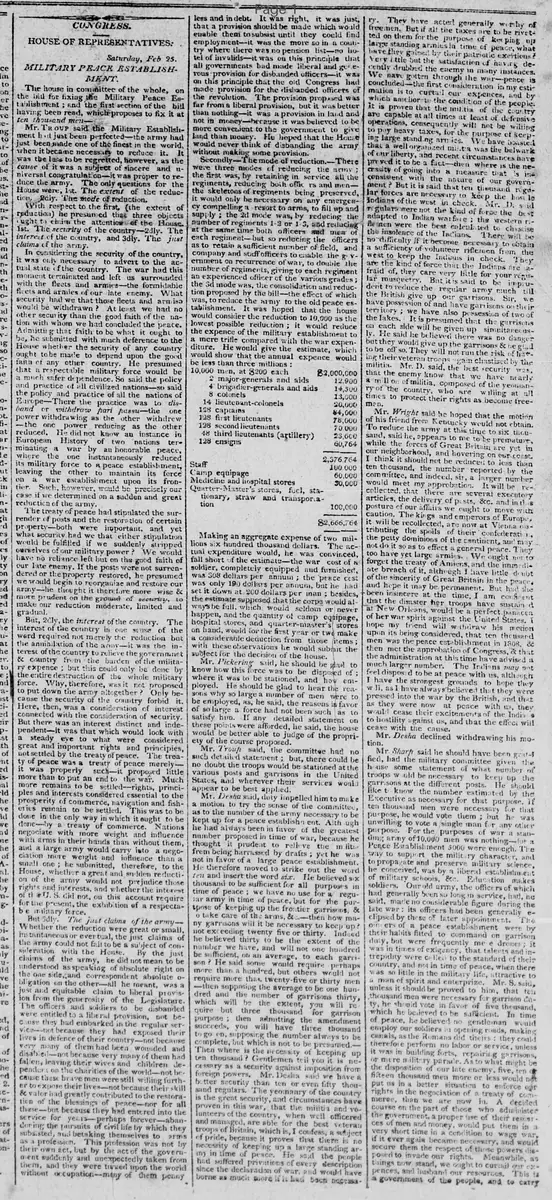
The house in committee of the whole, on the bill for fixing the Military Peace Establishment; and the first section of the bill having been read, which proposes to fix it at ten thousand men—
Mr. Troup said the Military Establishment had just been perfected—the army had just been made one of the finest in the world, when it became necessary to reduce it. It was the less to be regretted, however, as the cause of it was a subject of sincere and universal congratulation—it was proper to reduce the army. The only questions for the House were, 1st. The extent of the reduction. 2dly. The mode of reduction.
With respect to the first. (the extent of reduction) he presumed that three objects ought to claim the attention of the House. 1st. The security of the country—2dly. The interest of the country, and 3dly. The just claims of the army.
In considering the security of the country. it was only necessary to advert to the actual state of the country. The war had this moment terminated and left us surrounded with the fleets and armies—the formidable fleets and armies of our late enemy. What security had we that those fleets and armies would be withdrawn? At least we had no other security than the good faith of the nation with whom we had concluded the peace. Admitting that faith to be what it ought to be, he submitted with much deference to the House whether the security of any country ought to be made to depend upon the good faith of any other country. He presumed that a respectable military force would be a much safer dependence. So said the policy and practice of all civilized nations—so said the policy and practice of all the nations of Europe—There the practice was to disband or withdraw pari passu—the one power withdrawing as the other withdrew —the one power reducing as the other reduced. He did not know an instance in European History of two nations terminating a war by an honorable peace, where the one instantaneously reduced its military force to a peace establishment, leaving the other to maintain its force on a war establishment upon its frontier. Such, however, would be precisely our case if we determined on a sudden and great reduction of the army.
The treaty of peace had stipulated the surrender of posts and the restoration of certain property—both were important, and yet what security had we that either stipulation would be fulfilled if we suddenly stripped ourselves of our military power? We would have no reliance left but on the good faith of our late enemy. If the posts were not surrendered or the property restored, he presumed we would begin to reorganize and restore our army—he thought it therefore more wise & more prudent on the ground of security, to make our reduction moderate, limited and gradual.
But, 2dly, the interest of the country. The interest of the country in one sense of the word required not merely the reduction but the annihilation of the army—it was the interest of the country to relieve the government & country from the burden of the military expense; but this could only be done by the entire destruction of the whole military force. Why, therefore, was it not proposed to put down the army altogether? Only because the security of the country forbid it. Here, then, was a consideration of interest connected with the consideration of security. But there was an interest distinct and independent—it was that which would look with a steady eye to what were considered great and important rights and principles, not settled by the treaty of peace. The treaty of peace was a treaty of peace merely— it was properly such—it proposed little more than to put an end to the war. Much more remains to be settled—rights, principles and interests considered essential to the prosperity of commerce, navigation and fisheries remain to be settled. This was to be done in the only way in which it ought to be done—by a treaty of commerce. Nations negotiate with more weight and influence with arms in their hands than without them, and a large army would carry into a negotiation more weight and influence than a small one; he submitted, therefore, to the House, whether a great and sudden reduction of the army would not prejudice those rights and interests, and whether the interest of the U. S. did not, on this account require for the present, the exhibition of a respectable military force.
But 3dly. The just claims of the army— Whether the reduction were great or small, instantaneous or eventual, the just claims of the army could not fail to be a subject of consideration with the House. By the just claims of the army, he did not mean to be understood as speaking of absolute right on the one side, and correspondent absolute obligation on the other—all he meant, was a just and equitable claim to liberal provision from the generosity of the Legislature. The officers and soldiers to be disbanded were entitled to a liberal provision, not because they had embarked in the regular service—not because they had exposed their lives in defence of their country—not because very many of them had been wounded and disabled—not because very many of them had fallen, leaving their wives and children dependent on the charities of the world—not because these brave men were still willing further to expose their lives—not because their skill & valor had greatly contributed to the restoration of the blessings of peace—nor for all these—but because they had entered into the service for years—perhaps forever—abandoning the pursuits of civil life by which they subsisted, and betaking themselves to arms as a profession. This profession was not by their own act, but by the act of the government suddenly and unexpectedly taken from them, and they were turned upon the world without occupation—many of them penniless and in debt. It was right, it was just, that a provision should be made which would enable them to subsist until they could find employment—it was the more so in a country where there was no pension list—no hotel of invalids—it was on this principle that all governments had made liberal and generous provision for disbanded officers—it was on this principle that the old Congress had made provision for the disbanded officers of the revolution. The provision proposed was far from a liberal provision, but it was better than nothing—it was a provision in land and not in money—because it was believed to be more convenient to the government to give land than money. He hoped that the House would never think of disbanding the army without making some provision.
Secondly—The mode of reduction.—There were three modes of reducing the army; the first was, by retaining in service all the regiments, reducing both officers and men—the skeletons of regiments being preserved, it would only be necessary on any emergency compelling a resort to arms, to fill up and supply; the 2d mode was, by reducing the number of regiments 1-2 or 1-3, and reducing at the same time both officers and men of each regiment—but so reducing the officers as to retain a sufficient number of field, and company and staff officers to enable the government on recurrence of war, to double the number of regiments, giving to each regiment an experienced officer of the various grades; the 3d mode was, the consolidation and reduction proposed by the bill—the effect of which was, to reduce the army to the old peace establishment. It was hoped that the house would consider the reduction to 10,000 as the lowest possible reduction; it would reduce the expense of the military establishment to a mere trifle compared with the war expenditure. He would give the estimate, which would show that the annual expense would be less than three millions:
Making an aggregate expense of two millions six hundred thousand dollars. The actual expenditure would, he was convinced, fall short of the estimate—the war cost of a soldier, completely equipped and furnished, was 308 dollars per annum; the peace cost was only 190 dollars per annum, but he had set it down at 200 dollars per man; besides, the estimate supposed that the corps would always be full, which would seldom or never happen, and the quantity of camp equipage, hospital stores, and quarter-master's stores on hand, would for the first year or two make a considerable deduction from those items; with these observations he would submit the subject for the decision of the house.
Mr. Pickering said, he should be glad to know how this force was to be disposed of; where it was to be stationed, and how employed. He should be glad to hear the reasons why so large a number of men were to be employed, as, he said, the reasons in favor of so large a force had not been such as to satisfy him. If any detailed statement on these points were afforded, he said, the house would be better able to judge of the propriety of the course proposed.
Mr. Troup said, the committee had no such detailed statement; but, there could be no doubt the troops would be stationed at the various posts and garrisons in the United States, and wherever their services would appear to be best applied.
Mr. Desha said, duty impelled him to make a motion to try the sense of the committee, as to the number of the army necessary to be kept up for a peace establishment. Although he had always been in favor of the greatest number proposed in time of war, because he thought it prudent to relieve the militia from being harassed by drafts; yet he was not in favor of a large peace establishment. He therefore moved to strike out the word ten and insert the word six. He believed six thousand to be sufficient for all purposes in time of peace; we have no use for a regular army in time of peace, but for the purpose of keeping up the frontier garrisons. & to take care of the arms, &c.—then how many garrisons will it be necessary to keep up? not exceeding twenty five or thirty. Indeed he believed thirty to be the extent of the number we have, and will not one hundred be sufficient, on an average, to each garrison? He said some would require perhaps more than a hundred, but others would not require more than twenty-five or thirty men —then supposing the average to be one hundred and the number of garrisons thirty, which will be the extent, you will require but three thousand for garrison purpose; then admitting the amendment succeeds, you will have three thousand to go on, supposing the number always to be complete, but which is not to be presumed.— Then where is the necessity of keeping up ten thousand? Gentlemen tell you it is necessary as a security against imposition from foreign powers. Mr. Desha said we have a better security than ten or even fifty thousand regulars. The yeomanry of the country is the great security, and circumstances have proven in this war, that the militia and volunteers of the country, when well officered and managed, are able for the best veteran troops of Britain, which is, I confess, a subject of pride, because it proves that there is no necessity of keeping up a large standing army in time of peace. He said the people had suffered privations of every description since the declaration of war, and would have borne as much more if it had been necessary. They have acted generally worthy of freemen. But if all the taxes are to be riveted on them for the purpose of keeping up large standing armies in time of peace, what have they gained by their patriotic exertions? very little but the satisfaction of having decently drubbed the enemy in many instances. We have gotten through the war—peace is concluded—the first consideration in my estimation is to curtail our expenses, and by which ameliorate the condition of the people. It is proven that the militia of the country are capable at all times at least of defensive operations, consequently will not be willing to pay heavy taxes, for the purpose of keeping large standing armies. We have boasted that a well organized militia was the bulwark of our liberty, and recent circumstances have proved it to be a fact—then where is the necessity of going into a measure that is inconsistent with the nature of our government? But it is said that ten thousand regular forces are necessary to keep the hostile Indians of the west in check. Mr. D. said regulars were not the kind of force the best adapted to Indian warfare: the western riflemen were the best calculated to chastise the insolence of the Indians. There will be no difficulty if it become necessary to obtain a sufficiency of volunteer riflemen from the west to keep the Indians in check. They are the kind of force that the Indians are afraid of, they care very little for your regular musketry. But it is said to be imprudent to reduce the regular army much till the British give up our garrisons. Sir, we have possession of and have garrisons on their territory; we have also possession of two of the Lakes. It is presumed that the garrisons on each side will be given up simultaneously. He said he believed there was no danger but they would give up the garrisons & be glad to be of so. They will not run the risk of having their veteran troops again chastised by the militia. Mr. D. said, the best security was, that the enemy know that we have nearly a million of militia, composed of the yeomanry of the country, who are willing at all times to protect their rights as become freemen.
Mr. Wright said he hoped that the motion of his friend from Kentucky would not obtain. To reduce the army at this time to six thousand, said he, appears to me to be premature, while the forces of Great Britain are yet in our neighborhood, and hovering on our coast. I think it should not be reduced to less than ten thousand, the number reported by the committee, and indeed, sir, a larger number would meet my approbation. It will be recollected, that there are several executory articles, the delivery of posts, &c. and in this posture of our affairs we ought to move with caution. The kings and emperors of Europe, it will be recollected, are now at Vienna distributing the spoils of their confederation, the petty dominions of the continent, and may not do it so as to effect a general peace. They too have yet large armies. We ought not to forget the treaty of Amiens, and the immediate breach of it, although I have little doubt of the sincerity of Great Britain in the peace. and hope it may be permanent. But had she been insincere at the time, I am confident that the disaster her troops have sustained at New Orleans, would be a perfect panacea of her war spirit against the United States. I hope my friend will withdraw his motion upon its being considered, that ten thousand men was the peace establishment in 1802, & then met the approbation of Congress, & that the administration at this time have advised a much larger number. The Indians may not feel disposed to be at peace with us, although I have the strongest grounds to hope they will, as I have always believed that they were pressed into the war by the British, and that as they were now at peace with us, they would cease their excitements of the Indians to hostility against us, and that the effect will cease with the cause.
Mr. Desha declined withdrawing his motion.
Mr. Sharp said he should have been gratified, had the military committee given the house some statement of what number of troops would be necessary to keep up the garrisons at the different posts. He should like to know the number estimated by the Executive as necessary for that purpose. If ten thousand men were necessary for that purpose, he would vote them; but he was unwilling to vote a single man for any other purpose. For the purposes of war a standing army of 10,000 men was nothing—for a Peace Establishment 5000 were enough. The way to support the military character, and to propagate and preserve military science, he conceived, was by a liberal establishment of military schools, &c. Education makes soldiers. Our old army, the officers of which had generally been so long in service, had, he said, made no considerable figure during the late war: its officers had been generally eclipsed by those of later appointment. The officers of a peace establishment were by their habits fitted to command on garrison duty, but were frequently mere drones; it was in times of exigency, that talents and intrepidity were called to the standard of their country, and not in time of peace, when there was so little in the military life, attractive to a man of spirit and enterprise. Mr. S. said, unless it should be proved to him, that ten thousand men were necessary for garrison duty, he should vote in favor of five thousand, which he believed to be sufficient. In time of peace, he believed no gentleman would employ our soldiers in opening roads, making canals, as the Romans did theirs: they could therefore perform no labor or service, unless it was in building forts, repairing garrisons, or mere military parade. As to what might be the disposition of our late enemy, five, ten fifteen thousand men more or less would not put us in a better situation to enforce our rights in the negotiation of a treaty of commerce, than we are now in. A decided course on the part of those who administered the government, a proper use of their resources of men and money, would put them in a very short time in a condition to wage war, if it ever again became necessary, and would secure them the respect of those powers disposed to invade our rights. Meanwhile, as things now stand, we ought to curtail our expenses, and husband our resources. This is a government of the people, and to carry
| 10,000 men, at $200 each | 82,000,000 |
| 2 major-generals and aids | 12,900 |
| 4 brigadier-generals and aids | 14,500 |
| 8 colonels | 13,000 |
| 14 lieutenant-colonels | 20,000 |
| 128 captains | 84,000 |
| 128 first lieutenants | 78,000 |
| 128 second lieutenants | 70,000 |
| 48 third lieutenants (artillery) | 23,600 |
| 128 ensigns | 60,764 |
| Staff | 2,376,764 |
| Camp equipage | 100,000 |
| Medicine and hospital stores | 60,000 |
| Quarter-Master's stores | 30,000 |
them with you, the burthens you impose on them should be made as light as possible.
Mr. S. said he felt as much as any one the value of the services rendered by our army; he admired as much as any one the brilliant achievements by the talents of our officers & the bravery of the soldiers. That character had been principally acquired since the commencement of the war, and was not to be supported by the extent of the Peace Establishment beyond its necessary force, but rather by the establishment of proper military academical institutions throughout the country, &c.
(Debate to be continued.)
What sub-type of article is it?
What keywords are associated?
What entities or persons were involved?
Where did it happen?
Domestic News Details
Primary Location
United States House Of Representatives
Event Date
Saturday, Feb 25.
Key Persons
Outcome
debate ongoing; motion by mr. desha to reduce army to 6,000 men; estimated annual expense for 10,000 men at two million six hundred thousand dollars.
Event Details
Debate in committee of the whole on bill to fix military peace establishment at 10,000 men. Mr. Troup argued for moderate, gradual reduction considering security, national interests in future negotiations, and provisions for disbanded soldiers. Mr. Pickering sought details on disposition and employment. Mr. Desha moved to amend to 6,000, arguing militia sufficiency for defense and garrisons needing only 3,000. Mr. Wright opposed reduction below 10,000 due to lingering British forces and treaty obligations. Mr. Sharp favored 5,000 for garrisons, emphasizing military education over large standing army.