Thank you for visiting SNEWPapers!
Sign up free
Gazette Of The United States And Daily Evening Advertiser
Philadelphia, Philadelphia County, Pennsylvania
What is this article about?
British House of Commons debates cover Habeas Corpus concerns, the inferior sailing of British ships compared to French, and supply motions including discussions on the Imperial Loan guarantee, war policy against France, naval augmentation, and peace prospects.
Merged-components note: Merged continuation of the British Parliament debates across pages, as the text flows sequentially in reading order.
Clippings
1 of 2
OCR Quality
Full Text
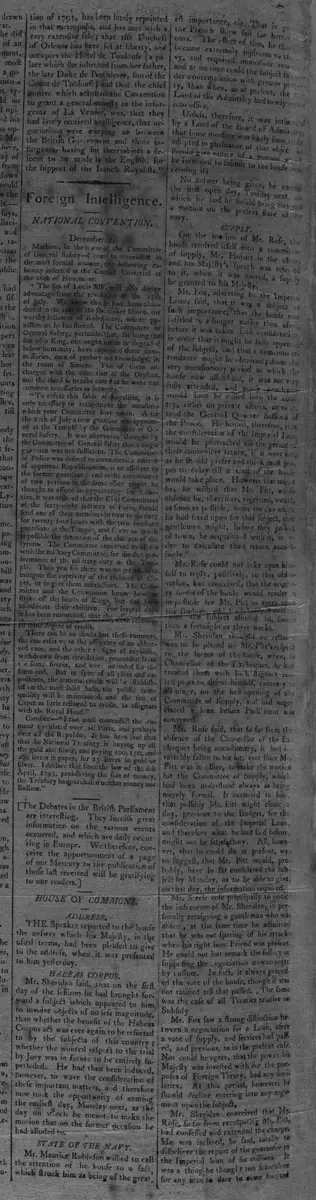
HOUSE OF COMMONS.
ADDRESS.
The Speaker reported to the house the answer which his Majesty, in the usual terms, had been pleased to give to the address, when it was presented to him yesterday.
HABEAS CORPUS.
Mr. Sheridan said, that on the first day of the session he had brought forward a subject which appeared to him to involve objects of no less magnitude, than whether the benefit of the Habeas Corpus act was ever again to be resorted to by the subjects of this country; whether the wonted respect to the trial by Jury was in future to be entirely superseded. He had then been induced, however, to wave the consideration of these important matters, and therefore now took the opportunity of naming the earliest day, Monday next, as the day on which he meant to make the motion that on the former occasion he had alluded to.
STATE OF THE NAVY
Mr. Maurice Robinson wished to call the attention of the house to a fact which struck him as being of the greatest importance, viz. That in general the French ships sail far better than ours. The effect of this, he thought, became extremely injurious to the navy, and required immediate remedy, and at no time could the subject stand in contemplation with greater propriety, than when, as at present, the First Lord of the Admiralty had newly come into office.
Unless, therefore, it was intimated by a Lord of the Board of Admiralty that some measure was likely soon to be adopted in pursuance of that object he should give notice of a motion which he intended to submit to the house concerning it.
No answer being given, he named the first open day, Tuesday next on which he said he should bring forward a motion on the present state of the navy.
SUPPLY.
On the motion of Mr. Rose, the house resolved itself into a committee of supply, Mr. Hobart in the chair, and his Majesty's speech was referred to it, when it was moved, a supply be granted to his Majesty.
Mr. Fox, adverting to the Imperial Loan, said, that it was a subject of such importance, that the house was entitled to a longer notice than usual before it was taken into consideration in order that it might be fully apprised of the subject, and that a numerous attendance might be obtained; from the very uncustomary period at which the house now assembled, it was not very fully attended, and many gentlemen would soon be called into the country, either on private affairs, or to attend the General Quarter Sessions of the Peace. He hoped, therefore, that the consideration of the Imperial Loan would be protracted till the period of their convenient return, if it were not, as he should prefer and think most proper to delay till a Call of the house would take place. However that might be, he wished that Mr. Pitt, whose absence he therefore regretted, would, as soon as possible, name the day which he had fixed upon for that subject, then gentlemen might, before they go out of town, be acquainted with it, in order to calculate their return accordingly.
Mr. Rose could not take upon himself to reply, positively, to this observation, but conceived, that the necessary forms of the house would render it impossible for Mr. Pitt to enter upon the Budget, which lay would include the subject alluded to, sooner than a fortnight or three weeks.
Mr. Sheridan thought no reliance was to be placed on Mr. Pitt's respect to the forms of the house, when, as Chancellor of the Exchequer, he had treated them with such flagrant contempt as to absent himself, contrary to all usage, on the first opening of the Committee of Supply, and had negotiated a loan before Parliament was convened.
Mr. Rose said, that so far from the absence of the Chancellor of the Exchequer being uncustomary, it had invariably fallen to his lot, ever since Mr. Pitt was in office, to make the motion for the Committee of Supply, which had been understood always as being merely formal. It occurred to him, that possibly Mr. Pitt might choose a day, previous to the Budget, for the consideration of the Imperial Loan, and therefore what he had said before, might not be satisfactory. All, however, that he could do at present, was to suggest, that Mr. Pitt would, probably, have so far considered the subject by Monday, as to be able to give, on that day, the information required.
Mr. Steele rose principally to notice the indecorum of Mr. Sheridan, in personally arraigning a gentleman who was absent, at the same time he admitted that he was sparing of his attacks when his right hon. Friend was present. He could not but remark the fallacy of supposing the negociation unwarranted by custom. In fact, it always preceded the vote of the house, though it was not ratified till that passed. The same was the case of all Treaties relative to Subsidy.
Mr. Fox saw a strong distinction between a negociation for a Loan, after a vote of supply, and services had passed, and previous, as in the present case. Nor could he agree, that those powers his Majesty was invested with for the purposes of Foreign Treaty, had any similarity. At this period, however, he should decline entering into any argument upon the subject.
Mr. Sheridan conceived that Mr. Rose, so far from exculpating Mr. Pitt, had confessed and extended the charge. He was inclined, he said, totally to disbelieve the report of the guarantee to the Imperial loan of six millions. It was a thing he thought too scandalous for any man to dare to come forward.
and state it barefaced to the country: on that subject let himself, therefore, could have nothing to add. Mr. Pitt, (who had come into the house while Mr. Sheridan was speaking) said, that he could not consider a committee of supply as any thing else than a matter of course, when even the amendment to the address, proposed to invest his majesty with the most liberal means of preparation, nor the degree of supply, nor its application were at all to come into consideration. In spite of any language which the honorable gentleman might think it useful for his purpose to indulge himself in, he felt no hesitation to declare, in a manner the most open and unmasked, that when the guarantee of a loan was the most likely means to annoy the enemy, and obtain the object of the war, he should ever be ready both to advise and avow the measure; and it was with great satisfaction that he had become more and more convinced, since the former debate, that those arrangements had really been made in consequence of that proposition, that were likely to meet our most sanguine expectations of return. Mr. Fox could not, like his honorable friend, (Mr. Sheridan) disbelieve any report of the intention of ministers, on account of its rashness or absurdity, after he had had the example of the Prussian subsidy: and when he recollected that an obstinate perseverance in error was one of their most prominent features, the report of an Imperial loan was confirmed beyond the possibility of doubt. He then repeated the observations that he had made before Mr. Pitt was present. He objected to the negotiation as it opened a door to undue influence on members of that house who might be parties to the loan, and thereby interested in carrying on the war, to which the loan was to be applied. Mr. Pitt said, that he proposed to make the guarantee a separate consideration from the Budget, and that Wednesday, the first of this month, was the day on which he would bring it forward. He was bound to enter into the negotiation, as it enabled him to ascertain what auxiliary force this country could look to from the co-operation of the emperor, which was a very material article for him to submit to them, when the services of the approaching campaign were considered. This was the only reason of the loan taking place so much earlier this year than the last. No undue influence could arise, as seemed to be insinuated, for the support of the war, as those who were parties to the loan were most interested that there should be prospects of peace, which, on whatever terms it was made, would infallibly at first occasion a rise in the funds, and no views of that nature would affect the loan, as even Mr. Fox himself admitted, that our preparations should not in any degree be relaxed, if that object was pursued. He, however, would tell the stock-holders, if he were asked, that a continuation of war, under our present circumstances, made their property more secure and valuable than any peace could do that at present could be obtained. This was his sincere opinion, though he was aware, that, at first, the impression would be otherwise. Mr. Francis doubted, whether the negotiation was conducted in a manner sufficiently open to all propositions whatever merit it might otherwise possess. Mr. Thornton declared, that the principle motive of his supporting that amendment was a conviction that our endeavors for peace would be ineffectual; in which case he looked forward to a perfect union of sentiment throughout the country, and the vigorous exertion of all its powers as the consequence. Though he was disappointed in this view, he meant to give his utmost support to ministers in the prosecution of the war, which he believed to be as just and necessary as ever. Mr. Wilberforce professed to entertain some hopes of success had propositions of peace been made, which he continued to think would have been the wisest and most political course, but as the decision of the House had shut out that question, the only one which remained was; Whether we should have a vigorous or a languid war? And he had no scruple in saying the former, and being of that opinion like the honorable Gentlemen who spoke last, he would give every support to Administration in his power. On the subject of the Imperial Loan, as a means of the war he had not however fully made up his mind, though the inclination of his opinion was its favour. Mr. Duncombe expressed similar sentiments, reserving to himself the liberty of objecting to any mode of carrying on the war which he might not approve of. Mr. Fox wished as the subject would be frequently brought forward, that the true points of difference in the House were clearly stated, and publicly understood. He conceived that Ministers rejected all idea of treating with the present government of France; and that they contended for an eternal and unextinguishable war till it was changed into a form partaking of Monarchy. If the war were continued, no one was more for its being a vigorous continuation than himself; and one cause of his objection to it was, that it would not be conducted with vigor. If the Imperial Loan should even be admitted right, as attaching the Emperor to the prosecution of the war, yet another question would arise, Whether we should act separately or conjoined? He must ever deprecate that system of concert and mutual dependence which had so miserably failed in the two former campaigns. Every power, in his opinion, should act separately against the common enemy in a given point, with no reliance on the co-operation of any other power, but the diversion which their hostility would occasion. He warned Ministers to look with a serious and anxious concern to the increase of our Naval Power, on the unrivalled superiority of which alone we could depend for safety. Not a crevice should be vacant in the land where a ship could be built, nor one man employed on any other service, till every vessel in our fleet was manned. Every other object, in comparison to the Navy, sunk into insignificance. The undisputed pre-eminence of which should be our prime concern and only reliance. Mr. Martin and Mr. M. Robinson most heartily concurred in the idea of augmenting and calling forth every exertion of Naval Power that we were capable of; and the latter would gladly have voted the six Millions of Imperial Loans to the exclusive service of the Navy. Mr. Pitt was as anxious as any one that the points of difference should be clearly and generally understood, and he thought that he had taken some pains at least to make himself understood on that subject, in the course of the last debate. He regarded the present Government of France, as one with which no treaty of Peace could be made, with safety or honour; and we were not at present in a state which should induce us to be satisfied with an unsafe Peace. Under the present existing circumstances, therefore, he did disclaim all intention of treating with France: but he wished that it should be understood that this determination was confined to the actual state in which both the parties were in. True it was, that in his opinion the best security that we could have for such a treaty, was a restoration of Monarchy in France in some shape or degree; but he was not bound by any thing that he had said, from treating with a Republican form or even the present Government, if it should modify itself so as to be capable of giving that security we look for; or if our situation should unfortunately, and contrary to all probability be so changed. that an insecure peace should become desirable as a less evil than carrying on the war. At this time a proposition of that nature he was persuaded would have directly the contrary effect that was looked for; Instead of uniting and inspiring it would sever and depress us. He observed, with much satisfaction, upon the fair and candid manner in which those Gentlemen who had been induced to vary in their opinions since the last Session, had explained and limited the nature of their variance. Mr. Sheridan professed himself but little the wiser for Mr. Pitt's explanations in general, and the same want of benefit, he was obliged to complain on the occasion. He admitted, that on the outset there was something explicit, but it was so buried in the mass of words that followed, that no distinct idea remained. If he understood any thing, it was, that no peace was to be made with the present Government of France while it was the same. The fashionable phrase of present existing circumstances, so perplexed the previous meaning that he could infer nothing else, which yet however, Mr. Pitt seemed to wish should not be understood. Mr. Barham, Mr. Jolliffe, and Sir W. Milner, said a few words; after which Mr. Hobart, as chairman of the Committee of Supply, put the question, That a supply be granted to his Majesty, which was carried, and ordered to be reported To-morrow. Adjourned.
What sub-type of article is it?
What keywords are associated?
What entities or persons were involved?
Where did it happen?
Foreign News Details
Primary Location
Europe
Key Persons
Outcome
supply granted to his majesty; motions planned for habeas corpus on monday next, navy state on tuesday next, imperial loan on wednesday the first of this month.
Event Details
Debates in the House of Commons include reports on the King's response to the address, Mr. Sheridan's motion on Habeas Corpus, Mr. Maurice Robinson's concerns about French ships sailing better than British and planned motion on navy state, and committee of supply discussions on the Imperial Loan guarantee of six millions to the Emperor, war policy against France, naval power augmentation, and peace negotiations, with Mr. Pitt defending the loan and rejecting peace with current French government.