Thank you for visiting SNEWPapers!
Sign up free
Story
June 18, 1832
Lynchburg Virginian
Lynchburg, Virginia
What is this article about?
An anonymous contributor describes a humane method for training young steers to the yoke using a swiveling pole on a post, advocating kind treatment over whipping to prevent bad habits and cruelty.
Clipping
OCR Quality
65%
Fair
Full Text
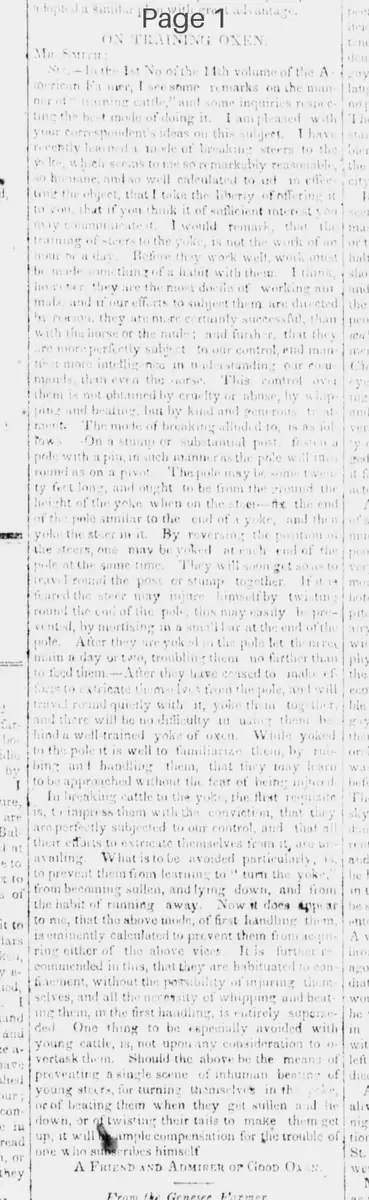
ON TRAINING OXEN
In the last volume of the American Farmer, I see some remarks on the manner of training cattle, and some inquiries respecting the mode of doing it. I was glad with your correspondent's ideas on this subject. I have lately had a little of breaking steers to the yoke which I think is markedly remarkable and so well calculated to induce to our entire effect, that I took the liberty of offering it to you that if you think it of sufficient interest to my friends I would remark the training of steers to the yoke.
Do not the ways of oxen ... Before that work well worth or by no means something of a hoax with the p I think, for they are the most docile of working animals and our efforts to subject them are directed by cause they have certainly been more successful than with the horse or the mule; and further that they are more perfectly safely to our control and more tenacious in the thing in usual is oxen animals than even the horse. This control of them is not obtained by cruelty or abuse, by whipping and beating but by kind and generous treatment.
The mode of breaking them is as follows: On a substantial post, set a pole with a pin, in which a man can thrust the pole will in rounds on a pivot. The pole may be some twenty feet long, and ought to be from the ground the height of the yoke when on the beast - one end of the pole similar to the end of yoke and the stay yoke the same meat. By reversing the position the steers, one may be yoked at each end of the pole at the same time. They will soon get accustomed to travel round the post or stump together. If it is feared the steer way may harm himself by two, turning round the end of the pole this may easily be prevented, by mooring in a chain at the end of the pole. After they are yoked to the pole let them run a day or so, trouble them no further than to feed them. After they have ceased to make efforts to get at it from the pole and will leave in and quietly with it. Yoke them to the together and there will be no difficulty in using them in hand a well trained yoke of oxen. Will yoked to this pole it is well to familiarize them by rubbing and handling them, that they may learn to be approached without the fear of being hurt. In breaking cattle to the yoke, the first regulation is, to impress them with the conviction, that they are perfectly subjected to our control. and that their efforts to extricate themselves from it do us avail. What is to be avoided particularly. to prevent them from learning, to turn the yoke. from becoming sullen, and lying down, and from the habit of running away. Now it does appear to me, that the above mode, of first handling them is eminently calculated to prevent them from taking either of the above vices. It is truly to be commended in this, that they are habituated to our harness, without the possibility of injuring themselves, and all the necessary whipping and beating them, in the first handling, is entirely superseded. One thing to be especially avoided with young cattle, is, not upon any consideration to overtask them. Should the above be the means of preventing a single scene of inhuman beating of young steers, for turning themselves in the act of beating them when they get sullen and down, or of twisting their tails to make them get up, it will amply compensate for the trouble of one who subscribes himself A FRIEND AND ADMIRER OF GOOD OXEN
In the last volume of the American Farmer, I see some remarks on the manner of training cattle, and some inquiries respecting the mode of doing it. I was glad with your correspondent's ideas on this subject. I have lately had a little of breaking steers to the yoke which I think is markedly remarkable and so well calculated to induce to our entire effect, that I took the liberty of offering it to you that if you think it of sufficient interest to my friends I would remark the training of steers to the yoke.
Do not the ways of oxen ... Before that work well worth or by no means something of a hoax with the p I think, for they are the most docile of working animals and our efforts to subject them are directed by cause they have certainly been more successful than with the horse or the mule; and further that they are more perfectly safely to our control and more tenacious in the thing in usual is oxen animals than even the horse. This control of them is not obtained by cruelty or abuse, by whipping and beating but by kind and generous treatment.
The mode of breaking them is as follows: On a substantial post, set a pole with a pin, in which a man can thrust the pole will in rounds on a pivot. The pole may be some twenty feet long, and ought to be from the ground the height of the yoke when on the beast - one end of the pole similar to the end of yoke and the stay yoke the same meat. By reversing the position the steers, one may be yoked at each end of the pole at the same time. They will soon get accustomed to travel round the post or stump together. If it is feared the steer way may harm himself by two, turning round the end of the pole this may easily be prevented, by mooring in a chain at the end of the pole. After they are yoked to the pole let them run a day or so, trouble them no further than to feed them. After they have ceased to make efforts to get at it from the pole and will leave in and quietly with it. Yoke them to the together and there will be no difficulty in using them in hand a well trained yoke of oxen. Will yoked to this pole it is well to familiarize them by rubbing and handling them, that they may learn to be approached without the fear of being hurt. In breaking cattle to the yoke, the first regulation is, to impress them with the conviction, that they are perfectly subjected to our control. and that their efforts to extricate themselves from it do us avail. What is to be avoided particularly. to prevent them from learning, to turn the yoke. from becoming sullen, and lying down, and from the habit of running away. Now it does appear to me, that the above mode, of first handling them is eminently calculated to prevent them from taking either of the above vices. It is truly to be commended in this, that they are habituated to our harness, without the possibility of injuring themselves, and all the necessary whipping and beating them, in the first handling, is entirely superseded. One thing to be especially avoided with young cattle, is, not upon any consideration to overtask them. Should the above be the means of preventing a single scene of inhuman beating of young steers, for turning themselves in the act of beating them when they get sullen and down, or of twisting their tails to make them get up, it will amply compensate for the trouble of one who subscribes himself A FRIEND AND ADMIRER OF GOOD OXEN
What sub-type of article is it?
Instructional Guide
Agricultural Advice
What themes does it cover?
Moral Virtue
Nature
What keywords are associated?
Oxen Training
Yoking Steers
Humane Methods
Breaking Cattle
Kind Treatment
Swiveling Pole
What entities or persons were involved?
A Friend And Admirer Of Good Oxen
Story Details
Key Persons
A Friend And Admirer Of Good Oxen
Story Details
Method involves yoking steers to a pivoting pole on a post to accustom them to restraint humanely, avoiding cruelty and preventing vices like running away or lying down through gentle handling and feeding.