Thank you for visiting SNEWPapers!
Sign up free
The Virginia Gazette
Richmond, Williamsburg, Richmond County, Virginia
What is this article about?
Mr. Cruger's speech in Parliament defends American colonists' actions as excesses born of love for liberty, criticizes coercive measures and the Stamp Act for straining relations, advocates for a liberal constitution to maintain union while preserving colonial liberties and British supremacy.
Merged-components note: Continuation of story featuring Mr. Cruger's speech on American affairs in a great assembly.
Clipping
OCR Quality
Full Text
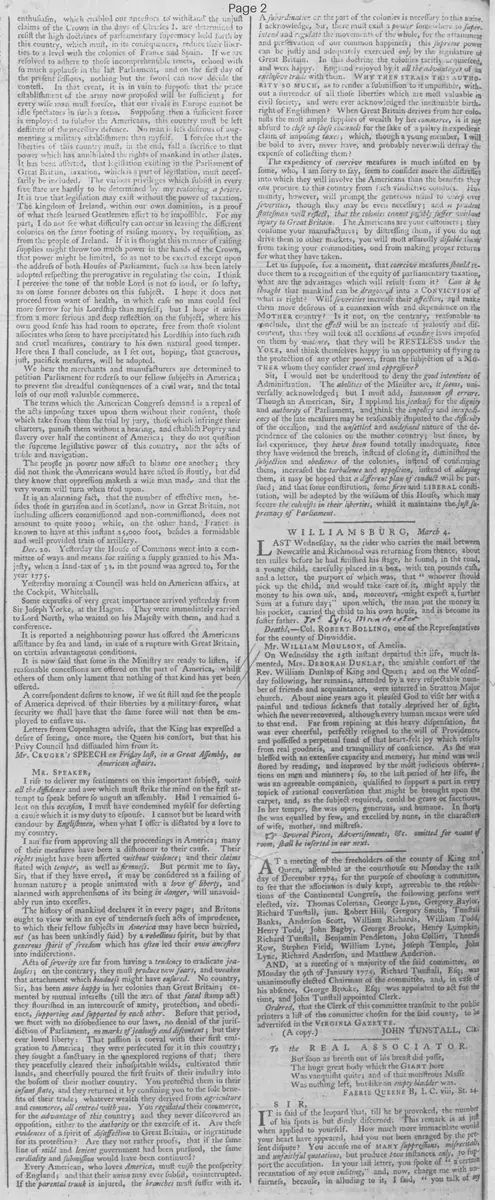
American affairs.
Mr. SPEAKER,
I rise to deliver my sentiments on this important subject, with
all the diffidence and awe which must strike the mind on the first at-
tempt to speak before so august an assembly. Had I remained si-
lent on this occasion, I must have condemned myself for deserting
a cause which it is my duty to espouse. I cannot but be heard with
candour by Englishmen, when what I offer is dictated by a love to
my country.
I am far from approving all the proceedings in America; many
of their measures have been a dishonour to their cause. Their
rights might have been asserted without violence; and their claims
stated with temper, as well as firmness. But permit me to say,
Sir, that if they have erred, it may be considered as a failing of
human nature; a people animated with a love of liberty, and
alarmed with apprehensions of its being in danger, will unavoid-
ably run into excesses.
The history of mankind declares it in every page; and Britons
ought to view with an eye of tenderness such acts of imprudence,
to which their fellow subjects in America may have been hurried,
not (as has been unkindly said) by a rebellious spirit, but by that
generous spirit of freedom which has often led their own ancestors
into indiscretions.
Acts of severity are far from having a tendency to eradicate jea-
lousies; on the contrary, they must produce new fears, and weaken
that attachment which kindness might have ensured. No country,
Sir, has been more happy in her colonies than Great Britain; ce-
mented by mutual interests (till the era of that fatal stamp act)
they flourished in an intercourse of amity, protection, and obedi-
ence, supporting and supported by each other. Before that period,
we meet with no disobedience to our laws, no denial of the juris-
diction of Parliament, no marks of jealousy and discontent; but they
ever loved liberty: That passion is coeval with their first emi-
grations to America; they were persecuted for it in this country;
they sought a sanctuary in the unexplored regions of that; there
they peacefully cleared their inhospitable wilds, cultivated their
lands, and cheerfully poured the first fruits of their industry into
the bosom of their mother country. You protected them in their
infant state, and they returned it by confining you to the sole bene-
benefits of their trade; whatever wealth they derived from agriculture
and commerce, all centred with you. You regulated their commerce,
for the advantage of this country; and they never discovered an
opposition, either to the authority or the exercise of it. Are these
evidence of a spirit of disaffection to Great Britain, or ingratitude
for its protection? Are they not rather proofs, that if the same
line of mild and lenient government had been pursued, the same
cordiality and submission would have been continued?
Every American, who loves America, must wish the prosperity
of England; and that their union may ever subsist, uninterrupted.
If the parental trunk is injured, the branches must suffer with it.
A subordination on the part of the colonies is necessary to this union.
I acknowledge, Sir, there must exist a power somewhere to super.
intend and regulate the movements of the whole, for the attainment
and preservation of our common happiness; this supreme power
can be justly and adequately exercised only by the legislature of
Great Britain. In this doctrine the colonies tacitly acquiesced,
and were happy. England enjoyed by it all the advantages of an
exclusive trade with them. WHY THEN STRAIN THIS AUTHO-
RITY so MUCH, as to render a submission to it impossible, with-
out a surrender of all those liberties which are most valuable in
civil society, and were ever acknowledged the inestimable birth-
right of Englishmen? When Great Britain derives from her colo-
nies the most ample supplies of wealth by her commerce, is it no
absurd to close up these channels for the sake of a paltry inexpedient
claim of imposing taxes; which, though a young member, I will
be bold to aver, never have, and probably never will defray the
expense of collecting them?
The expediency of coercive measures is much insisted on by
some, who, I am sorry to say, seem to consider more the distresses
into which they will involve the Americans than the benefits they
can procure to this country from such vindictive conduct. Hu-
manity, however, will prompt the generous mind to sweep over
severities, though they may be even necessary; and a prudent
statesman will reflect, that the colonies cannot possibly suffer without
injury to Great Britain. The Americans are your customers; they
consume your manufactures; by distressing them, if you do not
drive them to other markets, you will most assuredly disable them
from taking your commodities, and from making proper returns
for what they have taken.
Let us suppose, for a moment, that coercive measures should re-
duce them to a recognition of the equity of parliamentary taxation,
what are the advantages which will result from it? Can it be
thought that mankind can be dragooned into a Conviction of
what is right? Will severities increase their affection, and make
them more desirous of a connexion with and dependence on the
Mother country? Is it not, on the contrary, reasonable to
conclude, that the effect will be an increase of jealousy and dis-
content, that they will seek all occasions of evading laws imposed
on them by violence, that they will be RESTLESS under the
YOKE, and think themselves happy in an opportunity of flying to
the protection of any other power, from the subjection of a Mo-
THER whom they consider cruel and oppressive?
Sir, I would not be understood to deny the good intentions of
Administration. The abilities of the Minister are, it seems, uni-
versally, acknowledged; but I must add, humanum est errare.
Though an American, Sir, I applaud his jealousy for the dignity
and authority of Parliament, and think the impolicy and inexpedi-
ency of the late measures may be reasonably imputed to the difficulty
of the occasion, and the unsettled and undefined nature of the de-
pendence of the colonies on the mother country; but since, by
sad experience, they have been found totally inadequate, since
they have widened the breach, instead of closing it, diminished the
subjection and obedience of the colonies, instead of confirming
them, increased the turbulence and opposition, instead of allaying
them, it may be hoped that a different plan of conduct will be pur-
sued; and that some constitution, some firm and LIBERAL conti-
tution, will be adopted by the wisdom of this House, which may
secure the colonies in their liberties, whilst it maintains the just su-
premacy of Parliament.
What sub-type of article is it?
What themes does it cover?
What keywords are associated?
What entities or persons were involved?
Where did it happen?
Story Details
Key Persons
Location
Great Assembly
Event Date
Friday Last
Story Details
Mr. Cruger delivers a speech advocating for leniency toward American colonies, arguing that their excesses stem from love of liberty, criticizing the Stamp Act and coercive measures for harming mutual interests, and calling for a liberal constitution to preserve union and liberties.