Thank you for visiting SNEWPapers!
Sign up free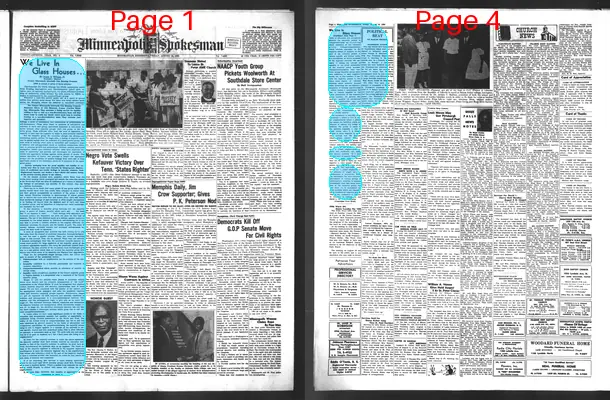
Minneapolis Spokesman
Minneapolis, Hennepin County, Minnesota
What is this article about?
Opinion piece by James A. Tillman, Jr. in Minneapolis Spokesman (Aug 12, 1960) examines psychosocial damages from housing discrimination by race, religion, or origin, impacting minorities with inferiority and majorities with false superiority; outlines U.S. stages toward equality, highlighting housing as last barrier.
Merged-components note: Continuation of the article 'We Live In Glass Houses' from page 1 to page 4; the page 4 segment was incorrectly labeled 'editorial' but is part of the same narrative story on housing segregation and discrimination.
Clippings
1 of 2
OCR Quality
Full Text
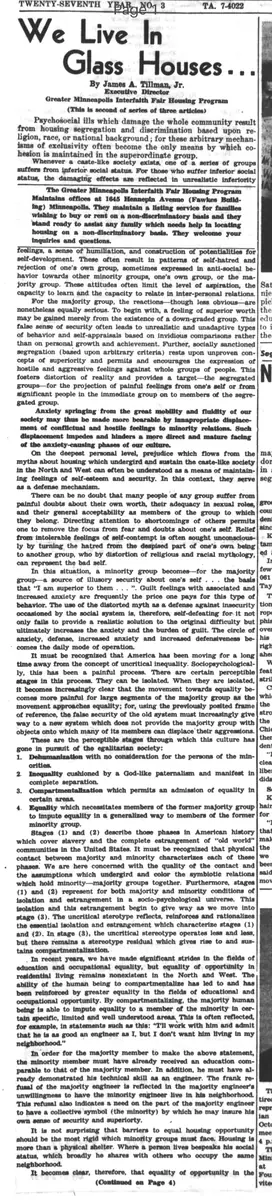
By James A. Tillman, Jr.
Executive Director
Greater Minneapolis Interfaith Fair Housing Program
(This is second of series of three articles)
Psychosocial ills which damage the whole community result from housing segregation and discrimination based upon religion, race, or national background; for these arbitrary mechanisms of exclusivity often become the only means by which cohesion is maintained in the superordinate group.
Whenever a caste-like society exists, one of a series of groups suffers from inferior social status. For those who suffer inferior social status, the damaging effects are reflected in unrealistic inferiority feelings, a sense of humiliation, and construction of potentialities for self-development. These often result in patterns of self-hatred and rejection of one's own group, sometimes expressed in anti-social behavior towards other minority groups, one's own group, or the majority group. These attitudes often limit the level of aspiration, the capacity to learn and the capacity to relate in inter-personal relations.
For the majority group, the reactions though less obvious are nonetheless equally serious. To begin with, a feeling of superior worth may be gained merely from the existence of a down-graded group. This false sense of security often leads to unrealistic and unadaptive types of behavior and self-appraisals based on invidious comparisons rather than on personal growth and achievement. Further, socially sanctioned segregation (based upon arbitrary criteria) rests upon unproven concepts of superiority and permits and encourages the expression of hostile and aggressive feelings against whole groups of people. This fosters distortion of reality and provides a target-the segregated groups for the projection of painful feelings from one's self or from significant people in the immediate group on to members of the segregated group.
Anxiety springing from the great mobility and fluidity of our society may thus be made more bearable, by inappropriate displacement of conflictual and hostile feelings to minority relations. Such displacement impedes and hinders a more direct and mature facing of the anxiety-causing phases of our culture.
On the deepest personal level, prejudice which flows from the myths about housing which undergird and sustain the caste-like society in the North and West can often be understood as a means of maintaining feelings of self-esteem and security. In this context, they serve as a defense mechanism
There can be no doubt that many people of any group suffer from painful doubts about their own worth, their adequacy in sexual roles, and their general acceptability as members of the group to which they belong. Directing attention to shortcomings of others permits one to remove the focus from fear and doubts about one's self, Relief from intolerable feelings of self-contempt is often sought unconsciously by turning the hatred from the despised part of one's own being to another group, who by distortion of religious and racial mythology, can represent the bad self.
In this situation, a minority group becomes for the majority group a source of illusory security about one's self . . . the basis that "I am superior to them . . . ". Guilt feelings with associated and increased anxiety are frequently the price one pays for this type of behavior. The use of the distorted myth as a defense against insecurity occasioned by the social system is, therefore, self-defeating for it not only fails to provide a realistic solution to the original difficulty but ultimately increases the anxiety and the burden of guilt. The circle of anxiety, defense, increased anxiety and increased defensiveness becomes the daily mode of operation.
It must be recognized that America has been moving for a long time away from the concept of uncritical inequality. Sociopsychologically, this has been a painful process. There are certain perceptible stages in this process. They can be isolated. When they are isolated, it becomes increasingly clear that the movement towards equality becomes more painful for large segments of the majority group as the movement approaches equality; for, using the previously posited frame of reference, the false security of the old system must increasingly give way to a new system which does not provide the majority group with objects onto which many of its members can displace their aggressions.
These are the perceptible stages through which this culture has gone in pursuit of the egalitarian society:
1. Dehumanization with no consideration for the persons of the minorities.
2. Inequality cushioned by a God-like paternalism and manifest in complete separation
3. Compartmentalization which permits an admission of equality in certain areas.
4. Equality which necessitates members of the former majority group to impute equality in a generalized way to members of the former minority group.
Stages (1) and (2) describe those phases in American history which cover slavery and the complete estrangement of "old world" communities in the United States. It must be recognized that physical contact between majority and minority characterizes each of these phases. We are here concerned with the quality of the contact and the assumptions which undergird and color the symbiotic relations which hold minority-majority groups together. Furthermore, stages (1) and (2) represent for both majority and minority conditions of isolation and estrangement in a socio-psychological universe. This isolation and this estrangement begin to give way as we move into stage (3). The uncritical stereotype reflects, reinforces and rationalizes the essential isolation and estrangement which characterize stages (1) and (2). In stage (3), the uncritical stereotype operates less and less, but there remains a stereotype residual which gives rise to and sustains compartmentalization.
In recent years, we have made significant strides in the fields of education and occupational equality, but equality of opportunity in residential living remains nonexistent in the North and West. The ability of the human being to compartmentalize has led to and has been reinforced by greater equality in the fields of educational and occupational opportunity. By compartmentalizing, the majority human being is able to impute equality to a member of the minority in certain specific, limited and well understood areas. This is often reflected, for example, in statements such as this: "I'll work with him and admit that he is as good an engineer as I, but I don't want him living in my neighborhood."
In order for the majority member to make the above statement, the minority member must have already received an education comparable to that of the majority member, In addition, he must have already demonstrated his technical skill as an engineer. The frank refusal of the majority engineer is reflected in the majority engineer's unwillingness to have the minority engineer live in his neighborhood.
This refusal also indicates a need on the part of the majority engineer to have a collective symbol (the minority) by which he may insure his own sense of security and superiority.
It is not surprising that barriers to equal housing opportunity should be the most rigid which minority groups must face. Housing is more than a physical shelter. Where a person lives bespeaks his social status, which broadly he shares with others who occupy the same neighborhood.
It becomes clear, therefore, that equality of opportunity in the
(Continued on Page 4)
Page 4, Minneapolis SPOKESMAN, Friday, August 12, 1960
We Live In Glass Houses
(Continued from Page 1)
fields of education and occupation permits the majority person to compartmentalize his thinking about members of the minority group. Compartmentalization, which involves admission by the majority person of equality on the part of the minority person in certain specific and limited areas, is a mechanism by which members of the majority preclude the necessity of taking the concept of equality to the whole personality of the minority group member. Compartmentalization may reinforce among majority group members resistance to open neighborhoods; for, in this instance, it permits the majority person to embrace some degree of rational thinking about minority persons while preserving the one symbol—inequality of housing opportunities—which makes it unnecessary for him to impute equality to the whole personality of the minority group member. All persons who embrace equality of educational and job opportunities may not, therefore, embrace equality of housing opportunity. In fact, their commitment to the former sometimes make commitment to the latter doubly painful.
The movement to suburbia often represents a desire to live in better neighborhoods where a person can escape the liabilities which are inherent in central city living. In addition, the ability to move to the suburbs bespeaks a rise in social status, since it is always related in some measure to economic success and the symbols which attach thereto. When a member of a minority group which is low on the rank-order scale moves into a closed neighborhood, the symbols no longer serve as mechanisms of exclusivity. When one remembers the socio-economic antecedents of various groups in contemporary America, it becomes increasingly clear that many members of the majority group feel they must (to be successful) acquire symbols which are inaccessible to members of minority groups. This is why resistance to equality in America is making its last stand in the field of housing.
(Concluded Next Week)
What sub-type of article is it?
What themes does it cover?
What keywords are associated?
What entities or persons were involved?
Where did it happen?
Story Details
Key Persons
Location
Minneapolis, North And West United States
Event Date
August 12, 1960
Story Details
The article analyzes the psychosocial harms of housing segregation and discrimination by religion, race, or national background, affecting both minority and majority groups through inferiority feelings, self-hatred, false superiority, and prejudice as defense mechanisms. It outlines stages of American progress toward equality: dehumanization, paternalistic inequality, compartmentalization, and full equality, noting persistent barriers in residential housing despite advances in education and occupation.