Thank you for visiting SNEWPapers!
Sign up free
Story
October 18, 1962
Smyrna Times
Smyrna, Kent County, Delaware
What is this article about?
Delaware Civil Defense Director Lt-Col. J. Arnold Sullivan reports that 300,000 residents could be shielded from nuclear fallout via existing and upgradable shelters, with 118,932 spaces currently available, mostly in New Castle County.
Clipping
OCR Quality
98%
Excellent
Full Text
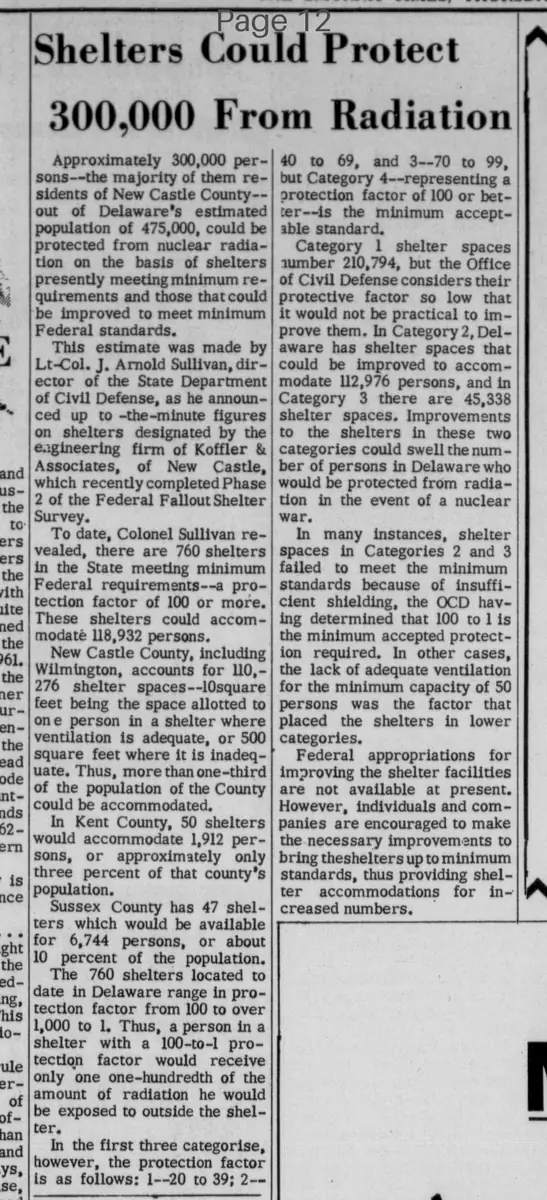
Shelters Could Protect 300,000 From Radiation
Approximately 300,000 persons--the majority of them residents of New Castle County--out of Delaware's estimated population of 475,000, could be protected from nuclear radiation on the basis of shelters presently meeting minimum requirements and those that could be improved to meet minimum Federal standards.
This estimate was made by Lt-Col. J. Arnold Sullivan, director of the State Department of Civil Defense, as he announced up-to-the-minute figures on shelters designated by the engineering firm of Koffler & Associates, of New Castle, which recently completed Phase 2 of the Federal Fallout Shelter Survey.
To date, Colonel Sullivan revealed, there are 760 shelters in the State meeting minimum Federal requirements--a protection factor of 100 or more. These shelters could accommodate 118,932 persons.
New Castle County, including Wilmington, accounts for 110,276 shelter spaces--10 square feet being the space allotted to one person in a shelter where ventilation is adequate, or 500 square feet where it is inadequate. Thus, more than one-third of the population of the County could be accommodated.
In Kent County, 50 shelters would accommodate 1,912 persons, or approximately only three percent of that county's population.
Sussex County has 47 shelters which would be available for 6,744 persons, or about 10 percent of the population.
The 760 shelters located to date in Delaware range in protection factor from 100 to over 1,000 to 1. Thus, a person in a shelter with a 100-to-1 protection factor would receive only one one-hundredth of the amount of radiation he would be exposed to outside the shelter.
In the first three categories, however, the protection factor is as follows: 1--20 to 39; 2--40 to 69, and 3--70 to 99, but Category 4--representing a protection factor of 100 or better--is the minimum acceptable standard.
Category 1 shelter spaces number 210,794, but the Office of Civil Defense considers their protective factor so low that it would not be practical to improve them. In Category 2, Delaware has shelter spaces that could be improved to accommodate 112,976 persons, and in Category 3 there are 45,338 shelter spaces. Improvements to the shelters in these two categories could swell the number of persons in Delaware who would be protected from radiation in the event of a nuclear war.
In many instances, shelter spaces in Categories 2 and 3 failed to meet the minimum standards because of insufficient shielding, the OCD having determined that 100 to 1 is the minimum accepted protection required. In other cases, the lack of adequate ventilation for the minimum capacity of 50 persons was the factor that placed the shelters in lower categories.
Federal appropriations for improving the shelter facilities are not available at present. However, individuals and companies are encouraged to make the necessary improvements to bring the shelters up to minimum standards, thus providing shelter accommodations for increased numbers.
Approximately 300,000 persons--the majority of them residents of New Castle County--out of Delaware's estimated population of 475,000, could be protected from nuclear radiation on the basis of shelters presently meeting minimum requirements and those that could be improved to meet minimum Federal standards.
This estimate was made by Lt-Col. J. Arnold Sullivan, director of the State Department of Civil Defense, as he announced up-to-the-minute figures on shelters designated by the engineering firm of Koffler & Associates, of New Castle, which recently completed Phase 2 of the Federal Fallout Shelter Survey.
To date, Colonel Sullivan revealed, there are 760 shelters in the State meeting minimum Federal requirements--a protection factor of 100 or more. These shelters could accommodate 118,932 persons.
New Castle County, including Wilmington, accounts for 110,276 shelter spaces--10 square feet being the space allotted to one person in a shelter where ventilation is adequate, or 500 square feet where it is inadequate. Thus, more than one-third of the population of the County could be accommodated.
In Kent County, 50 shelters would accommodate 1,912 persons, or approximately only three percent of that county's population.
Sussex County has 47 shelters which would be available for 6,744 persons, or about 10 percent of the population.
The 760 shelters located to date in Delaware range in protection factor from 100 to over 1,000 to 1. Thus, a person in a shelter with a 100-to-1 protection factor would receive only one one-hundredth of the amount of radiation he would be exposed to outside the shelter.
In the first three categories, however, the protection factor is as follows: 1--20 to 39; 2--40 to 69, and 3--70 to 99, but Category 4--representing a protection factor of 100 or better--is the minimum acceptable standard.
Category 1 shelter spaces number 210,794, but the Office of Civil Defense considers their protective factor so low that it would not be practical to improve them. In Category 2, Delaware has shelter spaces that could be improved to accommodate 112,976 persons, and in Category 3 there are 45,338 shelter spaces. Improvements to the shelters in these two categories could swell the number of persons in Delaware who would be protected from radiation in the event of a nuclear war.
In many instances, shelter spaces in Categories 2 and 3 failed to meet the minimum standards because of insufficient shielding, the OCD having determined that 100 to 1 is the minimum accepted protection required. In other cases, the lack of adequate ventilation for the minimum capacity of 50 persons was the factor that placed the shelters in lower categories.
Federal appropriations for improving the shelter facilities are not available at present. However, individuals and companies are encouraged to make the necessary improvements to bring the shelters up to minimum standards, thus providing shelter accommodations for increased numbers.
What sub-type of article is it?
Historical Event
What themes does it cover?
Survival
Catastrophe
What keywords are associated?
Fallout Shelters
Nuclear Radiation
Civil Defense
Delaware Shelters
Protection Factor
What entities or persons were involved?
Lt Col. J. Arnold Sullivan
Koffler & Associates
Where did it happen?
Delaware
Story Details
Key Persons
Lt Col. J. Arnold Sullivan
Koffler & Associates
Location
Delaware
Story Details
Lt-Col. J. Arnold Sullivan announces that approximately 300,000 Delaware residents, mostly in New Castle County, could be protected from nuclear radiation using 760 shelters meeting minimum federal standards (protection factor of 100 or more), accommodating 118,932 persons, with potential improvements to Category 2 and 3 shelters adding capacity for 158,314 more.