Thank you for visiting SNEWPapers!
Sign up free
Alexandria Daily Gazette, Commercial & Political
Alexandria, Virginia
What is this article about?
Report from Seville on Spanish General Reding's military operations in Catalonia against French forces under St. Cyr. Describes troop repositioning, skirmishes, retreat from Igualada, and a fierce battle at Valls on February 24-25, 1809, where outnumbered Spanish troops fought valiantly before withdrawing to Tarragona. Reding wounded but recovering.
Clipping
OCR Quality
Full Text
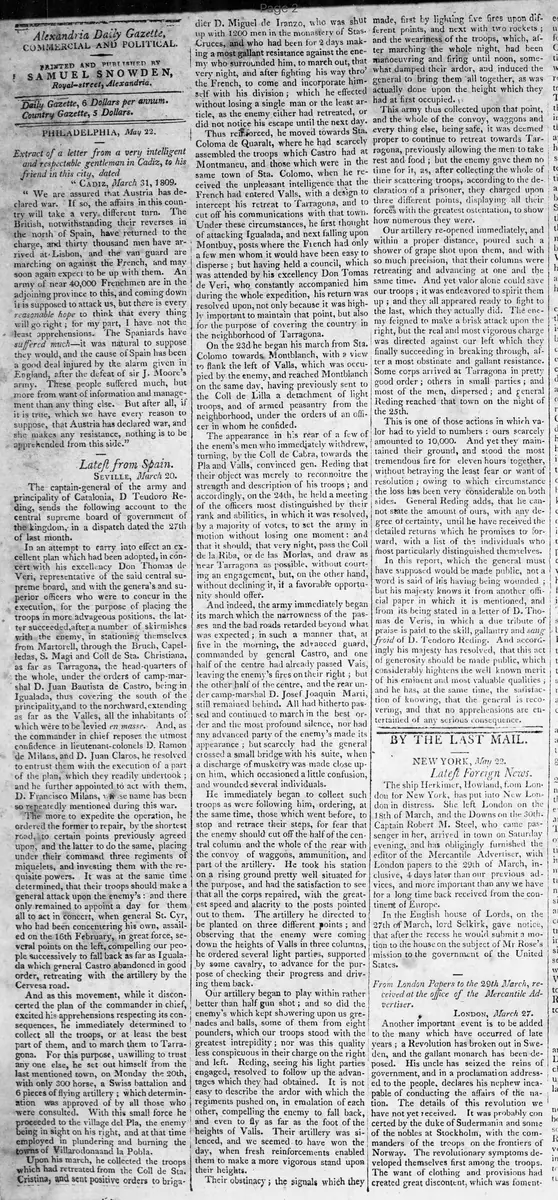
Seville, March 20.
The captain-general of the army and principality of Catalonia, D. Teodoro Reding, sends the following account to the central supreme board of government of the kingdom, in a dispatch dated the 27th of last month.
In an attempt to carry into effect an excellent plan which had been adopted, in concert with his excellency Don Thomas de Veri, representative of the said central supreme board, and with the generals and superior officers who were to concur in the execution, for the purpose of placing the troops in more advantageous positions, the latter succeeded, after a number of skirmishes with the enemy, in stationing themselves from Martorell, through the Bruch, Capelladas, S. Magi and Coll de Sta. Christina, as far as Tarragona, the head-quarters of the whole, under the orders of camp-marshal D. Juan Bautista de Castro, being in Igualada, thus covering the south of the principality, and to the northward, extending as far as the Valles, all the inhabitants of which were to be levied en masse. And, as the commander in chief reposes the utmost confidence in lieutenant-colonels D. Ramon de Milans, and D. Juan Claros, he resolved to entrust them with the execution of a part of the plan, which they readily undertook; and he further appointed to act with them D. Francisco Milans, whose name has been so repeatedly mentioned during this war.
The more to expedite the operation, he ordered the former to repair, by the shortest road, to certain points previously agreed upon, and the latter to do the same, placing under their command three regiments of miquelets, and investing them with the requisite powers. It was at the same time determined, that their troops should make a general attack upon the enemy's: and there only remained to appoint a day for them all to act in concert, when general St. Cyr, who had been concentering his own, assailed on the 16th February, in great force, several points on the left, compelling our people successively to fall back as far as Igualada which general Castro abandoned in good order, retreating with the artillery by the Cervesa road.
And as this movement, while it disconcerted the plan of the commander in chief, excited his apprehensions respecting its consequences, he immediately determined to collect all the troops, or at least the best part of them, and to march them to Tarragona. For this purpose, unwilling to trust any one else, he set out himself from the last mentioned town, on Monday the 20th, with only 300 horse, a Swiss battalion and 6 pieces of flying artillery; which determination was approved of by all those who were consulted. With this small force he proceeded to the village del Pla, the enemy being in sight on his right, and at that time employed in plundering and burning the towns of Villarodona and la Pobla.
Upon his march, he collected the troops which had retreated from the Coll de Sta. Cristina, and sent positive orders to brigadier D. Miguel de Iranzo, who was shut up with 1200 men in the monastery of Stas. Cruces, and who had been for 2 days making a most gallant resistance against the enemy who surrounded him, to march out, that very night, and after fighting his way thro' the French, to come and incorporate himself with his division; which he effected without losing a single man or the least article, as the enemy either had retreated, or did not notice his escape until the next day.
Thus reinforced, he moved towards Sta. Coloma de Queralt, where he had scarcely assembled the troops which Castro had at Montmaneu, and those which were in the same town of Sta. Coloma, when he received the unpleasant intelligence that the French had entered Valls, with a design to intercept his retreat to Tarragona, and to cut off his communications with that town.
Under these circumstances, he first thought of attacking Igualada, and next falling upon Montbuy, posts where the French had only a few men whom it would have been easy to disperse; but having held a council, which was attended by his excellency Don Tomas de Veri, who constantly accompanied him during the whole expedition, his return was resolved upon, not only because it was highly important to maintain that point, but also for the purpose of covering the country in the neighborhood of Tarragona.
On the 23d he began his march from Sta. Coloma towards Montblanch, with a view to flank the left of Valls, which was occupied by the enemy, and reached Montblanch on the same day, having previously sent to the Coll de Lilla a detachment of light troops, and of armed peasantry from the neighborhood, under the orders of an officer in whom he confided.
The appearance in his rear of a few of the enemy's men who immediately withdrew, turning, by the Coll de Cabra, towards the Pla and Valls, convinced gen. Reding that their object was merely to reconnoitre the strength and description of his troops; and accordingly, on the 24th, he held a meeting of the officers most distinguished by their rank and abilities, in which it was resolved, by a majority of votes, to set the army in motion without losing one moment: and that it should, that very night, pass the Coll de la Riba, or de las Morlas, and draw as near Tarragona as possible, without courting an engagement, but, on the other hand, without declining it, if a favorable opportunity should offer.
And indeed, the army immediately began its march which the narrowness of the passes and the bad roads retarded beyond what was expected; in such a manner that, at five in the morning, the advanced guard, commanded by general Castro, and one half of the centre had already passed Valls, leaving the enemy's fires on their right; but the other half of the centre, and the rear under camp-marshal D. Josef Joaquin Marti, still remained behind. All had hitherto passed and continued to march in the best order and the most profound silence, nor had any advanced party of the enemy's made its appearance; but scarcely had the general crossed a small bridge with his suite, when a discharge of musketry was made close upon him, which occasioned a little confusion, and wounded several individuals.
He immediately began to collect such troops as were following him, ordering, at the same time, those which went before, to stop and retrace their steps, for fear that the enemy should cut off the half of the central column and the whole of the rear with the convoy of waggons, ammunition, and part of the artillery. He took his station on a rising ground pretty well situated for the purpose, and had the satisfaction to see that all the corps repaired, with the greatest speed and alacrity to the posts pointed out to them. The artillery he directed to be planted on three different points; and observing that the enemy were coming down the heights of Valls in three columns, he ordered several light parties, supported by some cavalry, to advance for the purpose of checking their progress and driving them back.
Our artillery began to play within rather better than half gun shot; and so did the enemy's which kept showering upon us grenades and balls, some of them from eight pounders, which our troops stood with the greatest intrepidity; nor was this quality less conspicuous in their charge on the right and left. Reding, seeing his light parties engaged, resolved to follow up the advantages which they had obtained. It is not easy to describe the ardor with which the regiments pushed on, in emulation of each other, compelling the enemy to fall back, and even to fly as far as the foot of the heights of Valls. Their artillery was silenced, and we seemed to have won the day, when fresh reinforcements enabled them to make a more vigorous stand upon their heights.
Their obstinacy; the signals which they made, first by lighting five fires upon different points, and next with two rockets; and the weariness of the troops, which, after marching the whole night, had been manoeuvring and firing until noon, somewhat damped their ardor, and induced the general to bring them all together, as was actually done upon the height which they had at first occupied.
This army thus collected upon that point, and the whole of the convoy, waggons and every thing else, being safe, it was deemed proper to continue to retreat towards Tarragona, previously allowing the men to take rest and food; but the enemy gave them no time for it, as, after collecting the whole of their scattering troops, according to the declaration of a prisoner, they charged upon three different points, displaying all their forces with the greatest ostentation, to show how numerous they were.
Our artillery re-opened immediately, and within a proper distance, poured such a shower of grape shot upon them, and with so much precision, that their columns were retreating and advancing at one and the same time. And yet valor alone could save our troops; it was endeavored to spirit them up; and they all appeared ready to fight to the last, which they actually did. The enemy feigned to make a brisk attack upon the right, but the real and most vigorous charge was directed against our left which they finally succeeded in breaking through, after a most obstinate and gallant resistance.
Some corps arrived at Tarragona in pretty good order; others in small parties; and most of the men, dispersed; and general Reding reached that town on the night of the 25th.
This is one of those actions in which valor had to yield to numbers: ours scarcely amounted to 10,000. And yet they maintained their ground, and stood the most tremendous fire for eleven hours together, without betraying the least fear or want of resolution; owing to which circumstance the loss has been very considerable on both sides. General Reding adds, that he cannot state the amount of ours, with any degree of certainty, until he have received the detailed returns which he promises to forward, with a list of the individuals who most particularly distinguished themselves.
In this report, which the general must have supposed would be made public, not a word is said of his having being wounded; but his majesty knows it from another official paper in which it is mentioned, and from its being stated in a letter of D. Thomas de Veris, in which a due tribute of praise is paid to the skill, gallantry and sang froid of D. Teodoro Reding. And accordingly his majesty has resolved, that this act of generosity should be made public, which considerably heightens the well known merit of his eminent and most valuable qualities; and he has, at the same time, the satisfaction of knowing, that the general is recovering, and that no apprehensions are entertained of any serious consequence.
What sub-type of article is it?
What keywords are associated?
What entities or persons were involved?
Where did it happen?
Foreign News Details
Primary Location
Catalonia
Event Date
February 16 25
Key Persons
Outcome
spanish forces approximately 10,000 men fought for 11 hours against superior french numbers; heavy losses on both sides, exact spanish casualties pending; troops retreated to tarragona; general reding wounded but recovering.
Event Details
Spanish forces under General Reding attempted to reposition troops in Catalonia per a strategic plan but faced French assaults led by General St. Cyr starting February 16, forcing retreats. Reding rallied troops, rescued besieged forces, and during a night march on February 24-25, engaged in a major battle at Valls. Spanish artillery and infantry initially repelled French advances but ultimately yielded to reinforcements and fatigue, withdrawing to Tarragona after fierce fighting.