Thank you for visiting SNEWPapers!
Sign up free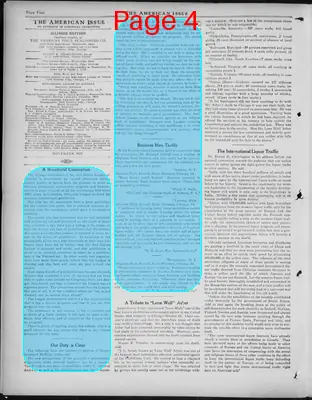
Editorial
November 1, 1925
The American Issue
Westerville, Delaware County, Ohio
What is this article about?
The editorial praises the 1920s Chicago convention of the Anti-Saloon League as the most impactful since 1913, highlighting strong attendance, publicity, and resolve to enforce prohibition amid wet propaganda. It quotes Superintendent McBride on supporting enforcement and re-engaging the church, and includes telegrams from business leaders endorsing prohibition's benefits.
Clipping
OCR Quality
95%
Excellent
Full Text
A Wonderful Convention
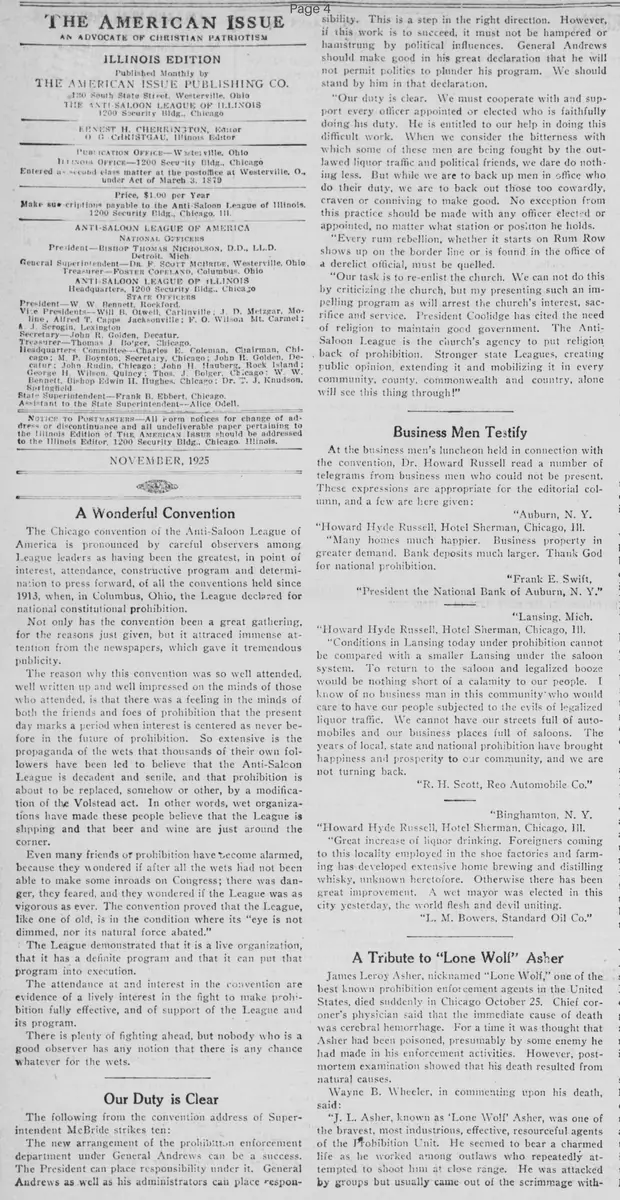
The Chicago convention of the Anti-Saloon League of America is pronounced by careful observers among League leaders as having been the greatest, in point of interest, attendance, constructive program and determination to press forward, of all the conventions held since 1913, when, in Columbus, Ohio, the League declared for national constitutional prohibition.
Not only has the convention been a great gathering for the reasons just given, but it attracted immense attention from the newspapers, which gave it tremendous publicity.
The reason why this convention was so well attended, well written up and well impressed on the minds of those who attended, is that there was a feeling in the minds of both the friends and foes of prohibition that the present day marks a period when interest is centered as never before in the future of prohibition. So extensive is the propaganda of the wets that thousands of their own followers have been led to believe that the Anti-Saloon League is decadent and senile, and that prohibition is about to be replaced, somehow or other, by a modification of the Volstead act. In other words, wet organizations have made these people believe that the League is slipping and that beer and wine are just around the corner.
Even many friends of prohibition have become alarmed, because they wondered if after all the wets had not been able to make some inroads on Congress; there was danger, they feared, and they wondered if the League was as vigorous as ever. The convention proved that the League, like one of old, is in the condition where its "eye is not dimmed, nor its natural force abated."
The League demonstrated that it is a live organization, that it has a definite program and that it can put that program into execution.
The attendance at and interest in the convention are evidence of a lively interest in the fight to make prohibition fully effective, and of support of the League and its program.
There is plenty of fighting ahead, but nobody who is a good observer has any notion that there is any chance whatever for the wets.
Our Duty is Clear
The following from the convention address of Superintendent McBride strikes ten:
The new arrangement of the prohibition enforcement department under General Andrews can be a success. The President can place responsibility under it. General Andrews as well as his administrators can place responsibility. This is a step in the right direction. However, if this work is to succeed, it must not be hampered or hamstrung by political influences. General Andrews should make good in his great declaration that he will not permit politics to plunder his program. We should stand by him in that declaration.
"Our duty is clear. We must cooperate with and support every officer appointed or elected who is faithfully doing his duty. He is entitled to our help in doing this difficult work. When we consider the bitterness with which some of these men are being fought by the outlawed liquor traffic and political friends, we dare do nothing less. But while we are to back up men in office who do their duty, we are to back out those too cowardly, craven or conniving to make good. No exception from this practice should be made with any officer elected or appointed, no matter what station or position he holds.
"Every rum rebellion, whether it starts on Rum Row shows up on the border line or is found in the office of a derelict official, must be quelled.
"Our task is to re-enlist the church. We can not do this by criticizing the church, but by presenting such an impelling program as will arrest the church's interest, sacrifice and service. President Coolidge has cited the need of religion to maintain good government. The Anti-Saloon League is the church's agency to put religion back of prohibition. Stronger state Leagues, creating public opinion, extending it and mobilizing it in every community, county, commonwealth and country, alone will see this thing through!"
Business Men Testify
At the business men's luncheon held in connection with the convention, Dr. Howard Russell read a number of telegrams from business men who could not be present. These expressions are appropriate for the editorial column, and a few are here given:
"Auburn, N. Y.
"Howard Hyde Russell, Hotel Sherman, Chicago, Ill.
"Many homes much happier. Business property in greater demand. Bank deposits much larger. Thank God for national prohibition.
"Frank E. Swift,
"President the National Bank of Auburn, N. Y."
"Lansing, Mich.
"Howard Hyde Russell, Hotel Sherman, Chicago, Ill.
"Conditions in Lansing today under prohibition cannot be compared with a smaller Lansing under the saloon system. To return to the saloon and legalized booze would be nothing short of a calamity to our people. I know of no business man in this community who would care to have our people subjected to the evils of legalized liquor traffic. We cannot have our streets full of automobiles and our business places full of saloons. The years of local, state and national prohibition have brought happiness and prosperity to our community, and we are not turning back.
"R. H. Scott, Reo Automobile Co."
"Binghamton, N. Y.
"Howard Hyde Russell, Hotel Sherman, Chicago, Ill.
"Great increase of liquor drinking. Foreigners coming to this locality employed in the shoe factories and farming has developed extensive home brewing and distilling whisky, unknown heretofore. Otherwise there has been great improvement. A wet mayor was elected in this city yesterday, the world flesh and devil uniting.
"I. M. Bowers, Standard Oil Co."
The Chicago convention of the Anti-Saloon League of America is pronounced by careful observers among League leaders as having been the greatest, in point of interest, attendance, constructive program and determination to press forward, of all the conventions held since 1913, when, in Columbus, Ohio, the League declared for national constitutional prohibition.
Not only has the convention been a great gathering for the reasons just given, but it attracted immense attention from the newspapers, which gave it tremendous publicity.
The reason why this convention was so well attended, well written up and well impressed on the minds of those who attended, is that there was a feeling in the minds of both the friends and foes of prohibition that the present day marks a period when interest is centered as never before in the future of prohibition. So extensive is the propaganda of the wets that thousands of their own followers have been led to believe that the Anti-Saloon League is decadent and senile, and that prohibition is about to be replaced, somehow or other, by a modification of the Volstead act. In other words, wet organizations have made these people believe that the League is slipping and that beer and wine are just around the corner.
Even many friends of prohibition have become alarmed, because they wondered if after all the wets had not been able to make some inroads on Congress; there was danger, they feared, and they wondered if the League was as vigorous as ever. The convention proved that the League, like one of old, is in the condition where its "eye is not dimmed, nor its natural force abated."
The League demonstrated that it is a live organization, that it has a definite program and that it can put that program into execution.
The attendance at and interest in the convention are evidence of a lively interest in the fight to make prohibition fully effective, and of support of the League and its program.
There is plenty of fighting ahead, but nobody who is a good observer has any notion that there is any chance whatever for the wets.
Our Duty is Clear
The following from the convention address of Superintendent McBride strikes ten:
The new arrangement of the prohibition enforcement department under General Andrews can be a success. The President can place responsibility under it. General Andrews as well as his administrators can place responsibility. This is a step in the right direction. However, if this work is to succeed, it must not be hampered or hamstrung by political influences. General Andrews should make good in his great declaration that he will not permit politics to plunder his program. We should stand by him in that declaration.
"Our duty is clear. We must cooperate with and support every officer appointed or elected who is faithfully doing his duty. He is entitled to our help in doing this difficult work. When we consider the bitterness with which some of these men are being fought by the outlawed liquor traffic and political friends, we dare do nothing less. But while we are to back up men in office who do their duty, we are to back out those too cowardly, craven or conniving to make good. No exception from this practice should be made with any officer elected or appointed, no matter what station or position he holds.
"Every rum rebellion, whether it starts on Rum Row shows up on the border line or is found in the office of a derelict official, must be quelled.
"Our task is to re-enlist the church. We can not do this by criticizing the church, but by presenting such an impelling program as will arrest the church's interest, sacrifice and service. President Coolidge has cited the need of religion to maintain good government. The Anti-Saloon League is the church's agency to put religion back of prohibition. Stronger state Leagues, creating public opinion, extending it and mobilizing it in every community, county, commonwealth and country, alone will see this thing through!"
Business Men Testify
At the business men's luncheon held in connection with the convention, Dr. Howard Russell read a number of telegrams from business men who could not be present. These expressions are appropriate for the editorial column, and a few are here given:
"Auburn, N. Y.
"Howard Hyde Russell, Hotel Sherman, Chicago, Ill.
"Many homes much happier. Business property in greater demand. Bank deposits much larger. Thank God for national prohibition.
"Frank E. Swift,
"President the National Bank of Auburn, N. Y."
"Lansing, Mich.
"Howard Hyde Russell, Hotel Sherman, Chicago, Ill.
"Conditions in Lansing today under prohibition cannot be compared with a smaller Lansing under the saloon system. To return to the saloon and legalized booze would be nothing short of a calamity to our people. I know of no business man in this community who would care to have our people subjected to the evils of legalized liquor traffic. We cannot have our streets full of automobiles and our business places full of saloons. The years of local, state and national prohibition have brought happiness and prosperity to our community, and we are not turning back.
"R. H. Scott, Reo Automobile Co."
"Binghamton, N. Y.
"Howard Hyde Russell, Hotel Sherman, Chicago, Ill.
"Great increase of liquor drinking. Foreigners coming to this locality employed in the shoe factories and farming has developed extensive home brewing and distilling whisky, unknown heretofore. Otherwise there has been great improvement. A wet mayor was elected in this city yesterday, the world flesh and devil uniting.
"I. M. Bowers, Standard Oil Co."
What sub-type of article is it?
Temperance
Moral Or Religious
Social Reform
What keywords are associated?
Anti Saloon League
Prohibition Convention
Chicago
Temperance Movement
Volstead Act
Wet Propaganda
Enforcement
Church Support
What entities or persons were involved?
Anti Saloon League Of America
Superintendent Mcbride
General Andrews
President Coolidge
Dr. Howard Russell
Frank E. Swift
R. H. Scott
I. M. Bowers
Editorial Details
Primary Topic
Praise For Anti Saloon League's Chicago Convention And Commitment To Prohibition Enforcement
Stance / Tone
Strongly Pro Prohibition And Supportive Of The Anti Saloon League
Key Figures
Anti Saloon League Of America
Superintendent Mcbride
General Andrews
President Coolidge
Dr. Howard Russell
Frank E. Swift
R. H. Scott
I. M. Bowers
Key Arguments
The Chicago Convention Was The Greatest Since 1913 In Interest, Attendance, Program, And Determination.
The Convention Countered Wet Propaganda Claiming The League's Decline And Impending Modification Of The Volstead Act.
The League Remains Vigorous And Capable Of Executing Its Program.
Support Prohibition Enforcement By Backing Dutiful Officers And Opposing Ineffective Ones.
Re Enlist The Church Through Compelling Programs To Support Prohibition.
Business Leaders Report Benefits Like Happier Homes, Prosperity, And Oppose Returning To Saloons.
Despite Some Increases In Illegal Drinking, Overall Improvement Under Prohibition.