Thank you for visiting SNEWPapers!
Sign up free
Providence Patriot, Columbian Phenix
Providence, Providence County, Rhode Island
What is this article about?
Reports from London papers detail intense battles between Polish forces and Russian invaders near Warsaw in late February 1831, with heavy casualties on both sides. Poles fought bravely, initially repelling advances, but Russians gained victory at Praga. Warsaw placed under siege amid ongoing hostilities.
Merged-components note: Clear textual continuation of the Polish war news from page 1 to page 2, with the page 1 text ending mid-sentence ('under.') and page 2 picking up seamlessly ('Under the orders...'). Sequential reading orders across pages support merging into one logical foreign news article.
Clippings
1 of 2
OCR Quality
Full Text
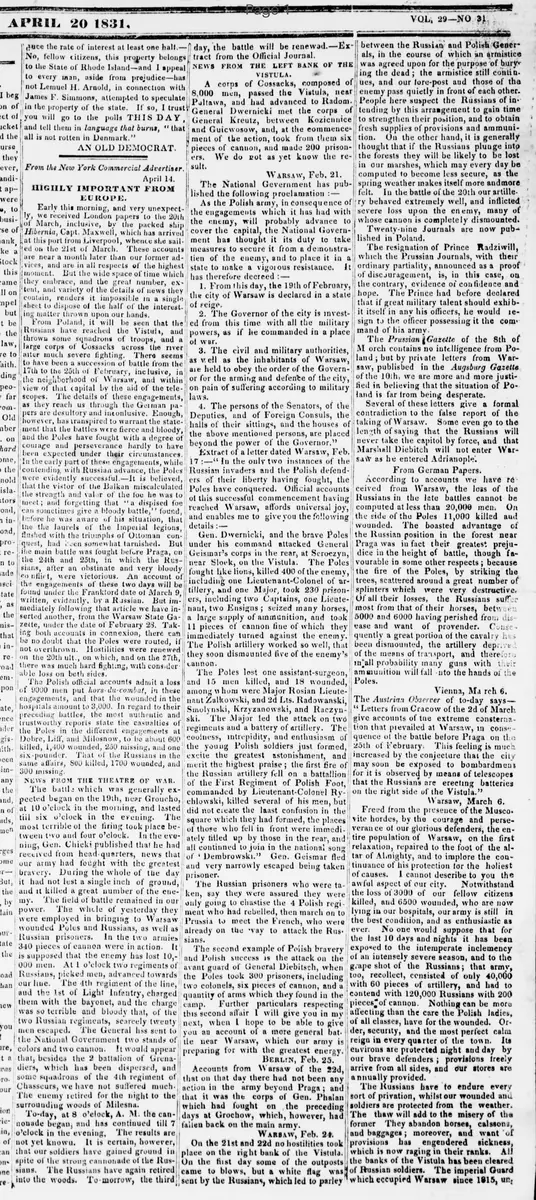
HIGHLY IMPORTANT FROM EUROPE.
Early this morning, and very unexpectedly, we received London papers to the 20th of March, inclusive, by the packet ship Hibernia, Capt. Maxwell, which has arrived at this port from Liverpool, whence she sailed on the 21st of March. These accounts are near a month later than our former advices, and are in all respects of the highest moment. But the wide space of time which they embrace, and the great number, extent, and variety of the details of news they contain, renders it impossible in a single sheet to dispose of the half of the interesting matter thrown upon our hands.
From Poland, it will be seen that the Russians have reached the Vistula, and thrown some squadrons of troops, and a large corps of Cossacks across the river after much severe fighting. There seems to have been a succession of battles from the 17th to the 25th of February, inclusive, in the neighborhood of Warsaw, and within view of that capital by the aid of the telescopes. The details of these engagements, as they reach us through the German papers are desultory and inconclusive. Enough, however, has transpired to warrant the statement that the battles were fierce and bloody, and the Poles have fought with a degree of courage and perseverance hardly to have been expected under their circumstances. In the early part of these engagements, while contending with Russian advance, the Poles were evidently successful.--It is believed, that the victor of the Balkan miscalculated the strength and valor of the foe he was to meet; and forgetting that "a despised foe can sometimes give a bloody battle," found, before he was aware of his situation, that the laurels of the Imperial legions, flushed with the triumphs of Ottoman conquest, had been somewhat tarnished. But the main battle was fought before Praga, on the 24th and 25th, in which the Russians, after an obstinate and very bloody conflict, were victorious. An account of the engagements of these two days will be found under the Frankfort date of March 9, written, evidently, by a Russian. But immediately following that article we have inserted another, from the Warsaw State Gazette, under the date of February 28. Taking both accounts in connexion, there can be no doubt that the Poles were routed, if not overthrown. Hostilities were renewed on the 26th ult., on which, and on the 27th, there was much hard fighting, with considerable loss on both sides.
The Polish official accounts admit a loss of 5000 men put hors de combat, in these engagements, and that the wounded in the hospitals amount to 3,000. In regard to their preceding battles, the most authentic and trustworthy reports state the casualties of the Poles in the different engagements at Dobre, Liff, and Milosnow, to be about 600 killed, 1400 wounded, 250 missing, and one six-pounder. That of the Russians in the same affairs, 800 killed, 1700 wounded, and 300 missing.
NEWS FROM THE THEATRE OF WAR.
The battle which was generally expected began on the 19th, near Grochow, at 10 o'clock in the morning, and lasted till six o'clock in the evening. The most terrible of the firing took place between two and four o'clock. In the evening, Gen. Chlopicki published that he had received from head-quarters, news that our army had fought with the greatest bravery. During the whole of the day it had not lost a single inch of ground, and it killed a great number of the enemy. The field of battle remained in our power. The whole of yesterday they were employed in bringing to Warsaw wounded Poles and Russians, as well as Russian prisoners. In the two armies 340 pieces of cannon were in action. It is supposed that the enemy has lost 10,000 men. At 1 o'clock two regiments of Russians, picked men, advanced towards our line. The 4th regiment of the line, and the 1st of Light Infantry, charged them with the bayonet, and the charge was so terrible and bloody that, of the two Russian regiments, scarcely twenty men escaped. The General has sent to the National Government two stands of colors and two cannon. It would appear that, besides the 2 battalion of Grenadiers, which has been dispersed, and some squadrons of the 4th regiment of Chasseurs, we have not suffered much. The enemy retired for the night to the surrounding woods of Grochow. To-day, at 8 o'clock, A. M. the cannonade began, and has continued till 7 o'clock in the evening. The results are not yet known. It is certain, however, that our soldiers have gained ground in spite of the strong cannonade of the Russians. The Russians have again retired into the woods. To-morrow, the third day, the battle will be renewed.-Extract from the Official Journal.
NEWS FROM THE LEFT BANK OF THE VISTULA.
A corps of Cossacks, composed of 8,000 men, passed the Vistula, near Pultawa, and had advanced to Radom. General Dwernicki met the corps of General Kreutz, between Koziennice and Guicwosow, and, at the commencement of the action, took from them six pieces of cannon, and made 200 prisoners. We do not as yet know the result.
WARSAW, Feb. 21.
The National Government has published the following proclamation:-
As the Polish army, in consequence of the engagements which it has had with the enemy, will probably advance to cover the capital, the National Government has thought it its duty to take measures to secure it from a demonstration of the enemy, and to place it in a state to make a vigorous resistance. It has therefore decreed:-
1. From this day, the 19th of February, the city of Warsaw is declared in a state of siege.
2. The Governor of the city is invested from this time with all the military powers, as if he commanded in a place of war.
3. The civil and military authorities, as well as the inhabitants of Warsaw, are held to obey the order of the Governor for the arming and defence of the city, on pain of suffering according to military laws.
4. The persons of the Senators, of the Deputies, and of Foreign Consuls, the halls of their sittings, and the houses of the above mentioned persons, are placed beyond the power of the Governor."
Extract of a letter dated Warsaw, Feb. 17:-"In the only two instances of the Russian invaders and the Polish defenders of their liberty having fought, the Poles have conquered. Official accounts of this successful commencement having reached Warsaw, affords universal joy, and enables me to give you the following details:-
Gen. Dwernicki, and the brave Poles under his command attacked General Geismar's corps in the rear, at Scroczyn, near Slok, on the Vistula. The Poles fought like lions, killed 400 of the enemy, including one Lieutenant-Colonel of artillery, and one Major, took 230 prisoners, including two Captains, one Lieutenant, two Ensigns; seized many horses, a large supply of ammunition, and took 11 pieces of cannon five of which they immediately turned against the enemy. The Polish artillery worked so well, that they soon dismounted five of the enemy's cannon. The Poles lost one assistant-surgeon, and 15 men killed, and 18 wounded, among whom were Major Rosian Lieutenant Zalkowski, and 2d Lts. Radowanski, Smolynski, Krzyzanowski, and Raczynski. The Major led the attack on two regiments and a battery of artillery. The coolness, intrepidity, and enthusiasm of the young Polish soldiers just formed, excite the greatest astonishment, and merit the highest praise; the first fire of the Russian artillery fell on a battalion of the First Regiment of Polish Foot commanded by Lieutenant-Colonel Rychlowski, killed several of his men, but did not create the least confusion in the square which they had formed, the places of those who fell in front were immediately filled up by those in the rear, and all continued to join in the national song of Dombrowski."
Gen. Geismar fled and very narrowly escaped being taken prisoner. The Russian prisoners who were taken, say they were assured they were only going to chastise the 4th Polish regiment who had rebelled, then march on to Prussia to meet the French, who were already on the way to attack the Russians.
The second example of Polish bravery and Polish success is the attack on the avant guard of General Diebitsch, when the Poles took 300 prisoners, including two colonels, six pieces of cannon, and a quantity of arms which they found in the camp. Further particulars respecting this second affair I will give you in my next, when I hope to be able to give you an account of a more general battle near Warsaw, which our army is preparing for with the greatest energy.
BERLIN, Feb. 25.
Accounts from Warsaw of the 22d, that on that day there had not been any action in the army beyond Praga; and that it was the corps of Gen. Chlopicki which had fought on the preceding days at Grochow, which, however, had fallen back on the main army.
Warsaw, Feb. 24.
On the 21st and 22d no hostilities took place on the right bank of the Vistula. On the first day some of the outposts came to blows, but a white flag was sent by the Russians, which led to parley between the Russian and Polish Generals, in the course of which an armistice was agreed upon for the purpose of burying the dead; the armistice still continues, and our fore-post and those of the enemy pass quietly in front of each other. People here suspect the Russians of intending by this arrangement to gain time to strengthen their position, and to obtain fresh supplies of provisions and ammunition. On the other hand, it is generally thought that if the Russians plunge into the forests they will be likely to be lost in our marshes, which may every day be computed to become less secure, as the spring weather makes itself more and more felt. In the battle of the 20th our artillery behaved extremely well, and inflicted severe loss upon the enemy, many of whose cannon is completely dismounted. Twenty-nine Journals are now published in Poland.
The resignation of Prince Radziwill, which the Prussian Journals, with their ordinary partiality, announced as a proof of discouragement, is, in this case, on the contrary, evidence of confidence and hope. The Prince had before declared that if great military talent should exhibit itself in any of his officers, he would resign to the officer possessing it the command of this army.
The Prussian Gazette of the 8th of March contains no intelligence from Poland; but by private letters from Warsaw, published in the Augsburg Gazette of the 10th, we are more and more justified in believing that the situation of Poland is far from being desperate. Several of these letters give a formal contradiction to the false report of the taking of Warsaw. Some even go to the length of saying that the Russians will never take the capital by force, and that Marshall Diebitsch will not enter Warsaw as he entered Adrianople.
From German Papers.
According to accounts we have received from Warsaw, the loss of the Russians in the late battles cannot be computed at less than 20,000 men: On the side of the Poles 11,000 killed and wounded. The boasted advantage of the Russian position in the forest near Praga was in fact their greatest prejudice in the height of battle, though favorable in some other respects; because the fire of the Poles, by striking the trees, scattered around a great number of splinters which were very destructive. Of all their losses, the Russians suffer most from that of their horses, between 5000 and 6000 having perished from disease and want of provender. Consequently a great portion of the cavalry has been dismounted, the artillery deprived of the means of transport, and therefore in all probability many guns with their ammunition will fall into the hands of the Poles.
Vienna, March 6.
The Austrian Observer of to-day says- "Letters from Cracow of the 2d of March give accounts of the extreme consternation that prevailed at Warsaw, in consequence of the battle before Praga on the 25th of February. This feeling is much increased by the conjecture that the city may soon be exposed to bombardment for it is observed by means of telescopes that the Russians are erecting batteries on the right side of the Vistula."
Freed from the presence of the Muscovite hordes, by the courage and perseverance of our glorious defenders, the entire population of Warsaw, on the first relaxation, repaired to the foot of the altar of Almighty, and to implore the continuance of his protection for the holiest of causes. I cannot describe to you the awful aspect of our city. Notwithstanding the loss of 3000 of our fellow citizens killed, and 6500 wounded, who are now lying in our hospitals, our army is still in the best condition, and as enthusiastic as ever. No one would suppose that for the last 10 days and nights it has been exposed to the intemperate inclemency of an intensely severe season, and to the grape shot of the Russians; that army, too, recollect, consisted of only 40,000 with 60 pieces of artillery, and had to contend with 120,000 Russians with 200 pieces of cannon. Nothing can be more affecting than the care the Polish ladies of all classes, have for the wounded. Order, security, and the most perfect calm reign in every quarter of the town. Its environs are protected night and day by our brave defenders; provisions freely arrive from all sides, and our stores are abundantly provided. The Russians have to endure every sort of privation, whilst our wounded and soldiers are protected from the weather. The thaw will add to the misery of the former They abandon horses, caissons, and baggages; moreover, and want of provisions has engendered sickness, which is now raging in their ranks. All the banks of the Vistula has been cleared of Russian soldiers. The Imperial Guard which occupied Warsaw since 1815, under the orders of the Czarewitch has been almost entirely destroyed. The Imperial Guard of Petersburg, under the Emperor's orders, is still at Kowno, and was only to quit that position after the fall of Warsaw. It consists of 14,000 infantry, and 7000 cavalry. The Government has distributed recompenses to the army. Prince Michael Radziwill, after his resignation, was appointed Knight of the Order of Military Merit, but he proved himself incapable of holding his important command. The elevation of Gen. John Shrzynecki, our present generalissimo, has met with universal approbation. This brave officer was born in Galicia, in 1787, and studied at Leopold. When the French armies entered Poland in 1806, Shrzynecki, then 19 years of age, left his father's house, and enlisted in the 1st Regt. of Infantry, commanded by Col. Kasimir Malachowski, now general of division, who lately covered himself with so much glory. At the opening of the memorable campaign of 1809, in the Grand Duchy of Warsaw, under Prince Joseph Poniatowski, Shrzynecki was raised to the rank of Captain in the 16th Regiment, then formed by Prince Constantine Czartoryski. In the campaign of Moscow, in 1812, he was appointed Chief of battalion; and in 1813 and 1814 he gave repeated proofs of his talent and integrity.
What sub-type of article is it?
What keywords are associated?
What entities or persons were involved?
Where did it happen?
Foreign News Details
Primary Location
Warsaw, Poland
Event Date
February 17 27, 1831
Key Persons
Outcome
poles: 5000 hors de combat, 3000 wounded in hospitals, total ~11,000 killed/wounded; russians: ~20,000 killed/wounded, 800 killed/1700 wounded/300 missing in early battles, 10,000 estimated in grochow, heavy cavalry/horse losses. russians victorious in main battle at praga but poles held ground initially; armistice for burying dead; russians strengthening positions.
Event Details
Series of battles near Warsaw from Feb 17-27, including at Grochow and Praga, with fierce fighting; Poles initially successful against Russian advances, capturing cannon/prisoners, but routed in main engagement; Cossacks crossed Vistula; Warsaw declared in state of siege; Polish army advancing to cover capital; reports of Polish bravery and Russian miscalculations.