Thank you for visiting SNEWPapers!
Sign up free
The Daily Dispatch
Richmond, Virginia
What is this article about?
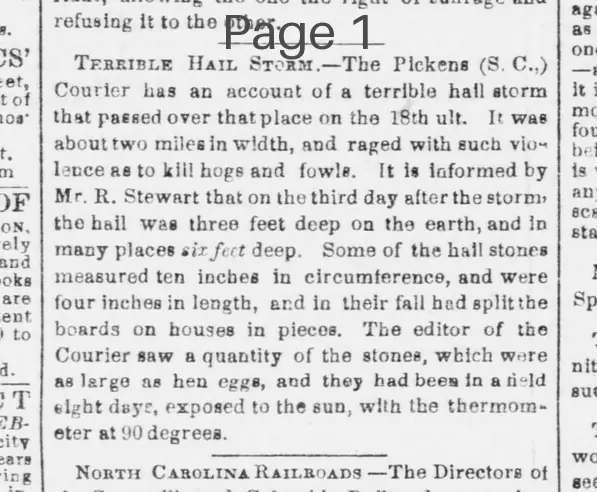
A severe hail storm passed over Pickens, S.C., on the 18th ult., about two miles wide, killing hogs and fowls, with hail accumulating up to six feet deep and stones up to ten inches in circumference damaging houses.
Clipping
OCR Quality
Full Text
What sub-type of article is it?
What keywords are associated?
What entities or persons were involved?
Where did it happen?
Domestic News Details
Primary Location
Pickens (S. C.)
Event Date
18th Ult.
Key Persons
Outcome
killed hogs and fowls; hail three feet deep on the earth, six feet deep in many places; hail stones split boards on houses in pieces
Event Details
terrible hail storm that passed over that place... about two miles in width, and raged with such violence... Some of the hail stones measured ten inches in circumference, and were four inches in length... The editor of the Courier saw a quantity of the stones, which were as large as hen eggs, and they had been in a field eight days, exposed to the sun, with the thermometer at 90 degrees.