Thank you for visiting SNEWPapers!
Sign up free
Literary
January 1, 1924
Yorkville Enquirer
York, York County, South Carolina
What is this article about?
Biographical introduction to author George Kibbe Turner, known for blending finance with romance in his writings. Excerpt from his story 'Held in Trust' features lawyer Jasper Haig searching New York for a young woman resembling the dying Adelaide Rutherford to preserve the Gorgam Trust Fund, amid her husband Hasbrouck's anxiety. Introduces salesgirl Mary Manchester facing hardships.
Clipping
OCR Quality
78%
Good
Full Text
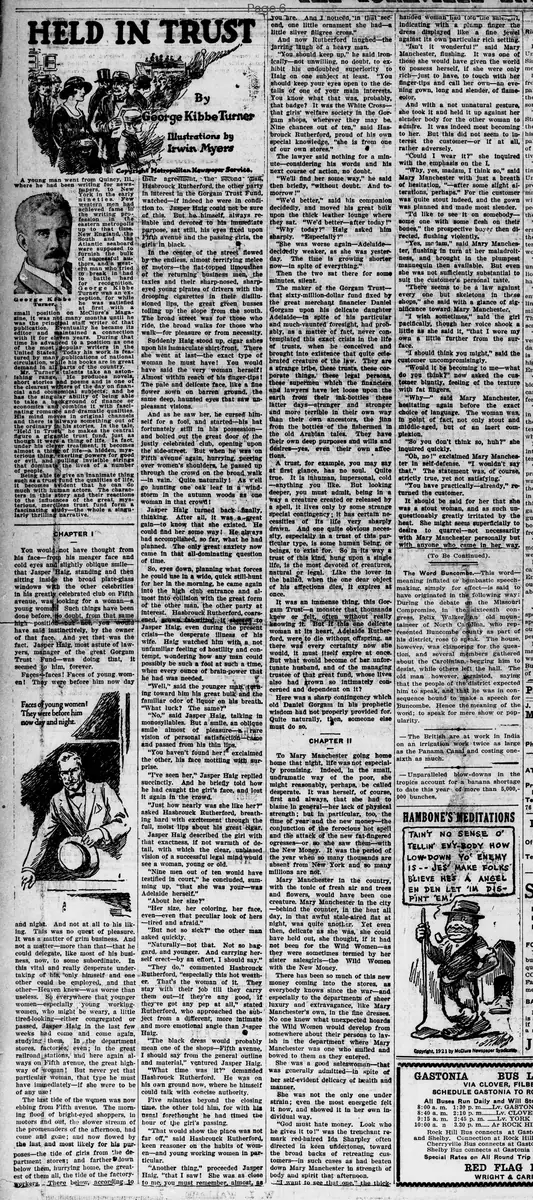
HELD IN TRUST
By George Kibbe Turner
Illustrations by Irwin Myers
Metropolitan Newspaper Service
A young man went from Quincy, Ill., to New York in the early nineties. Few western men had achieved fame in the writing profession up to that time. In the eastern metropolis New England, the South and the Atlantic seaboard furnish the bulk of successful authors, and a western man who tried to break into it had to battle hard for recognition. George Kibbe Turner was an exception, for while he was satisfied at first with small position on McClure's Magazine, it was not many months until he was the principal staff writer of that publication. Eventually he became its editor, and maintained a connection with it for eleven years. During that time he advanced to a position as one of the most popular writers in the United States. Today his work is featured by many publications of national circulation, while his books are in great demand in all parts of the country. Mr. Turner's talents take an astonishing range. He produces novels, short stories and poems and is one of the clearest writers of the day on financial and economical subjects; and he has the singular ability of being able to take a background of finance or economics and combine it with fascinating romance and dramatic qualities. His mind moves in original channels and there is always something out of the ordinary in his stories. In the tale, "Held in Trust" he makes the central figure a gigantic trust fund, just as though it were a thing of life. In fact, under his clever treatment, it becomes almost a thing of life-a hidden, mysterious thing exerting powers for good or evil, and pulling invisible strings that dominate the lives of a number of people. Being able to give an inanimate thing such as a trust fund the qualities of life, it becomes evident that he can do much with human actors. The characters in this story, and their reactions to the influences of the great, mysterious, merciless trust fund form a fascinating study-the whole a singularly thrilling narrative.
CHAPTER I
You would not have thought from his face-from his meager face and cold eyes and slightly oblique smile-that Jasper Haig, standing and then sitting inside the broad plate-glass windows with the other celebrities in his greatly celebrated club on Fifth avenue, was looking for a woman-a young woman. Such things have been done before, no doubt, from that same high position, but no one would have said instinctively, by the owner of that face. And yet that was the fact. Jasper Haig, most astute of lawyers, manager of the great Gorgam Trust Fund-was doing that, it seemed to him, forever. Faces! Faces! Faces of young women! They were before him now day and night. And not at all to his liking. This was no quest of pleasure. It was a matter of grim business. And not a matter-more than that-that he could delegate, like most of his business, now, to some subordinate. In this vital and really desperate undertaking of his, only himself and one other could be employed, and that other--Heaven knew-was worse than useless. So everywhere that younger women-especially young working women, who might be weary, a little tired-looking-either congregated or passed, Jasper Haig in the last few weeks had come and come again, studying them. In the department stores, factories, even; in the great railroad stations, and here again always on Fifth avenue, the great highway of woman! But never yet that particular woman, that type he must have immediately-if she were to be of any use! The last tide of the women was now ebbing from Fifth avenue. The morning flood of bright-eyed shoppers, in motors and out, the slower stream of the promenaders of the afternoon, had come and gone; and now flowed by the last and most likely for his purposes-the tide of girls from the department stores; and farther down below them, hurrying home, the greatest of them all, the tide of the factory-workers. There below, according to
In the center of the street flowed by the endless, almost terrifying melee of motors-the flat-topped limousines of the returning business men, the taxies and their sharp-nosed, sharp-eyed young pirates of drivers with the drooping cigarettes in their disillusioned lips, the great green busses toiling up the slope from the south. The broad street was for those who ride, the broad walks for those who walk-for pleasure or from necessity. Suddenly Haig stood up, cigar ashes upon his immaculate shirt-front. There she went at last the exact type of woman he must have! You would have said the very woman herself! Almost within reach of his finger-tips! The pale and delicate face, like a fine flower sown on barren ground, the same deep, haunted eyes that saw unpleasant visions. And as he saw her, he cursed himself for a fool, and started-his hat fortunately still in his possession-and bolted out the great door of the justly celebrated club, opening upon the side-street. But when he was on Fifth avenue again, hurrying, peering over women's shoulders, he passed up through the crowd on the broad walk in vain. Quite naturally! As well go hunting one oak leaf in a wind storm in the autumn woods as one woman in that crowd. Jasper Haig turned back finally, thinking. After all, it was a great gain--to know that she existed. He could find her some way! He always had accomplished, so far, what he had planned. The only great anxiety now came in that all-dominating question of time. So, eyes down, planning what forces he could use in a wide, quick still-hunt for her in the morning, he came again into the high club entrance and almost into collision with the great form of the other man, the other party at interest. Hasbrouck Rutherford, coarsened, grown fat as seemed to Jasper Haig, even during the present crisis--the desperate illness of his wife. Haig watched him with a not unfamiliar feeling of hostility and contempt, wondering how any man could possibly be such a fool at such a time, when every ounce of brain-power that he had was needed. "Well," said the younger man, turning toward him his great bulk and the familiar odor of liquor on his breath. "What luck? The same?" "No," said Jasper Haig, talking in monosyllables. But a smile, an oblique smile almost of pleasure-a rare vision of personal satisfaction-came and passed from his thin lips. "You haven't found her!" exclaimed the other, his face mottling with surprise. "I've seen her," Jasper Haig replied succinctly. And he briefly told how he had caught the girl's face, and lost it again in the crowd. "Just how nearly was she like her?" asked Hasbrouck Rutherford, breathing hard with excitement through the full, moist lips about his great cigar. Jasper Haig described the girl with that exactness, if not warmth of detail, with which the clear, unbiased vision of a successful legal mind would see a woman, young or old. "Nine men out of ten would have testified in court," he concluded, summing up, that she was your-was Adelaide herself." "About her size?" "Her size, her coloring, her face, even--even that peculiar look of hers-tired and afraid." "But not so sick?" the other man asked quickly. "Naturally-not that. Not so haggard, and younger. And carrying herself erect--by an effort, I should say." "They do," commented Hasbrouck Rutherford, "especially this hot weather. That's the woman of it. They stay with their job till they carry them out-if they're any good, if they've got any 'pep' at all," stated Rutherford, who approached the subject from a different, more intimate and more emotional angle than Jasper Haig. "The black dress would probably mean one of the shops-Fifth avenue, I should say from the general outline and material," ventured Jasper Haig. "What time was it?" demanded Hasbrouck Rutherford. He was on his own ground now, where he himself could talk with concise authority. Five minutes beyond the closing time, the other told him, for with his usual forethought he had timed the hour of the girl's passing. "That would show the place was not far off," said Hasbrouck Rutherford, keen reasoner on the habits of women-and young working women in particular. "Another thing," proceeded Jasper Haig, that I saw! She was as close to me, you must remember, almost, as
you are. And I noticed, in that second, one little ornament she had-a little silver filigree cross." And now Rutherford laughed-the jarring laugh of a heavy man. "You should keep up," he said ironically--not unwilling, no doubt, to exhibit his undoubted superiority to Haig on one subject at least. "You should keep your eyes open to the details of one of your main interests. You know what that was, probably, that badge? It was the White Cross-that girls' welfare society in the Gorgam shops, wherever they may be. Nine chances out of ten," said Hasbrouck Rutherford, proud of his own special knowledge, "she is from one of our own stores." The lawyer said nothing for a minute--considering his words and his next course of action, no doubt. "We'll find her some way," he said then briefly, "without doubt. And tomorrow!" "We'd better," said his companion decidedly, and moved his great bulk upon the thick leather lounge where they sat. "We'd better after today!" "Why today?" Haig asked him sharply. "Especially?" "She was worse again--Adelaide decidedly weaker, as she was yesterday. The time is growing shorter now--in spite of everything." Then the two sat there for some minutes, silent. The maker of the Gorgam Trust-that sixty-million-dollar fund fixed by the great merchant financier Daniel Gorgam upon his delicate daughter Adelaide--in spite of his particular and much-vaunted foresight, had probably, as a matter of fact, never contemplated this exact crisis in the life of trusts, when he conceived and brought into existence that quite celebrated creature of the law. They are a strange tribe, these trusts, these corporate things, these legal persons, these supermen which the financiers and lawyers have let loose upon the earth from their ink-bottles these latter days-stranger, and stronger and more terrible in their own way than their own ancestors, the jinn from the bottles-of the fishermen in the old Arabian tales. They have their own deep purposes and wills and desires--yes, even their own affections. A trust, for example, you may say at first glance, has no soul. Quite true. It is inhuman, impersonal, cold-anything you like. But looking deeper, you must admit, being in a way a creature created or released by a spell, it lives only by some strange special contingency; it has certain necessities of its life very sharply defined. And one quite obvious necessity, especially in a trust of this particular type, is some human being, or beings, to exist for. So in its way a trust of this kind, hung upon a single life, is the most devoted of creatures, natural or legal. Like the lover in the ballad, when the one dear object of his affections dies, it expires at once. It was an immense thing, this Gorgam Trust--a monster that thousands knew or felt, often without really knowing it. But if this one delicate woman at its heart, Adelaide Rutherford, were to die without offspring, as there was every certainty now she would, it must itself expire at once. But what would become of her unfortunate husband, and of the managing trustee of that great fund, whose lives also had grown so intimately concerned and dependent on it? Here was a sharp contingency which old Daniel Gorgam in his prophetic wisdom had not properly provided for. Quite naturally, then, someone else must do so.
CHAPTER II To Mary Manchester going home that night, life was not especially promising. Indeed, in the small, undramatic way of the poor, she might reasonably, perhaps, be called desperate. It was herself, of course, first and always, that she had to blame. In general-her lack of physical strength; but in particular, too, the time of year and the new money-the conjunction of the ferocious hot spell and the attack of the new fat-fingered ogresses--or so she saw them-with the New Money. It was the period of the year when so many thousands are absent from New York and so many millions are not. Mary Manchester in the country, with the tonic of fresh air and trees and flowers, would have been one creature. Mary Manchester in the city-behind the counter, in the heat all day, in that awful stale-aired flat at night, was quite another. Yet even then, delicate as she was, she could have held out, she thought, if it had not been for the Wild Women-as they were sometimes termed by her sister salesgirls-the Wild Women with the New Money. There has been so much of this new money coming into the stores, as everybody knows since the war-and especially to the departments of sheer luxury and extravagance, like Mary Manchester's own, in the fine dresses. No one knew what unexpected hoards the Wild Women would develop from somewhere about their persons to lavish in the department where Mary Manchester was one who smiled and bowed to them as they entered. She was a good saleswoman-that was generally admitted-in spite of her self-evident delicacy of health and manner. She was not the only one under strain; even the most energetic felt it now, and showed it in her own individual way. "God must hate money. Look who he gives it to!" was the trenchant remark red-haired Ida Sharpley often directed in keen undertones, toward the broad backs of retreating customers--in such cases as had beaten down Mary Manchester in strength of body and spirit that afternoon.
handed woman had touched the salesgirl indicating with a plump finger the dress displayed like a fine jewel against its own particular rich setting. "Isn't it wonderful!" said Mary Manchester, flushing. It was one of those she would have given the world to possess herself, if she were only rich-just to have, to touch with her finger-tips and call her own--an evening gown, long and slender, of flame-color. And with a not unnatural gesture, she took it and held it up against her slender body for the other woman to admire. It was indeed most becoming to her. But this did not seem to interest the customer or if at all, rather adversely. "Could I wear it?" she inquired with the emphasis on the I. "Why, yes, madam, I think so," said Mary Manchester with just a breath of hesitation, "after some slight alterations, perhaps." For the customer was quite stout indeed, and the gown was planned and made most slender. "I'd like to see it on somebody--some one with some flesh on their bones," the prospective buyer then directed, flushing violently. "Yes, madam," said Mary Manchester, flushing in turn at her maladroitness, and brought in the plumpest mannequin then available. But even she was not sufficiently substantial to suit the customer's personal taste. "There seems to be a law against every one but skeletons in these shops," she said with a glance of significance toward Mary Manchester. "I wish sometimes," said the girl pacifically, though her voice shook a little as she said it, "that I wore my own a little further from the surface." "I should think you might," said the customer uncompromisingly. "Would it be becoming to me-what do you think?" now asked the customer bluntly, feeling of the texture with fat fingers. "Why-" said Mary Manchester, hesitating again before the exact choice of language. The woman was, in point of fact, not only stout and middle-aged, but of an inert complexion. "So you don't think so, huh?" she inquired quickly. "Oh, no!" exclaimed Mary Manchester in self-defense. "I wouldn't say that." The statement was, of course, strictly true, yet not satisfying. "You have practically already," returned the customer. It should be said for her that she was a stout woman, and as such unquestionably greatly irritated by the heat. She might seem superficially to desire to quarrel-not necessarily with Mary Manchester personally but with anyone who came in her way. (To Be Continued).
By George Kibbe Turner
Illustrations by Irwin Myers
Metropolitan Newspaper Service
A young man went from Quincy, Ill., to New York in the early nineties. Few western men had achieved fame in the writing profession up to that time. In the eastern metropolis New England, the South and the Atlantic seaboard furnish the bulk of successful authors, and a western man who tried to break into it had to battle hard for recognition. George Kibbe Turner was an exception, for while he was satisfied at first with small position on McClure's Magazine, it was not many months until he was the principal staff writer of that publication. Eventually he became its editor, and maintained a connection with it for eleven years. During that time he advanced to a position as one of the most popular writers in the United States. Today his work is featured by many publications of national circulation, while his books are in great demand in all parts of the country. Mr. Turner's talents take an astonishing range. He produces novels, short stories and poems and is one of the clearest writers of the day on financial and economical subjects; and he has the singular ability of being able to take a background of finance or economics and combine it with fascinating romance and dramatic qualities. His mind moves in original channels and there is always something out of the ordinary in his stories. In the tale, "Held in Trust" he makes the central figure a gigantic trust fund, just as though it were a thing of life. In fact, under his clever treatment, it becomes almost a thing of life-a hidden, mysterious thing exerting powers for good or evil, and pulling invisible strings that dominate the lives of a number of people. Being able to give an inanimate thing such as a trust fund the qualities of life, it becomes evident that he can do much with human actors. The characters in this story, and their reactions to the influences of the great, mysterious, merciless trust fund form a fascinating study-the whole a singularly thrilling narrative.
CHAPTER I
You would not have thought from his face-from his meager face and cold eyes and slightly oblique smile-that Jasper Haig, standing and then sitting inside the broad plate-glass windows with the other celebrities in his greatly celebrated club on Fifth avenue, was looking for a woman-a young woman. Such things have been done before, no doubt, from that same high position, but no one would have said instinctively, by the owner of that face. And yet that was the fact. Jasper Haig, most astute of lawyers, manager of the great Gorgam Trust Fund-was doing that, it seemed to him, forever. Faces! Faces! Faces of young women! They were before him now day and night. And not at all to his liking. This was no quest of pleasure. It was a matter of grim business. And not a matter-more than that-that he could delegate, like most of his business, now, to some subordinate. In this vital and really desperate undertaking of his, only himself and one other could be employed, and that other--Heaven knew-was worse than useless. So everywhere that younger women-especially young working women, who might be weary, a little tired-looking-either congregated or passed, Jasper Haig in the last few weeks had come and come again, studying them. In the department stores, factories, even; in the great railroad stations, and here again always on Fifth avenue, the great highway of woman! But never yet that particular woman, that type he must have immediately-if she were to be of any use! The last tide of the women was now ebbing from Fifth avenue. The morning flood of bright-eyed shoppers, in motors and out, the slower stream of the promenaders of the afternoon, had come and gone; and now flowed by the last and most likely for his purposes-the tide of girls from the department stores; and farther down below them, hurrying home, the greatest of them all, the tide of the factory-workers. There below, according to
In the center of the street flowed by the endless, almost terrifying melee of motors-the flat-topped limousines of the returning business men, the taxies and their sharp-nosed, sharp-eyed young pirates of drivers with the drooping cigarettes in their disillusioned lips, the great green busses toiling up the slope from the south. The broad street was for those who ride, the broad walks for those who walk-for pleasure or from necessity. Suddenly Haig stood up, cigar ashes upon his immaculate shirt-front. There she went at last the exact type of woman he must have! You would have said the very woman herself! Almost within reach of his finger-tips! The pale and delicate face, like a fine flower sown on barren ground, the same deep, haunted eyes that saw unpleasant visions. And as he saw her, he cursed himself for a fool, and started-his hat fortunately still in his possession-and bolted out the great door of the justly celebrated club, opening upon the side-street. But when he was on Fifth avenue again, hurrying, peering over women's shoulders, he passed up through the crowd on the broad walk in vain. Quite naturally! As well go hunting one oak leaf in a wind storm in the autumn woods as one woman in that crowd. Jasper Haig turned back finally, thinking. After all, it was a great gain--to know that she existed. He could find her some way! He always had accomplished, so far, what he had planned. The only great anxiety now came in that all-dominating question of time. So, eyes down, planning what forces he could use in a wide, quick still-hunt for her in the morning, he came again into the high club entrance and almost into collision with the great form of the other man, the other party at interest. Hasbrouck Rutherford, coarsened, grown fat as seemed to Jasper Haig, even during the present crisis--the desperate illness of his wife. Haig watched him with a not unfamiliar feeling of hostility and contempt, wondering how any man could possibly be such a fool at such a time, when every ounce of brain-power that he had was needed. "Well," said the younger man, turning toward him his great bulk and the familiar odor of liquor on his breath. "What luck? The same?" "No," said Jasper Haig, talking in monosyllables. But a smile, an oblique smile almost of pleasure-a rare vision of personal satisfaction-came and passed from his thin lips. "You haven't found her!" exclaimed the other, his face mottling with surprise. "I've seen her," Jasper Haig replied succinctly. And he briefly told how he had caught the girl's face, and lost it again in the crowd. "Just how nearly was she like her?" asked Hasbrouck Rutherford, breathing hard with excitement through the full, moist lips about his great cigar. Jasper Haig described the girl with that exactness, if not warmth of detail, with which the clear, unbiased vision of a successful legal mind would see a woman, young or old. "Nine men out of ten would have testified in court," he concluded, summing up, that she was your-was Adelaide herself." "About her size?" "Her size, her coloring, her face, even--even that peculiar look of hers-tired and afraid." "But not so sick?" the other man asked quickly. "Naturally-not that. Not so haggard, and younger. And carrying herself erect--by an effort, I should say." "They do," commented Hasbrouck Rutherford, "especially this hot weather. That's the woman of it. They stay with their job till they carry them out-if they're any good, if they've got any 'pep' at all," stated Rutherford, who approached the subject from a different, more intimate and more emotional angle than Jasper Haig. "The black dress would probably mean one of the shops-Fifth avenue, I should say from the general outline and material," ventured Jasper Haig. "What time was it?" demanded Hasbrouck Rutherford. He was on his own ground now, where he himself could talk with concise authority. Five minutes beyond the closing time, the other told him, for with his usual forethought he had timed the hour of the girl's passing. "That would show the place was not far off," said Hasbrouck Rutherford, keen reasoner on the habits of women-and young working women in particular. "Another thing," proceeded Jasper Haig, that I saw! She was as close to me, you must remember, almost, as
you are. And I noticed, in that second, one little ornament she had-a little silver filigree cross." And now Rutherford laughed-the jarring laugh of a heavy man. "You should keep up," he said ironically--not unwilling, no doubt, to exhibit his undoubted superiority to Haig on one subject at least. "You should keep your eyes open to the details of one of your main interests. You know what that was, probably, that badge? It was the White Cross-that girls' welfare society in the Gorgam shops, wherever they may be. Nine chances out of ten," said Hasbrouck Rutherford, proud of his own special knowledge, "she is from one of our own stores." The lawyer said nothing for a minute--considering his words and his next course of action, no doubt. "We'll find her some way," he said then briefly, "without doubt. And tomorrow!" "We'd better," said his companion decidedly, and moved his great bulk upon the thick leather lounge where they sat. "We'd better after today!" "Why today?" Haig asked him sharply. "Especially?" "She was worse again--Adelaide decidedly weaker, as she was yesterday. The time is growing shorter now--in spite of everything." Then the two sat there for some minutes, silent. The maker of the Gorgam Trust-that sixty-million-dollar fund fixed by the great merchant financier Daniel Gorgam upon his delicate daughter Adelaide--in spite of his particular and much-vaunted foresight, had probably, as a matter of fact, never contemplated this exact crisis in the life of trusts, when he conceived and brought into existence that quite celebrated creature of the law. They are a strange tribe, these trusts, these corporate things, these legal persons, these supermen which the financiers and lawyers have let loose upon the earth from their ink-bottles these latter days-stranger, and stronger and more terrible in their own way than their own ancestors, the jinn from the bottles-of the fishermen in the old Arabian tales. They have their own deep purposes and wills and desires--yes, even their own affections. A trust, for example, you may say at first glance, has no soul. Quite true. It is inhuman, impersonal, cold-anything you like. But looking deeper, you must admit, being in a way a creature created or released by a spell, it lives only by some strange special contingency; it has certain necessities of its life very sharply defined. And one quite obvious necessity, especially in a trust of this particular type, is some human being, or beings, to exist for. So in its way a trust of this kind, hung upon a single life, is the most devoted of creatures, natural or legal. Like the lover in the ballad, when the one dear object of his affections dies, it expires at once. It was an immense thing, this Gorgam Trust--a monster that thousands knew or felt, often without really knowing it. But if this one delicate woman at its heart, Adelaide Rutherford, were to die without offspring, as there was every certainty now she would, it must itself expire at once. But what would become of her unfortunate husband, and of the managing trustee of that great fund, whose lives also had grown so intimately concerned and dependent on it? Here was a sharp contingency which old Daniel Gorgam in his prophetic wisdom had not properly provided for. Quite naturally, then, someone else must do so.
CHAPTER II To Mary Manchester going home that night, life was not especially promising. Indeed, in the small, undramatic way of the poor, she might reasonably, perhaps, be called desperate. It was herself, of course, first and always, that she had to blame. In general-her lack of physical strength; but in particular, too, the time of year and the new money-the conjunction of the ferocious hot spell and the attack of the new fat-fingered ogresses--or so she saw them-with the New Money. It was the period of the year when so many thousands are absent from New York and so many millions are not. Mary Manchester in the country, with the tonic of fresh air and trees and flowers, would have been one creature. Mary Manchester in the city-behind the counter, in the heat all day, in that awful stale-aired flat at night, was quite another. Yet even then, delicate as she was, she could have held out, she thought, if it had not been for the Wild Women-as they were sometimes termed by her sister salesgirls-the Wild Women with the New Money. There has been so much of this new money coming into the stores, as everybody knows since the war-and especially to the departments of sheer luxury and extravagance, like Mary Manchester's own, in the fine dresses. No one knew what unexpected hoards the Wild Women would develop from somewhere about their persons to lavish in the department where Mary Manchester was one who smiled and bowed to them as they entered. She was a good saleswoman-that was generally admitted-in spite of her self-evident delicacy of health and manner. She was not the only one under strain; even the most energetic felt it now, and showed it in her own individual way. "God must hate money. Look who he gives it to!" was the trenchant remark red-haired Ida Sharpley often directed in keen undertones, toward the broad backs of retreating customers--in such cases as had beaten down Mary Manchester in strength of body and spirit that afternoon.
handed woman had touched the salesgirl indicating with a plump finger the dress displayed like a fine jewel against its own particular rich setting. "Isn't it wonderful!" said Mary Manchester, flushing. It was one of those she would have given the world to possess herself, if she were only rich-just to have, to touch with her finger-tips and call her own--an evening gown, long and slender, of flame-color. And with a not unnatural gesture, she took it and held it up against her slender body for the other woman to admire. It was indeed most becoming to her. But this did not seem to interest the customer or if at all, rather adversely. "Could I wear it?" she inquired with the emphasis on the I. "Why, yes, madam, I think so," said Mary Manchester with just a breath of hesitation, "after some slight alterations, perhaps." For the customer was quite stout indeed, and the gown was planned and made most slender. "I'd like to see it on somebody--some one with some flesh on their bones," the prospective buyer then directed, flushing violently. "Yes, madam," said Mary Manchester, flushing in turn at her maladroitness, and brought in the plumpest mannequin then available. But even she was not sufficiently substantial to suit the customer's personal taste. "There seems to be a law against every one but skeletons in these shops," she said with a glance of significance toward Mary Manchester. "I wish sometimes," said the girl pacifically, though her voice shook a little as she said it, "that I wore my own a little further from the surface." "I should think you might," said the customer uncompromisingly. "Would it be becoming to me-what do you think?" now asked the customer bluntly, feeling of the texture with fat fingers. "Why-" said Mary Manchester, hesitating again before the exact choice of language. The woman was, in point of fact, not only stout and middle-aged, but of an inert complexion. "So you don't think so, huh?" she inquired quickly. "Oh, no!" exclaimed Mary Manchester in self-defense. "I wouldn't say that." The statement was, of course, strictly true, yet not satisfying. "You have practically already," returned the customer. It should be said for her that she was a stout woman, and as such unquestionably greatly irritated by the heat. She might seem superficially to desire to quarrel-not necessarily with Mary Manchester personally but with anyone who came in her way. (To Be Continued).
What sub-type of article is it?
Prose Fiction
What themes does it cover?
Commerce Trade
Death Mortality
Love Romance
What keywords are associated?
Gorgam Trust
Jasper Haig
Hasbrouck Rutherford
Adelaide Rutherford
Mary Manchester
Fifth Avenue
Trust Fund
New York
Working Women
What entities or persons were involved?
By George Kibbe Turner
Literary Details
Title
Held In Trust
Author
By George Kibbe Turner
Form / Style
Novel Excerpt Blending Finance And Romance
Key Lines
They Are A Strange Tribe, These Trusts, These Corporate Things, These Legal Persons, These Supermen Which The Financiers And Lawyers Have Let Loose Upon The Earth From Their Ink Bottles These Latter Days Stranger, And Stronger And More Terrible In Their Own Way Than Their Own Ancestors, The Jinn From The Bottles Of The Fishermen In The Old Arabian Tales.
So In Its Way A Trust Of This Kind, Hung Upon A Single Life, Is The Most Devoted Of Creatures, Natural Or Legal. Like The Lover In The Ballad, When The One Dear Object Of His Affections Dies, It Expires At Once.
God Must Hate Money. Look Who He Gives It To!