Thank you for visiting SNEWPapers!
Sign up free
The New Hampshire Gazette
Portsmouth, Rockingham County, New Hampshire
What is this article about?
Editorial from Conn. Witness praises Jefferson's re-election (162-14 votes) as redeeming Americans from Federalist oppression akin to foreign tyrannies, criticizes efforts to discredit policies like Louisiana purchase and Tripoli actions. (214 characters)
Clipping
OCR Quality
Full Text
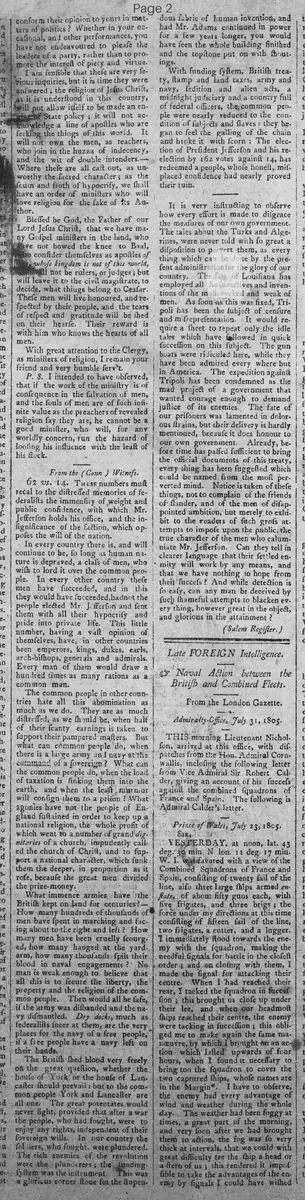
62 VS. 14. These numbers must recal to the distressed memories of federalists the immensity of weight and public confidence, with which Mr. Jefferson holds his office, and the insignificance of the faction, which opposes the will of the nation.
In every country there is, and will continue to be, so long as human nature is depraved, a class of men, who wish to lord it over the common people. In every other country these men have succeeded, and in this they would have succeeded, had not the people elected Mr. Jefferson and sent them with all their hypocrisy and pride into private life. This little number, having a vast opinion of themselves, have, in other countries been emperors, kings, dukes, earls, arch-bishops, generals and admirals. Every man of them would draw a hundred times as many rations as a common man.
The common people in other countries hate all this abomination as much as we do. They are as much distressed, as we should be, when half of their scanty earnings is taken to support their pampered masters. But what can common people do, when there is a large army and navy at the command of a sovereign? What can the common people do, when the load of taxation is sinking them into the earth, and when the least murmur will consign them to a prison? What agonies have not the people of England sustained in order to keep up a national religion, the whole profit of which went to a number of grand dignitaries of a church, impudently called the church of Christ, and to support a national character, which sunk them the deeper, in proportion as it rose, because the great men divided the prize-money.
What immense armies have the British kept on land for centuries? How many hundreds of thousands of men have spent in marching and facing about to the right and left? How many men have been cruelly courged, how many hanged at the yard-arm, how many thousands spilt their blood in naval engagements? No man is weak enough to believe that all this is to secure the liberty, the property and the religion of the common people. Then would all be safe, if the army was disbanded and the navy dismantled. Dry docks, much as federalists sneer at them, are the very places for the navy of a free people, if a free people have a navy left on their hands.
The British shed blood very freely on the great question, whether the house of York or the house of Lancaster should prevail: but to the common people York and Lancaster are all one. The great potentates would never fight; provided that after a war the people, who had fought, were to enjoy any rights, independent of their sovereign wills. In our country the soldiers, who fought, were plundered. The rich enemies of the revolution were the plunderers; the funding system was the instrument. This was a glorious corner stone for the stupendous fabric of human invention, and had Mr. Adams continued in power for a few years longer, you would have seen the whole building finished and the topstone put on with shoutings.
With funding system, British treaty, stamp and land taxes, army and navy, sedition and alien acts, a midnight judiciary and a country full of federal officers, the common people were nearly reduced to the condition of subjects and slaves: they began to feel the galling of the chain and broke it with corn: The election of President Jefferson and his re-election by 162 votes against 14, has redeemed a people, whose honest, misplaced confidence had nearly proved their ruin.
It is very instructing to observe how every effort is made to disgrace the measures of our own government. The tales about the Turks and Algerines, were never told with so great a disposition to pervert them, as every thing which can be done by the present administration for the glory of our country. The purchase of Louisiana has employed all the invectives and inventions of the most wicked and weak of men. As soon as this was fixed, Tripoli has been the subject of censure and misrepresentation. It would require a sheet to repeat only the idle tales which have followed in quick succession on this subject. The gun boats were ridiculed here, while they have been admired every where but in America. The expedition against Tripoli has been condemned as the mad project of a government that wanted courage enough to demand justice of its enemies. The fate of our prisoners was lamented in dolorous strains, but their delivery is hardly mentioned, because it does honour to our own government. Already, before time has passed sufficient to bring the official documents of this treaty, every thing has been suggested which could be named from the most perverted mind. Notice is taken of these things, not to complain of the friends of slander, and of the men of disappointed ambition, but merely to exhibit to the readers of such gross attempts to impose upon the public, the true character of the men who calumniate Mr. Jefferson. Can they tell in clearer language that their settled enmity will work by any means, and that we have nothing to hope from their success? And while detection is so easy, can any man be deceived by such shameful attempts to blacken every thing, however great in the object, and glorious in the attainment?
(Salem Register.)
What sub-type of article is it?
What keywords are associated?
What entities or persons were involved?
Domestic News Details
Key Persons
Outcome
the election of president jefferson and his re-election by 162 votes against 14, has redeemed a people, whose honest, misplaced confidence had nearly proved their ruin.
Event Details
Editorial commentary praising Mr. Jefferson's hold on public confidence with 162 electoral votes against 14 for Federalists, criticizing the Federalist faction as a class wishing to lord over common people, comparing to oppressive systems in other countries like England, highlighting how Federalist policies including funding system, taxes, army, navy, and acts nearly reduced people to subjects and slaves, but Jefferson's elections broke the chain; notes efforts to disgrace government measures like Louisiana purchase and Tripoli expedition.