Thank you for visiting SNEWPapers!
Sign up free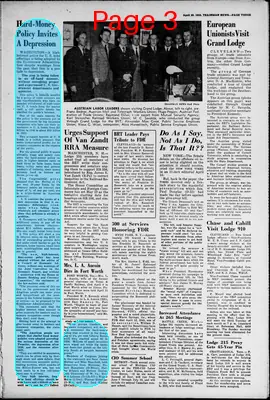
Story
April 20, 1953
Trainman News
Indianapolis, Marion County, Indiana
What is this article about?
Criticism of Eisenhower Administration's high-interest U.S. bond policy as a prelude to depression, opposed by nine Congress members demanding debate. Policy pressured by insurance companies, risking higher costs and deflation amid falling prices.
Clipping
OCR Quality
98%
Excellent
Full Text
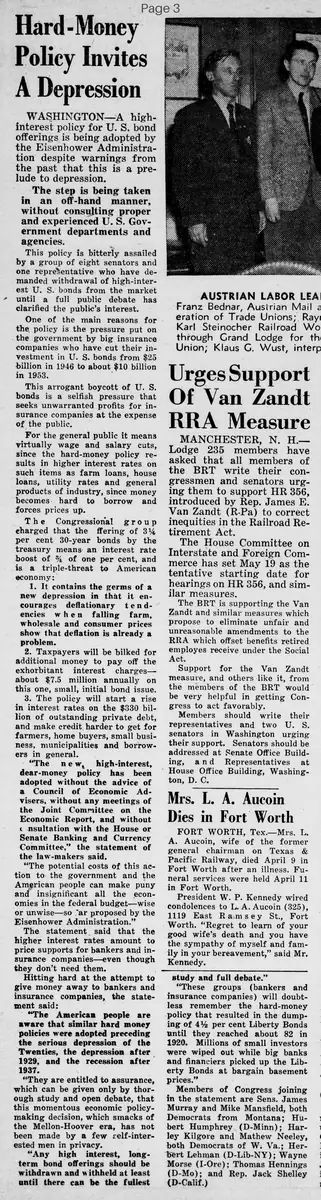
Hard-Money Policy Invites A Depression
WASHINGTON--A high-interest policy for U. S. bond offerings is being adopted by the Eisenhower Administration despite warnings from the past that this is a prelude to depression.
The step is being taken in an off-hand manner, without consulting proper and experienced U. S. Government departments and agencies.
This policy is bitterly assailed by a group of eight senators and one representative who have demanded withdrawal of high-interest U. S. bonds from the market until a full public debate has clarified the public's interest.
One of the main reasons for the policy is the pressure put on the government by big insurance companies who have cut their investment in U. S. bonds from $25 billion in 1946 to about $10 billion in 1953.
This arrogant boycott of U. S. bonds is a selfish pressure that seeks unwarranted profits for insurance companies at the expense of the public.
For the general public it means virtually wage and salary cuts, since the hard-money policy results in higher interest rates on such items as farm loans, house loans, utility rates and general products of industry, since money becomes hard to borrow and forces prices up.
The Congressional group charged that the offering of 3¼ per cent 30-year bonds by the treasury means an interest rate boost of ½ of one per cent, and is a triple-threat to American economy:
1. It contains the germs of a new depression in that it encourages deflationary tendencies when falling farm, wholesale and consumer prices show that deflation is already a problem.
2. Taxpayers will be bilked for additional money to pay off the exhorbitant interest charges--about $7.5 million annually on this one, small, initial bond issue.
3. The policy will start a rise in interest rates on the $330 billion of outstanding private debt, and make credit harder to get for farmers, home buyers, small business, municipalities and borrowers in general.
"The new, high-interest, dear-money policy has been adopted without the advice of a Council of Economic Advisers, without any meetings of the Joint Committee on the Economic Report, and without consultation with the House or Senate Banking and Currency Committee," the statement of the law-makers said.
"The potential costs of this action to the government and the American people can make puny and insignificant all the economies in the federal budget -wise or unwise -so far proposed by the Eisenhower Administration."
The statement said that the higher interest rates amount to price supports for bankers and insurance companies -even though they don't need them.
Hitting hard at the attempt to give money away to bankers and insurance companies, the statement said:
"The American people are aware that similar hard money policies were adopted preceding the serious depression of the Twenties, the depression after 1929, and the recession after 1937.
"They are entitled to assurance, which can be given only by thorough study and full debate, that this momentous economic policy-making decision, which smacks of the Mellon-Hoover era, has not been made by a few self-interested men in privacy.
"Any high interest, long-term bond offerings should be withdrawn and withheld at least until there can be the fullest study and full debate."
"These groups (bankers and insurance companies) will doubtless remember the hard-money policy that resulted in the dumping of 4½ per cent Liberty Bonds until they reached about 82 in 1920. Millions of small investors were wiped out while big banks and financiers picked up the Liberty Bonds at bargain basement prices."
Members of Congress joining in the statement are Sens. James Murray and Mike Mansfield, both Democrats from Montana; Hubert Humphrey (D-Minn); Harley Kilgore and Mathew Neely, both Democrats of W. Va.; Herbert Lehman (D-Lib-NY); Wayne Morse (I-Ore); Thomas Hennings (D-Mo); and Rep. Jack Shelley (D-Calif.)
WASHINGTON--A high-interest policy for U. S. bond offerings is being adopted by the Eisenhower Administration despite warnings from the past that this is a prelude to depression.
The step is being taken in an off-hand manner, without consulting proper and experienced U. S. Government departments and agencies.
This policy is bitterly assailed by a group of eight senators and one representative who have demanded withdrawal of high-interest U. S. bonds from the market until a full public debate has clarified the public's interest.
One of the main reasons for the policy is the pressure put on the government by big insurance companies who have cut their investment in U. S. bonds from $25 billion in 1946 to about $10 billion in 1953.
This arrogant boycott of U. S. bonds is a selfish pressure that seeks unwarranted profits for insurance companies at the expense of the public.
For the general public it means virtually wage and salary cuts, since the hard-money policy results in higher interest rates on such items as farm loans, house loans, utility rates and general products of industry, since money becomes hard to borrow and forces prices up.
The Congressional group charged that the offering of 3¼ per cent 30-year bonds by the treasury means an interest rate boost of ½ of one per cent, and is a triple-threat to American economy:
1. It contains the germs of a new depression in that it encourages deflationary tendencies when falling farm, wholesale and consumer prices show that deflation is already a problem.
2. Taxpayers will be bilked for additional money to pay off the exhorbitant interest charges--about $7.5 million annually on this one, small, initial bond issue.
3. The policy will start a rise in interest rates on the $330 billion of outstanding private debt, and make credit harder to get for farmers, home buyers, small business, municipalities and borrowers in general.
"The new, high-interest, dear-money policy has been adopted without the advice of a Council of Economic Advisers, without any meetings of the Joint Committee on the Economic Report, and without consultation with the House or Senate Banking and Currency Committee," the statement of the law-makers said.
"The potential costs of this action to the government and the American people can make puny and insignificant all the economies in the federal budget -wise or unwise -so far proposed by the Eisenhower Administration."
The statement said that the higher interest rates amount to price supports for bankers and insurance companies -even though they don't need them.
Hitting hard at the attempt to give money away to bankers and insurance companies, the statement said:
"The American people are aware that similar hard money policies were adopted preceding the serious depression of the Twenties, the depression after 1929, and the recession after 1937.
"They are entitled to assurance, which can be given only by thorough study and full debate, that this momentous economic policy-making decision, which smacks of the Mellon-Hoover era, has not been made by a few self-interested men in privacy.
"Any high interest, long-term bond offerings should be withdrawn and withheld at least until there can be the fullest study and full debate."
"These groups (bankers and insurance companies) will doubtless remember the hard-money policy that resulted in the dumping of 4½ per cent Liberty Bonds until they reached about 82 in 1920. Millions of small investors were wiped out while big banks and financiers picked up the Liberty Bonds at bargain basement prices."
Members of Congress joining in the statement are Sens. James Murray and Mike Mansfield, both Democrats from Montana; Hubert Humphrey (D-Minn); Harley Kilgore and Mathew Neely, both Democrats of W. Va.; Herbert Lehman (D-Lib-NY); Wayne Morse (I-Ore); Thomas Hennings (D-Mo); and Rep. Jack Shelley (D-Calif.)
What sub-type of article is it?
Historical Event
What themes does it cover?
Misfortune
Justice
What keywords are associated?
Hard Money Policy
Eisenhower Administration
Us Bonds
Depression Warning
Congressional Criticism
Insurance Companies
Interest Rates
What entities or persons were involved?
Eisenhower Administration
James Murray
Mike Mansfield
Hubert Humphrey
Harley Kilgore
Mathew Neely
Herbert Lehman
Wayne Morse
Thomas Hennings
Jack Shelley
Where did it happen?
Washington
Story Details
Key Persons
Eisenhower Administration
James Murray
Mike Mansfield
Hubert Humphrey
Harley Kilgore
Mathew Neely
Herbert Lehman
Wayne Morse
Thomas Hennings
Jack Shelley
Location
Washington
Event Date
1953
Story Details
The Eisenhower Administration adopts a high-interest policy for U.S. bonds despite historical warnings of depression, without proper consultation. Nine Congress members criticize it as benefiting bankers and insurance companies at public expense, demanding withdrawal for debate. Policy risks deflation, higher taxes, and costlier credit.